Research Tools

In order to improve the quality of systematic researches, various tools have been developed by well-known scientific institutes sporadically. Dr. Nader Ale Ebrahim has collected these sporadic tools under one roof in a collection named “Research Tool Box”. The toolbox contains over 720 tools so far, classified in 4 main categories: Literature-review, Writing a paper, Targeting suitable journals, as well as Enhancing visibility and impact factor.

Friday, 25 November 2022

A Failure to Communicate: Indicators of Open Access in the User Interface

 Source: https://scholarlykitchen.sspnet.org/2022/11/14/indicators-of-open-access-in-the-user-interface/

A Failure to Communicate: Indicators of Open Access in the User Interface

  • By Lisa Janicke Hinchliffe, Kalyn Nowlan
  • Nov 14, 2022
  • 13 Comments
  • Open Access
  • Research
  • Technology
  • Tools
  • User Experience
Tweet
Share
Pin
Buffer4
Share
4 Shares

Editor’s note: Today’s post is co-authored by Lisa Janicke Hinchliffe, TSK Chef, and Kalyn Nowlan, an MS/LIS candidate at the iSchool at University of Illinois Urbana-Champaign who also works at Funk Library, which supports research for the college of Agricultural, Consumer and Environmental Sciences. When Kalyn graduates in May, she is interested in pursuing academic librarianship, with a focus on scholarly communications and supporting student success. 

Publishing platforms typically use certain indicators, such as standardized text or symbols, to indicate whether articles in hybrid journals are open access. This communicates to users whether they can access the articles without a subscription or paying a per-article fee. These indicators are important to the publishers and the authors; communicating what type of access a user has to an article may influence the article’s reach. Librarians also rely on these indicators to properly assist those who are using these publishing platforms. Yet, in spite of these indicators, we have noted that users are often confused about whether they have access to an open access article. Something about the signaling is not communicating as intended.

Over the past months, we have conducted a pilot investigation into the signals used on a sample of platforms. Our analysis revealed that this aspect of the user interface is not standardized across the industry nor are symbols and text phrases always used predictably within a given platform. Industry initiatives such as Seamless Access and GetFTR have attended to questions related to consistent user experience with authorization and indicators for access for subscribed content. In today’s post, we bring attention to the uneven user experience with signals indicating open access content.
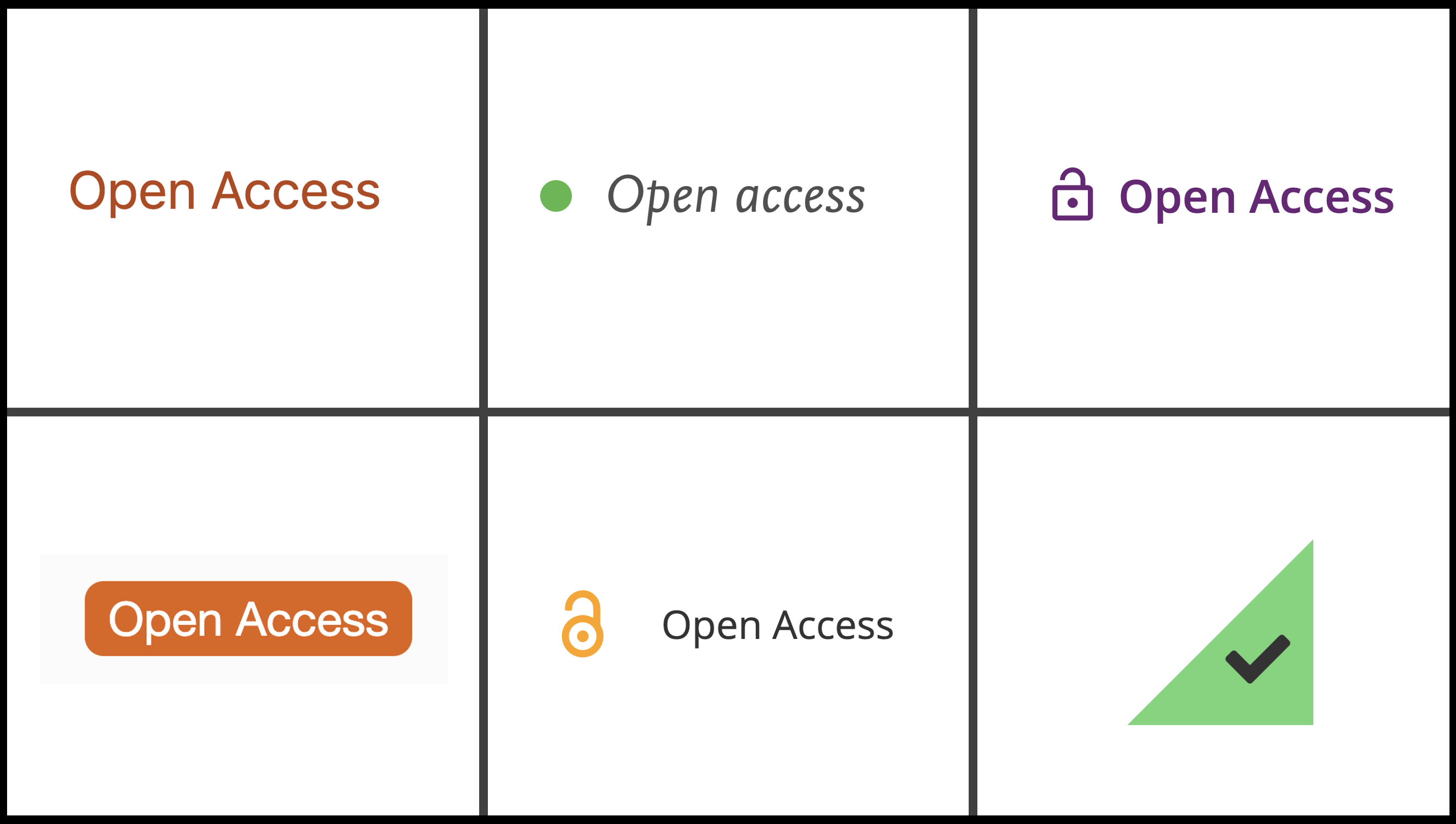
Collage of open access indicators
Collage of open access indicators from the five platforms.

In designing our inquiry, we were guided by two research questions: (1) how do publishing platforms indicate which articles are open access, and (2) is there consistency in the indicators used within and across scholarly publisher platforms? We believe this multi-platform analysis is particularly important as most users must navigate multiple sites during their research journey and so the user experience is not in the control of any single publisher. We selected five major publishers for our analysis: Elsevier, Springer, Wiley, Sage, and Taylor & Francis. As some of the largest academic publishers, their platforms are likely to be used, at least at some point, by the typical faculty member or college student user. 

Methodology

To determine how open access is indicated in the table of contents display, we selected one journal from each publisher. After downloading a current journal list for each publisher, we selected the first hybrid journal listed that was actively publishing in 2020 and located the first issue of that year that contained both open access and paywalled articles. We chose the early 2020 timeframe to ensure that any delayed open access papers (e.g., to comply with U.S. public access requirements) would be open. We went to the table of contents for the issue and noted how open access is indicated for the listed articles. 

To determine how open access is indicated in search results, we conducted a keyword search on each platform. We used the term “pandas” as an example search term, which brought up articles from multiple journals in multiple disciplines as the term can refer to an animal, it is also a term used in software programming and pediatric medicine, and it is used as slang. We then looked for open access indicators in the results, browsing through multiple screens if necessary in order to locate an open access article among those displayed. 

We organized our data in a spreadsheet by scholarly publisher (Elsevier, Sage, Springer, Taylor & Francis, and Wiley), and documented the results for each type of search (table of contents or keyword), the open access indicators in use, and, to differentiate as well between open, free, and subscription access, recorded whether a paywall or other indicators were used. We also captured screenshots or saved as a PDF each displayed screen used in analysis.

We collected pilot data in May and June 2022 in order to develop our methodology. We revisited the platforms in September and October 2022 to collect the data used in this analysis after noting that some publishers had updated their interfaces since the original data collection.

What We Found 

Reviewing the table of contents and keyword search results, we saw that, for the most part, these publishing platforms had internally consistent open access indicators. The indicators used were consistent regardless of whether we were viewing a table of contents or the results of a keyword search. However, indicators varied greatly across publishing platforms, with different terminology, colors, and symbols in use. We also found that open and paywalled access were not the only kinds of access that were indicated; some platforms provided third or even fourth options. These additional types were indicated with various phrases such as “full text access,” “free access,” or “available access” and with very little explanation about what differentiated these kinds of access from open access. 

In the table of contents, Elsevier’s indicator is a green dot with text reading “Open Access.” The green dot indicator is used in the keyword search. The same green dot indicator also appears with the label “Full Text Access.” Whenever the green dot appears, so did a PDF icon and the text “Download PDF.”

In the table of contents, Sage’s indicator is an orange unlocked icon with the text “Open Access” and a PDF/EPUB download icon. The same indicators are used in the keyword search results display. Another type of access is indicated by a green unlocked icon with text that says “Free Access” and the PDF/EPUB download icon. Sage also overtly labels non-open/non-free articles with the label “Restricted Access” and a black locked icon. 

In the table of contents, Springer’s indicator is orange text that says “Open Access.” In the keyword search, Springer uses an orange box with white text that says “Open Access.” Thus, Springer is consistent in use of color – always using an orange and white combination – but not consistent in which is background and which is text color.

Taylor & Francis displays each item in a table of contents or search results set in a box that offsets it from the page background. Indicators for access are in the lower right corner of an item box. For open access articles, Taylor & Francis uses an orange triangle with an unlocked icon in both tables of contents and keyword search displays. The term “Open Access” appears next to the triangle as a mouse-over. A green triangle with a checkmark in it also appears in the displays and the text “Free Access” shows upon mouse-over.

In the table of contents, Wiley’s indicator is purple text that says, “Open Access” and an unlocked icon. The same indicator is used in the keyword search. Another kind of access is indicated by blue text that says “Free Access” accompanied by an unlocked blue icon. We observed that Wiley does use the unlocked green icon seen on other platforms. However, Wiley does so accompanied by the label “Full Access” and this is when the user has subscription-based access to content. 

All of this was quite challenging to investigate and document. It involved hours of searching, capturing screen, clearing caches, incognito browsers, deleting one’s data from SeamlessAccess, and being vigilant to GetFTR powered links in order to reconcile our interpretations. As such, though we have sought to be accurate in our portrayals here, we share our findings with our acknowledged limitations. We welcome corrections to any errors in our interpretations in the comments to this piece. And, we would also suggest that such errors be seen as further evidence of just how confusing the signals and indicators are. 

Implications 

The data collected provide evidence of internal consistency of open access indicators on a single platform and overall cross-platform inconsistency. A publishing platform was deemed internally consistent if it has the same open access indicators on the table of contents and keyword search results. A platform was deemed internally inconsistent if the open access indicators are different in the table of contents and keyword search results. The only platform that did not have complete internal consistency was Springer, which used the same text and colors but inverts orange/white for text and background.

Elsevier, Sage, Wiley, and Taylor & Francis all had internal consistency; however, the symbols that they used to indicate open access differed significantly from one another. There were some similarities, such as the locked/unlocked imagery and download icons in Sage, Taylor & Francis, and Wiley, but the difference in colors and shapes were notable. When users are navigating through multiple platforms during their research process, not having universal symbolism for open access has the potential to slow them down and create confusion.

Another confusion is an absence of information to help a user distinguish among open/free/full/available/etc. access. Sometimes it is not clear whether the user has “free access” or “full access” to an article because they are affiliated with an institution with a subscription or because the article is open for reading for everyone. And, open access is indeed a kind of free access, but the inconsistency in terminology is likely to cause confusion. 

With Sage, whether a user has logged into the platform through their institution will impact the indicators that they see; if they are at a subscribing institution, a new label – “Available Access” – appears accompanied by the green unlocked icon. This means that collaborating scholars who are accessing the platform in different ways – unauthenticated or authenticated/unentitled vs authenticated/entitled – will see different indicators for the same article. Elsevier’s green dot may also confuse. While the green dot consistently indicates that the user has access, the green dot is associated with both “open access” and “free access” terminology as well as the “full-text access” that reflects a subscription-based entitlement.

Though the open access indicators in use within a given publishing platform are relatively consistent, this investigation documents that there is significant inconsistency across the platforms. Publishers use different colors, symbols, and terminology to indicate open access. They also use a variety of symbols and text to indicate other kinds of access that are free but also – one infers –in some way different from open access. Encountering such a wide array of symbols and terminology seems likely to create confusion about whether users can access certain articles and why. This is also a burden for expert users, such as librarians, who are navigating different platforms as they have to orient themselves repeatedly to different sets of indicators. 

Those of us in the library and publishing fields may understand the differences among terms like “open access,” “full text access,” “available access” and “free access” (or at least can usefully hypothesize about them); but, those outside of our professions likely will not. Efforts to better explain access indicators on a given platform would decrease user confusion. But, even better would be a shared taxonomy of indicators and texts implemented across the industry to improve the user experience.

Tweet
Share
Pin
Buffer4
Share
4 Shares
Lisa Janicke Hinchliffe

Lisa Janicke Hinchliffe

@lisalibrarian

Lisa Janicke Hinchliffe is Professor/Coordinator for Research and Teaching Professional Development in the University Library and affiliate faculty in the School of Information Sciences and Center for Global Studies at the University of Illinois at Urbana-Champaign. lisahinchliffe.com

View All Posts by Lisa Janicke Hinchliffe

Kalyn Nowlan

Kalyn Nowlan is an MS/LIS candidate at the iSchool at University of Illinois Urbana-Champaign who works at the Funk Library, which supports research for the college of Agricultural, Consumer and Environmental Sciences. When Kalyn graduates in May, she is interested in pursuing academic librarianship, with a focus on scholarly communications and supporting student success.

View All Posts by Kalyn Nowlan

Posted by Nader Ale Ebrahim at 20:22
Email ThisBlogThis!Share to XShare to FacebookShare to Pinterest
Labels: Bibliometrics, khnv Hg hfvhidl, Nader Ale Ebrahim, Research Impact, Research Tools, Research Visibility

No comments:

Post a Comment

Newer Post Older Post Home
View mobile version
Subscribe to: Post Comments (Atom)

Search This Blog

About Me

My photo
Nader Ale Ebrahim
Nader Ale Ebrahim currently works as a “Research Visibility and Impact” freelancer consultant. Nader is also an adjunct lecturer at Alzahra University. He was working as a visiting research fellow with Institute of Management and Research Services (IPPP), University of Malaya from 2013 to November 2017. Nader holds a PhD in Technology Management from the Faculty of Engineering, University of Malaya. He has over 25 years of experience in the field of technology management and new product development in different companies. His current research interests are University rankings, Open access, Research visibility, Research Tools, and Bibliometrics.
View my complete profile

ORCID

ORCID iD iconorcid.org/0000-0001-7091-4439

Impact Analysis NADER ALE EBRAHIM

Subscribe To "Research Tools"

Posts
Atom
Posts
Comments
Atom
Comments

Translate

@aleebrahim

Tweets by @aleebrahim

Nader Ale Ebrahim Publications on SCOPUS

Research Tools Mind Map

Research Tools Mind Map
Research Tools

Blog Archive

  • ►  2025 (13)
    • ►  August (2)
    • ►  June (1)
    • ►  May (3)
    • ►  April (1)
    • ►  February (4)
    • ►  January (2)
  • ►  2024 (25)
    • ►  December (1)
    • ►  November (4)
    • ►  October (1)
    • ►  June (1)
    • ►  May (5)
    • ►  April (6)
    • ►  March (2)
    • ►  February (4)
    • ►  January (1)
  • ►  2023 (157)
    • ►  December (4)
    • ►  November (2)
    • ►  October (7)
    • ►  September (8)
    • ►  August (4)
    • ►  July (6)
    • ►  June (7)
    • ►  May (17)
    • ►  April (18)
    • ►  March (19)
    • ►  February (18)
    • ►  January (47)
  • ▼  2022 (250)
    • ►  December (18)
    • ▼  November (45)
      • General Writing Resources
      • Strategies to improve visibility and impact throug...
      • Bibliographic identification codes
      • Creating search strategies to match results from a...
      • A Failure to Communicate: Indicators of Open Acces...
      • Planning to leave Twitter?
      • What Are Altmetrics and Why Do We Need Them?
      • How to select a journal for publication as a PhD s...
      • Source: https://medium.com/@vespinozag/what-is-gep...
      • Altmetric Attention Score: Three factors
      • How to structure your abstract
      • Strategies to Enhance Research Visibility, Impact ...
      • Publishing Research Support Documents in Open Acce...
      • How to Improve Research Visibility and Impact
      • How to Increase the Visibility and Impact of your ...
      • Why misconduct could keep scientists from earning ...
      • Research Tools for Collecting, Writing, Publishing...
      • Question: How to improve research visibility and i...
      • Types of academic writing
      • The Complete Guide to Mastodon and Twitter for Aca...
      • Research metrics and publishing
      • Researcher Identification
      • Scholarly Publishing: Researcher Profiles
      • Managing Your Online Presence
      • Increase Your Scholarly Impact
      • Publishing and Scholarly Communication: Promoting ...
      • Boost your academic profile
      • How using a unique identifier increases the visibi...
      • Enhancing your academic visibility & profile: YOU ...
      • Maximise the visibility of your research outputs b...
      • Top tips: making your article visible with SEO
      • How to Choose Effective SEO Keywords for Your Rese...
      • Title, Abstract and Keywords
      • Research Publishing & Impact: Researcher Profiles
      • Raising Your Research Visibility
      • Enhance your visibility
      • How to increase the visibility of your research?
      • Research Impact 101
      • Publishing Fast and Slow: A Review of Publishing S...
      • 10 amazing benefits of getting a PhD later in life
      • Best Chrome extensions for PhD Students
      • 50 Statement Of Purpose Examples (Graduate School,...
      • Types of academic writing
      • Mazungumzo - African Scholarly Conversations Train...
      • Research Tools for Collecting, Writing, Publishing...
    • ►  October (50)
    • ►  September (10)
    • ►  August (18)
    • ►  July (13)
    • ►  June (15)
    • ►  May (33)
    • ►  April (10)
    • ►  March (27)
    • ►  February (7)
    • ►  January (4)
  • ►  2021 (107)
    • ►  December (20)
    • ►  November (22)
    • ►  October (2)
    • ►  September (5)
    • ►  August (18)
    • ►  July (16)
    • ►  June (8)
    • ►  May (2)
    • ►  April (5)
    • ►  March (3)
    • ►  February (1)
    • ►  January (5)
  • ►  2020 (63)
    • ►  December (4)
    • ►  November (3)
    • ►  October (7)
    • ►  August (22)
    • ►  July (5)
    • ►  June (6)
    • ►  May (3)
    • ►  April (4)
    • ►  March (2)
    • ►  January (7)
  • ►  2019 (227)
    • ►  December (14)
    • ►  November (9)
    • ►  October (12)
    • ►  September (13)
    • ►  August (23)
    • ►  July (28)
    • ►  June (30)
    • ►  May (2)
    • ►  April (4)
    • ►  March (9)
    • ►  February (18)
    • ►  January (65)
  • ►  2018 (22)
    • ►  December (21)
    • ►  January (1)
  • ►  2017 (325)
    • ►  November (5)
    • ►  October (25)
    • ►  September (23)
    • ►  August (10)
    • ►  July (5)
    • ►  June (33)
    • ►  May (55)
    • ►  April (41)
    • ►  March (24)
    • ►  February (26)
    • ►  January (78)
  • ►  2016 (503)
    • ►  December (75)
    • ►  November (45)
    • ►  October (49)
    • ►  September (41)
    • ►  August (27)
    • ►  July (36)
    • ►  June (20)
    • ►  May (42)
    • ►  April (23)
    • ►  March (37)
    • ►  February (51)
    • ►  January (57)
  • ►  2015 (486)
    • ►  December (50)
    • ►  November (44)
    • ►  October (41)
    • ►  September (31)
    • ►  August (24)
    • ►  July (20)
    • ►  June (52)
    • ►  May (67)
    • ►  April (41)
    • ►  March (48)
    • ►  February (55)
    • ►  January (13)
  • ►  2014 (105)
    • ►  December (14)
    • ►  November (9)
    • ►  October (5)
    • ►  September (6)
    • ►  August (8)
    • ►  July (3)
    • ►  June (9)
    • ►  May (8)
    • ►  April (7)
    • ►  March (15)
    • ►  February (10)
    • ►  January (11)
  • ►  2013 (26)
    • ►  December (26)

Tweets by Nader Ale Ebrahim (@aleebrahim)

Tweets by @aleebrahim

SSRN Author: Nader Ale Ebrahim

Loading...

linking to SCOOP.IT profile

Nader Kred Score

Google Scholar Blog

Loading...

Visibility and Citation Impact

Visibility and Citation Impact by Nader Ale Ebrahim

Research Tools Box | Scoop.it

Loading...

Nader Ale Ebrahim's academic activities and relevant topics

Loading...

Citation to A comparison between ...

Loading...

Nader Ale Ebrahim in SCOPUS

Loading...

Cited " Effective strategies"

Loading...

Nader Ale Ebrahim

Loading...

Popular Posts

  • Beall's List of Predatory Journals and Publishers
    Source: https://beallslist.weebly.com/ Beall's List of Predatory Journals and Publishers ...
  • Copyright Checking and Pre-print / Post-print Preparations
    Copyright Checking and Pre-print / Post-print Preparations Copyright Checking and Pre-print / Post-print Preparations 16.03.2017, 13:21 ...
  • New Articles about Research Visibility, Impact and Evaluation
    Source: https://libraryguides.helsinki.fi/researchvisibility New Articles about Research Visibility, Impact and Evaluation ...
  • Writing the Results, Discussion and Conclusion chapters | Cecile Badenhorst
    Source: https://cecilebadenhorst.wordpress.com/carnegie-african-diaspora-workshops/writing-the-results-discussion-and-conclusion-chapters/ ...
  • 10 Chrome extensions to help manage references, notes, citations and capture information.
     Source: http://blogs.lse.ac.uk/impactofsocialsciences/2015/05/22/10-chrome-extensions-to-manage-references-notes-citations-and-capture-info...
  • IEEE - Search Engine Optimization (SEO) for IEEE Sites
    Source: https://www.ieee.org/about/webteam/resources/search_optimization.html Search engine optimization (SEO) is the act of modify...
  • Starting an Open Access Journal: a step-by-step guide part 1 to 5 | Dr. Martin Paul Eve
     Source: 1- https://www.martineve.com/2012/07/10/starting-an-open-access-journal-a-step-by-step-guide-part-1/ 2- https://www.martineve....
  • Bad Titles Hurt Good Papers - IHS Academic
    Source: http://www.theihs.org/academic/2012/05/31/bad-titles-hurt-good-papers/ Bad Titles Hurt Good Papers By: Bi...
  • Research Preparation: Things to do Before Starting Library Research Projects
     Source: http://web.calstatela.edu/library/guides/rprep.htm Research Preparation Things to do Before Starting Library Research Projects ...
  • Digital tools for researchers | Connected Researchers
     Source: http://connectedresearchers.com/online-tools-for-researchers/ Digital tools for researchers Find out how digital tools ca...

Nader Ale Ebrahim's academic activities and relevant topics

Loading...

CiteSeerX Documents: Dr. Nader Ale Ebrahim

Loading...

Popular Posts (All time)

  • Beall's List of Predatory Journals and Publishers
    Source: https://beallslist.weebly.com/ Beall's List of Predatory Journals and Publishers ...
  • Copyright Checking and Pre-print / Post-print Preparations
    Copyright Checking and Pre-print / Post-print Preparations Copyright Checking and Pre-print / Post-print Preparations 16.03.2017, 13:21 ...
  • New Articles about Research Visibility, Impact and Evaluation
    Source: https://libraryguides.helsinki.fi/researchvisibility New Articles about Research Visibility, Impact and Evaluation ...
  • Writing the Results, Discussion and Conclusion chapters | Cecile Badenhorst
    Source: https://cecilebadenhorst.wordpress.com/carnegie-african-diaspora-workshops/writing-the-results-discussion-and-conclusion-chapters/ ...
  • 10 Chrome extensions to help manage references, notes, citations and capture information.
     Source: http://blogs.lse.ac.uk/impactofsocialsciences/2015/05/22/10-chrome-extensions-to-manage-references-notes-citations-and-capture-info...
  • IEEE - Search Engine Optimization (SEO) for IEEE Sites
    Source: https://www.ieee.org/about/webteam/resources/search_optimization.html Search engine optimization (SEO) is the act of modify...
  • Starting an Open Access Journal: a step-by-step guide part 1 to 5 | Dr. Martin Paul Eve
     Source: 1- https://www.martineve.com/2012/07/10/starting-an-open-access-journal-a-step-by-step-guide-part-1/ 2- https://www.martineve....
  • Bad Titles Hurt Good Papers - IHS Academic
    Source: http://www.theihs.org/academic/2012/05/31/bad-titles-hurt-good-papers/ Bad Titles Hurt Good Papers By: Bi...
  • Research Preparation: Things to do Before Starting Library Research Projects
     Source: http://web.calstatela.edu/library/guides/rprep.htm Research Preparation Things to do Before Starting Library Research Projects ...
  • Digital tools for researchers | Connected Researchers
     Source: http://connectedresearchers.com/online-tools-for-researchers/ Digital tools for researchers Find out how digital tools ca...

Popular Posts (Last 30 days)

  • Review of ResearchGate : Pros and cons and recommendations – Open Research Exeter
     Source: http://blogs.exeter.ac.uk/openresearchexeter/2013/11/06/74/ Review of ResearchGate : Pros and cons and recommendations Tags: ...
  • IEEE - Search Engine Optimization (SEO) for IEEE Sites
    Source: https://www.ieee.org/about/webteam/resources/search_optimization.html Search engine optimization (SEO) is the act of modify...
  • Ranked: The Top 50 Most Visited Websites in the World
     Source: https://www.visualcapitalist.com/top-50-most-visited-websites/ Ranked: The Top 50 Most Visited Websites in the World ...
  • How do I use Scopus’ Author Feedback Wizard? | Elsevier TrainingDesk
    Source: http://trainingdesk.elsevier.com/how-to/how-do-i-use-scopus-author-feedback-wizard How do I use Scopus’ Author Feedback W...
  • Beall's List of Predatory Journals and Publishers
    Source: https://beallslist.weebly.com/ Beall's List of Predatory Journals and Publishers ...
  • 10 Chrome extensions to help manage references, notes, citations and capture information.
     Source: http://blogs.lse.ac.uk/impactofsocialsciences/2015/05/22/10-chrome-extensions-to-manage-references-notes-citations-and-capture-info...
  • List of Top 10 PDF Document Sharing Websites – 2015 | Top 10 Websites List
     Source: https://top10websiteslist.wordpress.com/2015/05/05/list-of-top-10-pdf-document-sharing-websites-2015/ List of Top 10 PDF Document ...
  • List of academic search engines that use Large Language models for generative answers and some factors to consider when using
     Source: https://musingsaboutlibrarianship.blogspot.com/2023/09/list-of-academic-search-engines-that.html Sep 28 ...
  • Writing for a Nature journal
    Source: https://www.nature.com/authors/author_resources/how_write.html How to write a paper Writing for a Nature journal Bef...
  • Make a profile on Academia.edu/ResearchGate/Mendeley - Raising Your Scholarly Profile - LibGuides at Duquesne University
     source: http://guides.library.duq.edu/scholarlyprofile/7DICDay2 Make a profile on Academia.edu, ResearchGate, AND/OR Mendeley You know all...

Popular Posts (Last 7 Days)

  • Review of ResearchGate : Pros and cons and recommendations – Open Research Exeter
     Source: http://blogs.exeter.ac.uk/openresearchexeter/2013/11/06/74/ Review of ResearchGate : Pros and cons and recommendations Tags: ...
  • How do I use Scopus’ Author Feedback Wizard? | Elsevier TrainingDesk
    Source: http://trainingdesk.elsevier.com/how-to/how-do-i-use-scopus-author-feedback-wizard How do I use Scopus’ Author Feedback W...
  • Ranked: The Top 50 Most Visited Websites in the World
     Source: https://www.visualcapitalist.com/top-50-most-visited-websites/ Ranked: The Top 50 Most Visited Websites in the World ...
  • IEEE - Search Engine Optimization (SEO) for IEEE Sites
    Source: https://www.ieee.org/about/webteam/resources/search_optimization.html Search engine optimization (SEO) is the act of modify...
  • Enhance Research Visibility by Tracking Citations
    Enhance Research Visibility by Tracking Citations 31.05.2016, 15:42 (GMT) by Nader Ale Ebrahim Congratulation, you published a paper.  ...
  • Citation Management
    Source: http://guides.library.yale.edu/content.php?pid=381455&sid=3126131 All Citation Management products have these basic features t...
  • List of academic search engines that use Large Language models for generative answers and some factors to consider when using
     Source: https://musingsaboutlibrarianship.blogspot.com/2023/09/list-of-academic-search-engines-that.html Sep 28 ...
  • Writing the Results, Discussion and Conclusion chapters | Cecile Badenhorst
    Source: https://cecilebadenhorst.wordpress.com/carnegie-african-diaspora-workshops/writing-the-results-discussion-and-conclusion-chapters/ ...
  • Make a profile on Academia.edu/ResearchGate/Mendeley - Raising Your Scholarly Profile - LibGuides at Duquesne University
     source: http://guides.library.duq.edu/scholarlyprofile/7DICDay2 Make a profile on Academia.edu, ResearchGate, AND/OR Mendeley You know all...
  • Author Identification Systems
     Source: http://www.istl.org/09-fall/tips.html Issues in Science and Technology Librarianship Fall 2009 DOI:10.5062/F40K26HX Tips fr...

CITATIONS BLOGS

Loading...

ScienceGate | Blog

Loading...

Kate Lindsay Blogs-Teaching in Digital Spaces

Loading...

A-cademic news

Loading...

Dr Asma Jabeen

Loading...

The Academic Designer

Loading...

drmarkgriffiths

Loading...

University Ranking Watch

Loading...

The Graduate Institute Library Blog

Loading...

Library & Learning Services

Loading...

Musings about librarianship

Loading...

World Ranking Guide

Loading...

University Ranking Watch

Loading...

BASE: Results for Nader Ale Ebrahim

Loading...

Musings about librarianship

Loading...

Musings about librarianship

Loading...

Research Tools Workshop Photos

Research Tools

Improve Citations Workshops Photo

Improve Citations

Latest publications

Loading...

Nader Ale Ebrahim Profile on PlumX

Nader Ale Ebrahim Profile on PlumX

Introduction to the “Research Tools”

Google Scholar Blog

Loading...

CWTS

Loading...

Webometric Thoughts

Loading...

GlobalHigherEd

Loading...

Introduction to Webometrics

Loading...

Productive Scholar

Loading...

Things You Should Know.....

Loading...

BodWiser

Loading...

Academic Visibility

Loading...

Research Information

Loading...

How to publish in journals

Loading...

Getting your paper noticed

Elsevier Connect

Loading...

University of Queensland Library UQ Library Guides: Getting Published

Loading...

Science Publication Network

Loading...

The Scientist Videographer

Loading...

Impact of Social Sciences

Loading...

Retraction Watch

Loading...

Open Science

Loading...

Kudos News

Loading...

Scholastica Blog

Loading...

InfoDoc MicroVeille

Loading...

APA Style Blog

Loading...

Impactstory blog

Loading...

Bodleian iSkills blog

Loading...

Open Access News

Loading...

WisBlawg

Loading...

Press Releases

Loading...

ScienceOpen Blog

Loading...

Comments on Reference Management Software

Loading...

openingscience.org

Loading...

Open Access @ CUNY

Loading...

Popular Posts

  • Beall's List of Predatory Journals and Publishers
    Source: https://beallslist.weebly.com/ Beall's List of Predatory Journals and Publishers ...
  • Copyright Checking and Pre-print / Post-print Preparations
    Copyright Checking and Pre-print / Post-print Preparations Copyright Checking and Pre-print / Post-print Preparations 16.03.2017, 13:21 ...
  • New Articles about Research Visibility, Impact and Evaluation
    Source: https://libraryguides.helsinki.fi/researchvisibility New Articles about Research Visibility, Impact and Evaluation ...
  • Writing the Results, Discussion and Conclusion chapters | Cecile Badenhorst
    Source: https://cecilebadenhorst.wordpress.com/carnegie-african-diaspora-workshops/writing-the-results-discussion-and-conclusion-chapters/ ...
  • 10 Chrome extensions to help manage references, notes, citations and capture information.
     Source: http://blogs.lse.ac.uk/impactofsocialsciences/2015/05/22/10-chrome-extensions-to-manage-references-notes-citations-and-capture-info...
  • IEEE - Search Engine Optimization (SEO) for IEEE Sites
    Source: https://www.ieee.org/about/webteam/resources/search_optimization.html Search engine optimization (SEO) is the act of modify...
  • Starting an Open Access Journal: a step-by-step guide part 1 to 5 | Dr. Martin Paul Eve
     Source: 1- https://www.martineve.com/2012/07/10/starting-an-open-access-journal-a-step-by-step-guide-part-1/ 2- https://www.martineve....
  • Bad Titles Hurt Good Papers - IHS Academic
    Source: http://www.theihs.org/academic/2012/05/31/bad-titles-hurt-good-papers/ Bad Titles Hurt Good Papers By: Bi...
  • Research Preparation: Things to do Before Starting Library Research Projects
     Source: http://web.calstatela.edu/library/guides/rprep.htm Research Preparation Things to do Before Starting Library Research Projects ...
  • Digital tools for researchers | Connected Researchers
     Source: http://connectedresearchers.com/online-tools-for-researchers/ Digital tools for researchers Find out how digital tools ca...

AUNILO

Loading...

Connected Researchers

Loading...

LIASA Higher Education Libraries Interest Group

Loading...

Plum Analytics - Tell the Story.

Loading...

Open Access News

Loading...

ScienceDirect Search: Top cited paper

Loading...

The SSRN Blog | The SSRN Blog

Loading...

The Sociological Imagination

Loading...

Scientific American Blog Posts

Loading...

Newsletter SciELO in Perspective (EN) Archive Feed

Loading...

Repository of the Academy's Library:

Loading...

Research Support Hub

Loading...

Exchanges

Loading...

Wiley Asia Blog

Loading...

Cited reference searching

Loading...

smartsciencecareer blog

Loading...

The Thesis Whisperer

Loading...

Academic Visibility

Loading...

Academic Evolution

Loading...

BodWiser

Loading...

Michael Habib | Product Manager and Librarian | Nudging Serendipity

Loading...

Pinboard (pigsonthewing)

Loading...

Scholarship 2.0: An Idea Whose Time Has Come

Loading...

Science in the Open

Loading...

Webometric Thoughts

Loading...

White Rose Research Online

Loading...

Research Trends

Loading...

Substantia Mea

Loading...

Sciencebite

Loading...

BioMed Central blog

Loading...

smartsciencecareer blog

Loading...

BioMed Central blog

Loading...

Research Trends

Loading...

QS Intelligence Unit

Loading...

The Plainspoken Scientist

Loading...

Exchanges

Loading...

Altmetric.com

Loading...

TIB|Blog

Loading...

How to publish in journals

Loading...

ThinkWrite Blog » citations

Loading...

HighWire

Loading...

Exchanges

Loading...

Google Scholar Digest

Loading...

Popular Posts

  • Review of ResearchGate : Pros and cons and recommendations – Open Research Exeter
     Source: http://blogs.exeter.ac.uk/openresearchexeter/2013/11/06/74/ Review of ResearchGate : Pros and cons and recommendations Tags: ...
  • How do I use Scopus’ Author Feedback Wizard? | Elsevier TrainingDesk
    Source: http://trainingdesk.elsevier.com/how-to/how-do-i-use-scopus-author-feedback-wizard How do I use Scopus’ Author Feedback W...
  • Ranked: The Top 50 Most Visited Websites in the World
     Source: https://www.visualcapitalist.com/top-50-most-visited-websites/ Ranked: The Top 50 Most Visited Websites in the World ...
  • IEEE - Search Engine Optimization (SEO) for IEEE Sites
    Source: https://www.ieee.org/about/webteam/resources/search_optimization.html Search engine optimization (SEO) is the act of modify...
  • Enhance Research Visibility by Tracking Citations
    Enhance Research Visibility by Tracking Citations 31.05.2016, 15:42 (GMT) by Nader Ale Ebrahim Congratulation, you published a paper.  ...
  • Citation Management
    Source: http://guides.library.yale.edu/content.php?pid=381455&sid=3126131 All Citation Management products have these basic features t...
  • List of academic search engines that use Large Language models for generative answers and some factors to consider when using
     Source: https://musingsaboutlibrarianship.blogspot.com/2023/09/list-of-academic-search-engines-that.html Sep 28 ...
  • Writing the Results, Discussion and Conclusion chapters | Cecile Badenhorst
    Source: https://cecilebadenhorst.wordpress.com/carnegie-african-diaspora-workshops/writing-the-results-discussion-and-conclusion-chapters/ ...
  • Make a profile on Academia.edu/ResearchGate/Mendeley - Raising Your Scholarly Profile - LibGuides at Duquesne University
     source: http://guides.library.duq.edu/scholarlyprofile/7DICDay2 Make a profile on Academia.edu, ResearchGate, AND/OR Mendeley You know all...
  • Author Identification Systems
     Source: http://www.istl.org/09-fall/tips.html Issues in Science and Technology Librarianship Fall 2009 DOI:10.5062/F40K26HX Tips fr...

Dr. Nader Ale Ebrahim's Publications on SCOPUS

Loading...

Science and the Web

Loading...

The SSRN Blog

Loading...

JOURNALS CLUB & CO.

Loading...

Teachers Mobile Technology

Loading...

Postgrad Blog

Loading...

The Research Whisperer

Loading...

Impactstory blog

Loading...

Altmetric.com

Loading...

Wiley Asia Blog

Loading...

Article RSS Feed | Elsevier Library Connect

Loading...

Text and Academic Authors Association Blog

Loading...

The Comics Grid (Blog)

Loading...

DiRT News

Loading...

Kudos News

Loading...

Scopus

Loading...

Publishing blog

Loading...

Scopus - BrightTALK

Loading...

Walt at Random

Loading...

A librarian abroad

Loading...

University Ranking Watch

Loading...

ResearchImpact

Loading...

The Writing Reader

Loading...

SciTechSociety

Loading...

Publication Stages – Enago Academy

Loading...

Open Research Exeter

Loading...

Google Scholar Blog

Loading...

News feed

Loading...

Research Visibility and Impact

Loading...

Nader Ale Ebrahim @ Twitter

Tweets by aleebrahim

Global Academy Jobs Blog

Loading...

Australasian Open Access Strategy Group

Loading...

Blog on Crossref

Loading...

University Ranking Watch

Loading...

Prof Hacker - Blogs - The Chronicle of Higher Education

Loading...

Compound Interest

Loading...

Total Pageviews

Subscribe To

Posts
Atom
Posts
Comments
Atom
Comments
Simple theme. Powered by Blogger.