In order to improve the quality of systematic researches, various tools have been developed by well-known scientific institutes sporadically. Dr. Nader Ale Ebrahim has collected these sporadic tools under one roof in a collection named “Research Tool Box”. The toolbox contains over 720 tools so far, classified in 4 main categories: Literature-review, Writing a paper, Targeting suitable journals, as well as Enhancing visibility and impact factor.
ChatGPT and the rise of AI writers: how should higher education respond?
The
proliferation of AI text generators such as ChatGPT has major
implications for higher education. Nancy Gleason explores how educators
should respond to these tools which can write essays in seconds
Deep
machine learning has reached a level of sophistication whereby
platforms can produce human-like text instantly. The latest craze is
around the mind-blowing capabilities of ChatGPT and GPT-3.5. With its
new user-friendly interface, the AI chatbot launched on 2 December had
attracted more than 1 million users within five days.
There are a growing number of AI-enabled content writers – Jasper, CopyAI and Rytr, to name a few. So, what sets ChatGPT apart?
It is prolific, highly effective and still
learning. And it is free. Most of these platforms cost money students do
not have. The new interface means everyone can use it. Putting
AI-enabled content development into a chat format is a new innovation
that makes it interactive, accessible and inviting.
ChatGPT and GPT-3.5 can produce very good
text in any structured language: poems, essays, blog posts, marketing
materials and all code languages.
For example, I gave it the prompt:
“You are a journalist. Explain what ChatGPT
is to THE Campus readers. Explain what it means for higher education.” I
received the following text in about 30 seconds.
ChatGPT is a new technology developed by
OpenAI, a research laboratory, which uses artificial intelligence (AI)
to enable natural-language conversations. It works by using a deep
learning model which is trained on large datasets of human
conversations. This model is then used to generate natural-sounding
responses to questions posed by users. ChatGPT has the potential to
revolutionize the way we communicate with computers, and it could have a
big impact on higher education. For example, ChatGPT could be used to
create virtual tutors, to interact with students in lectures, and to
help answer questions about course material. It could also be used to
create virtual research assistants, allowing students to ask questions
and receive answers quickly and accurately. In addition, ChatGPT could
enable smarter conversations between teachers, students, and
researchers, allowing them to collaborate more effectively and
efficiently.
There are of course naysayers who claim this
is not a big deal. They point out that AI-generated text is not perfect,
that it does not care about accuracy, that it lies. For example, it
produces fake citations and reproduces biases that exist in the
literature.
Here's one thing most of us agree on, processing
information in research papers takes work. But wouldn't it be great if
you could have AI explain papers to you no matter what the topic is, as
you read, whenever you want?
Picture this: every time you see
a complicated equation in research papers, you’d get an explanation of
it right there on the same screen. Even better, imagine you can ask any
number of follow-up questions and get answers to them instantly. That's
exactly what you get with SciSpace Copilot!
Use this AI assistant
to get explanations and answers on any research paper as you read. Works
for tables, equations, diagrams, jargon, and even lengthy blocks of
text. You don't have to pause and search for it elsewhere. And your
learning flow won't be disrupted.
Critical thinking and
problem-solving are the bedrock of research. Copilot provides all the
contextual information you ask for in real-time. It gives you more time
to think about the research and focus more on making inferences and
drawing meaningful conclusions.
What is SciSpace Copilot?
Copilot
is like your own personal AI research assistant. It's built using
GPT-3, a third-generation machine-learning model, and sits on top of our
research repository. That means whenever you need help, Copilot is
there to explain the paper, answer your queries, and provide you with
the context you need.
For starters, the AI assistant is available across all the 270 million+ papers on the SciSpace repository. So, you can simply search for the paper you want to look up to get started.
Or,
if you have the PDF stored on your device, you can sign up to SciSpace
and then upload the same. Either way, it provides contextual
explanations and answers you need.
How to get started with reading scientific papers using SciSpace Copilot?
Copilot
can assist you whether you're working on your literature review,
catching up on the latest in your field, or just reading for fun. Let's
look at how the AI research assistant helps you to break down and get
through all those academic papers.
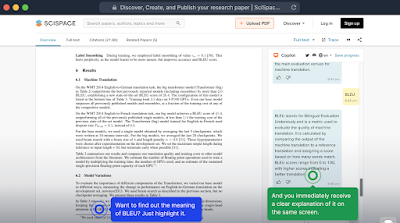
1. Highlight text to understand them better
Came
across unfamiliar terms or acronyms while reading a research paper?
With Copilot, simply highlight it to get an explanation on the same
screen.
Highlight terms to get explanations from the AI assistant
It
works for lengthy passages too. So, next time you're stuck while
reading a paper, just select the text which requires further
elaboration. Get background information about what is being discussed in
the passage — concepts, theories, methods and learn how they are
relevant to the paper.
Highlight paragraphs to get Copilot to break them down for you and give you more context
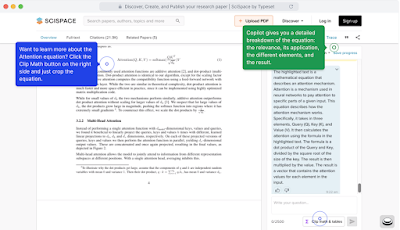
2. Crop formulas and tables to learn their implications
Comprehending
the math in a paper can be challenging. You can skim through and read
the results, but what if there was a better option? Now just clip every
equation you see in a paper to get your AI research assistant to explain
it to you. Glean more insights by breaking equations down step-by-step
and making sense of their implications.
Crop formulas to learn their implications
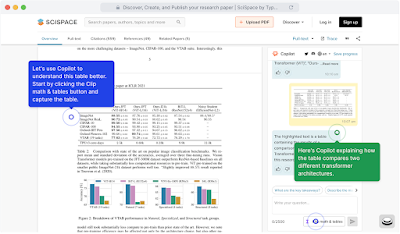
You
can also crop tables for an overview of the data. It should help you
analyze and examine the data more closely and gain more context into the
conclusions drawn by the author.
Snip tables to get more context on the data
3. Ask questions to get more context and clarity
Learning
cannot be complete without questions. Asking questions is how you
connect your existing knowledge with new information. You can, of
course, refer to another text or reach out to authors or peers with your
queries. But what if you need a quick answer so that you can keep
reading?
Copilot makes that easy and instant. Just type in your
query as you're reading, and the AI research assistant provides a
relevant answer on the same page. Be it a technical question or
something related to the theory or methodology. Feel free to ask any
number of questions.
Ask any number of questions you need to get the full context
On
top of that, if Copilot's initial answer to a question fails to clarify
your doubt completely, you can zero in on it with follow-up questions.
You can also do the same if you want to dig deeper into the explanations
you receive for excerpts and equations.
Ask follow-up questions if you want to understand the concept further
These
are the three key ways you can use Copilot. In addition to this, you
can converse with the AI research assistant in multiple languages. It
can explain papers and provide answers in any language you choose. We
currently support ten languages and plan to add many more.
Converse and get explanations in multiple languages
And
please know that your conversation with Copilot on a particular paper
is automatically saved. This way, you can refer back to it anytime you
need.
Wrapping up
Copilot is still very
much a work in progress. We are continuously working to enhance the
features and make Copilot even more helpful for researchers and other
research readers. The aim is to make research papers more interactive so
that you get contextual help while reading.
We at SciSpace are
working to make every published paper utilized to its optimum. Copilot
is just the beginning; join us on our journey.
Journals to trial tool that automatically flags reproducibility and transparency issues in papers
By Dalmeet Singh Chawla8 December 2022
A tool using natural language processing
and machine learning algorithms is being rolled-out on journals to
automatically flag reproducibility, transparency and authorship problems
in scientific papers.
The tool, Ripeta, has existed since
2017 and has already been run on millions of journal papers following
its release, but now the tool’s creators have enabled its latest
versions to be run on papers before peer review. In August, Ripeta was integrated
with the widekly used manuscript submission system Editorial Manager in
a bid to identify shortcomings in papers before they are sent out to
peer review at journals. At this stage the tool’s creators won’t
disclose which journals are using Ripeta, citing commercial
confidentiality.
Ripeta sifts through papers to identify ‘trust markers’ for papers
such as whether they contain data and code availability statements, open
access statements, as well as ethical approvals, author contributions,
repository notices and funding declarations.
From October 2022, the technology behind Ripeta was also integrated
in the scholarly database Dimensions, giving users access to metadata
about trust markers – for a fee – in 33 million academic papers
published since 2010.
An upcoming white paper reporting trends based on the 33 million
Dimensions records reveals that the proportion of academic papers
containing funding statements has risen steadily from just over 30% in
2011 to just under 50% in 2021. Over the same period, competing interest
statements have also increased sharply to just under 40% – an increase
of just over 30%. Meanwhile information about ethical approvals and
authors’ contribution statements has shot up from around 5% of scholarly
papers in 2011 to more than 25% in 2021. Although the number of papers
containing data availability statements has gone from close to zero in
2011 to more than 20% in 2021, specific code availability sections are
yet to see common adoption, emerging only in the last three years.
‘It would be like having an app within a smartphone platform,’ says
Leslie McIntosh, chief executive officer and founder of US-based Ripeta.
‘The hope is that people would use this and improve the manuscript
before they get published.’
If Ripeta prompts researchers to fix issues such as code and data
availability statements or ethical approval statements, that would free
up time for editors and peer reviewers to focus on the actual science,
McIntosh says. ‘Just because they have all the pieces [it doesn’t] mean
that they actually have a well stated hypothesis and their methods are
good.’
McIntosh says her customers include research institutions, funding
agencies, policymakers and individual researchers. ‘Checking for
nefarious things is hot’ at the moment, McIntosh says. ‘The way that
we’re checking for that and being able to leverage dimensions and
[identify] potential nefarious networks is actually very unique.’
Michèle Nuijten, a meta-science researcher at Tilburg University in the Netherlands who helped create the algorithm statcheck,
which flags statistical errors in scientific studies, says it’s a great
idea to spot shortcomings in papers before publication. ‘I do hope that
these kinds of tools are here to stay because we need some help in
dealing with the enormous amount of output.’
One downside of AI tools is that they’re not completely transparent
and it’s often unclear how they work. McIntosh agrees that all software
is biased due to the data they are trained on and the implicit biases of
people who create the tools. To minimise biases, she argues that there
always needs to be manual data validation and curation, with humans
always in the loop with the findings and making the final decisions.