Research Tools

In order to improve the quality of systematic researches, various tools have been developed by well-known scientific institutes sporadically. Dr. Nader Ale Ebrahim has collected these sporadic tools under one roof in a collection named “Research Tool Box”. The toolbox contains over 720 tools so far, classified in 4 main categories: Literature-review, Writing a paper, Targeting suitable journals, as well as Enhancing visibility and impact factor.

Tuesday, 30 August 2022

What do we really know about academic search engine optimization (ASEO) and an announcement.

 Source: http://musingsaboutlibrarianship.blogspot.com/2021/06/what-do-we-really-know-about-academic.html

What do we really know about academic search engine optimization (ASEO) and an announcement.

Announcement

This blog has been using Feedburner to provide RSS and email subscriptions for over a decade (since 2009!). Unfortunately Feedburner has accounced that email subscriptions are going away in July, so to ensure that those of you who have subscribed to this blog via email continue to receive emails, I'm moving everyone to a new service - follow.it for the next blog post in July (estimated release 15th July).

What this means for you.


For those of you who subscribe via email:

No action needed, you wll automatically be subscribed to emails via the new follow.it service  There is no need to create a followit account unless you want to. If you do not wish to continue email subscriptions from this blog and want to be excluded from this service, please email me to aarontay at gmail.com by 2nd of July 2021.


For those of you who subscribe via RSS:

No action needed currently. The Feedburner RSS feed will continue to work, however I highly recommend you switch over to the new RSS feed as it's unclear how long Feedburner is going to be maintained. 

To do so, Enter the following https://follow.it/musings-about-librarianship-aaron-tay into your RSS feed reader

What do we really know about academic search optimization?

One of the areas that I have been asked by researchers in recent years is on how to maximise visibility of their research. 

Thus far, I have had 2 musings on this topic

  • Systematically improving the visibility of your research on social media - what would this look like?
  • Systematically improving the visibility of your research on social media -Visual abstracts, Video abstracts , Plain language abstracts and more 

The first covers how to track your online promotions and to assess what works while the second post focuses more specifically on whether posting additional content like visual abstracts, video abstracts helps with gaining more attention on social media.

All this is well and good but what about Academic Search Engine Optimization (ASEO). If you are unfamilar with the concept of Search Engine Optimization (SEO) it is usually defined as such

Search engine optimization is the process of improving the quality and quantity of website traffic to a website or a web page from search engines. SEO targets unpaid traffic rather than direct traffic or paid traffic

SEO industry is by now a two decade old industry, where consultants provide services that will help draw traffic to your websites by ranking high on search engine result pages (SERP) which implies of course claiming to know the secrets to getting your website and pages highly ranked on top search engines such as Google.

I understand it is a highly competitive industry, with high stakes (ranking #1 on a popular keyword vs #100 on google makes a big deal for traffic), where gurus pore over comments by Googlers, or run experiments to try to figure out how what makes Google's search algorithms tick and it's a constant cat and mouse game, as SEO experts react to major Google updates that make big changes to the algorithms. 

By analogy, Academic Search Engine Optimization (ASEO) has the same idea which is to optimize your academic content (typically journal articles) so it will rank higher in search engines typically Google and Google Scholar.

The term "Academic Search Engine Optimization" appears to be coined in 2010 , and the first paper that coined the term studied this in the context of what aftects the ranking of Google Scholar.

The first paper on ASEO found that citation have a very strong influence on the ranking of publications found in Google Scholar. This is a result with a strong effect (r=0.9) that has been found over and over again in follow up papers with larger samples and more sophisticated methods and is generally accepted to be one of the things we know for sure about Google Scholar.

In general though, I don't think ASEO has been a hot area of research in the decade that followed (at least if you search by the term). While there has been tons of research around Google Scholar, a glance at the bibliography produced by EC3 Research Group's Google Scholar Digest shows that most of the research on Google Scholar focuses on traditional bibliometrics areas such as comparison of Google Scholar index coverage with other scholarly indexes, whether Google Scholar is appropriate as a ranking tool etc.

As you will see, there is a strand in bibliometrics that while not focusing on ASEO per se, studies factors correlated with citation counts and this is sometimes used to support ASEO recommendations.

That said a recent publication - Increasing visibility and discoverability of scholarly publications with academic search engine optimization published in 2021 caught my eye. How much has the research on ASEO improved since the term was coined in 2010?

What follows will be a short summary of the paper and a discussion of the sources of the evidence for such ASEO tips. I discuss what ASEO really "works" means, difficulty of actually measuring this and musing about whether we can really use correlational observation studies to make confident recommendations for ASEO.

Ultimately the question is  what we can really be sure about ASEO today. 

An summary of ASEO tips in 2021

The article - Increasing visibility and discoverability of scholarly publications with academic search engine optimization published is positioned as a practical piece to advise researchers and contains no original research of it's own but instead draws from other published research and there's a lot to like about it.

Firstly, it nicely divides the advice into sections like

  • Title optimization
  • Keyword optimization
  • Abstract optimization
and even has a section on ASEO for books (which is excellent since a lot of advice acts like journal articles are the only thing).

They also have three nice infographics which are available CC-BY that summarise some but not all the tips. 


But are we sure these ASEO tips really work?

I'm not an expert on ASEO by any means but I'm somewhat familar with the literature around Google Scholar and due to my past work, have a bit of understanding of search engines. Most of the advice in the article look reasonable to me and are worth a try. 

The problem is, are we really sure these ASEO tips work? Can they backfire? How do we know?

One objection that immediately leaps to mind is that a lot of the advice given here are based on research many years old. A seasoned SEO expert would tell you any specific usable optimization tips that are a few years old are pretty much useless since Google changes so quickly.

One answer to that is that if one confines oneself to Google Scholar, given how ASEO hasn't attracted a lot of attention, and that Google Scholar is mostly a side project in Google, it is unlikely the algo has changed as much as Google. Sure there has been papers showing that one can spam Google Scholar with fake papers to increase citation counts  (or see more recent paper ), but I think Google Scholar is on record of not being overly worried as this doesn't seem to have caught on. (Side note: Does predatory journals count as spamming?).

That said I have encountered companies that have approached me with offers to enhance discovery of Institutional Repository contents, basically by converting PDF to xml. In theory that might help, but who knows? Still this is ASEO more akin to traditional SEO being done at the site or repository level (e.g. speed up pages, proper site maps etc), which we will not discuss here  

Still I have doubts. That we really know if ASEO actually works.

But let's define what works mean... it could mean

(a) If I followed the ASEO tips, my paper would rank higher or appear more often than if I didn't in Google Scholar etc

or

(b) If I followed the ASEO tips, my paper would get more visibility leading to more attention, download and ultimately citations.

Clearly (b) is much harder to provide evidence for since even if you achieve a higher ranking on Google Scholar and is seen the casual pathway to acting on it to citing it is a bit further. Just as traditional SEO might help your webpage appear more and get more eyeballs whether they ultimately buy from your website (or whatever action you want them to do) might still not occur.

But let's say we stick with (a) and just focus on visibility on Google Scholar, how sure are we these ASEO tips given work?

The main issue here is that even if ASEO works it is often hard to be sure. With traditional SEO, you have a baseline ranking of your website at a certain point of time, intervene and measure the change. With a lot of ASEO tips like writing titles, abstracts, you just have one shot at it.....

Still, what reasons are we given to believe ASEO works?

Looking at the paper I see two common reasons given.

a) Reasons based on understanding how the academic search engine generally works (first principles)

b) Reasons based on empirical studies - correlational, observational studies


Reasons based on understanding how the academic search engine generally works

"Images and graphs in publications should also be optimized for findability. It is important to note that text in images can only be recognized by search engines if the image is saved in a vector graphics format such as .svg and .eps"

The article gives the above advice for handing images in publications and goes on to point out that text in common image formats like .bmp, .jpg and .png formats are not machine-readable and suggests adding the file caption as metadata to the images.

This I believe is based on very early studies showing Google/Google Scholar could not index such images, assuming this remains unchanged this seems to be worth doing. 

Here's another

From an ASEO perspective there should be more emphasis on the title and less information hidden in subtitles. Many databases do not even display subtitles in the list of results, which indicates that these articles will also be poorly ranked. Furthermore, it is difficult for users to identify the subject of an article, especially if the title is very long and therefore cut when using a mobile device. 

In this case as the paper states, this recommendation is based on the way academic search engines display titles particularly on mobile. They make the very sensible suggestion that firstly creative titles that aren't clear what topic the publication is covering might not be a good idea and even if you combine a creative but unclear main title with a more definitive subtitle it can backfire since the subtitle often isnt displayed or is cut off after the first few characters and the reader might just assume the paper isn't relevant.

Another guideline given for titles, is to avoid Suspended hyphens , special characters, diacritical signs and formulae (basically characters that can't be expressed in UTF-8) in titles because they reduce findability.

The issue with suspended hyphens is that we as human readers can make the semantic connection but search engines often cannot. Humans will readily combine the parts ‘pre-’ and ‘natal’ to pre-natal or prenatal, while search engines cannot always combine them. 

 Again this rings true, as a librarian, I can tell you whenever I search for a publication long title with a hyphen or  colon and I can't find it, I will try to search again with a short fragment without the hyphen or colon just in case and often the publication appears! 

So findability is definitely an issue. 

Mathematical formulae can create another set of problems: the representation in basic text code. It is vital to limit characters to basic text code like UTF-8.11 In that case, if special characters like the Φ symbol cannot be displayed properly the problem lies with the end user’s device. ...In order to find the book, you will need to use the Φ symbol. If the platform that hosts the book cannot display a special character like the Φ symbol, the search functionality is impaired."

Of course all these issues make it hard for a publication to be properly indexed and when citation indexes try to link references to source publications (typically done automatically), such problems can lead to real citations being missed  ( being seen as a citation variant) leading to lost citations!

There are a lot more such examples, they sometimes don't even cite peer reviewed papers for evidence because they are based on common sense reasoning. 

I think such advice is probably harmless, though I don't really know if we can be sure they actually do help.


Reasons based on empirical studies - correlational, observational studies

So are there actually empirical studies that give you some assurance these tips help? This is where things get iffy. 

There is indeed quite a lot of papers studying what affects citation rates of papers and unfortunately the vast majority are basically correlational studies.

For example there are quite a lot of studies on the effect of different charateristics on titles on citation counts and they are inevitably correlational studies.

Just taking one example, The effect of characteristics of title on citation rates of articles provides a correlational study covering different aspects of titles from

  • use of a hyphen or a colon separating different ideas within a sentence
  • articles with different words in the keywords (at least two different keywords)
  • length of title etc
Beyond effect of titles, other studies have studied length of articles, reference lists , effect of authors and more.

So can we just use these findings to provide support for ASEO tips? For example this working paper "extracts 33 different ways for increasing the citations possibilities." based on such studies.

The issue of course is these are only correlational studies should we based ASEO tips on these studies? By doing so are we making casual claims based on studies that do not warrant such claims? 

While evidence of correlation does not necessarily mean there are no casual links (for example the evidence for Google Scholar weighting relevancy by citation count is so strong few people doubt this is a casual factor), most correlational studies are not on as strong footing and  the studies sometimes or often contradict.


Scite report on Short and amusing: The relationship between title characteristics, downloads, and citations in psychology articles


Even for ASEO tips that seem to make sense like avoiding the presence of colons in title (see above) results have been mixed with some studies finding no effect, while others finding an effect. Similarly with studies about the length of titles, with some titles suggesting longer titles get more citation counts and others the opposite. 

No doubt confounding factors are at play plus the usual replicability issues, but I think one should be careful about giving confident recommendations for ASEO based on just these studies. 

In fact, in the working paper I mentioned they are careful to state these are for "increasing the citations possibilities" which is careful phrasing. Still when I look through the 33 strategies, I think some of the strategies suggested are on far stronger footing than others.

For example among the 33 strategies there are ones like

"Write a review paper - Reviews are more likely to be cited than original research papers"
which I think is one of the findings that is as solid as you get in this arena, given that citation metrics now normalize by type (article, review).

Then there are ones like
"Deposit paper in Open Access repository" and "Start blogging"

which look harmless and are worth a try as the more avenues your paper are found or mentioned, you have a better chance to be visible and probably won't hurt.

The working papers also suggests as a seperate strategy of making papers Open Access based on a belief in the Open Access Citation advantage. Unfortunately this is a  disputed finding and for obvious reasons, of so many X correlates with citation count studies this is the one finding that has gotten the most  scrutiny. How much scrunity? Enough studies to fill a bibliography and a systematic review with some findings suggesting in some fields hybrid journals have the biggest Open Citation Advantage though controlling for preprint citations diminishes it. Still I wouldn't run out to pay a huge APC in a hybrid based on this!

Fact is though there are a lot of to my eyes semi-random findings in such correlational studies, for example I recently read a study with a fairly counter-initutive result that says on the balance papers that get cited in reviews tend to be worse off in citation counts eventually, than those that were not. To my eyes this looks like a very sophisticated study (goes beyond the usual let's download papers from Scopus and do a simple correlation/t-test) and it gives fairly good a priori reasons for why the results might be so, but I still wouldn't run around asking review papers to remove their cites of my paper based on just this study!

For an example of a ASEO tip given that seems odd to me is the following
"Papers published after having first been rejected elsewhere receive significantly more citations (Ball 2012)"
I haven't read Ball 2012, but this sounds really odd to me, and I'm not sure what authors supposed to do with this finding?


Conclusion

My view is ASEO is currently still in a nascent state and one must be careful about overpromising. I've seen invited speakers confidently give suggestions like the title should be X to Y words long, reference lists so and so long based on such isolated studies.

While I understand the desire from researchers to want clear cut guidance, I think we need to avoid giving misleading advice particularly when such advice isn't easy to follow or natural to do.

For instance, telling researchers to use ORCID and other PIDs when possible , deposit to repostories when possible and to some extent avoid hyphens in titles probably won't hurt.

But often savvy researchers want more and may even push us to give less obvious advice, still I would be really iffy about giving definitive advice like
for best citability, the length of title should be no less than 10 words but no more than 25, article length should be..... 
This is not to say actual studies on ASEO similar to RCT (randomised control trials) cannot be done to give us better confidence to make casual claims the way SEO does so, but thus far I have not seen much academic research along those lines.

That said, there might indeed be some private underground group of experts who have indeed studied ASEO deeply (some publishers? some private consultants) and are keeping such knowledge private only to paying customers. After all if hard earned ASEO techniques that work become generally known, everyone adopting them will negate their effectiveness.

I also suspect if ASEO becomes a real thing (the way SEO is), it would overall be a net harm, with only ASEO specialists gaining benefits, as everyone spends a lot of effort to keep up while remaining in place (like the Red Queen Effect where you run to just keep in the same spot?). 

Fortunately, I suspect despite the intense competition in academia as it currently stands there is an instinctive dis-taste about such techniques which are seen as "gaming" which goes against the general belief that good research will/should naturally rise to the top.

Perhaps just as there is "White hat SEO" and "Black hat SEO", ASEO techniques might be classified similarly..

However, while this might be so now , who knows what the future will bring....


Posted 27th June 2021 by Aaron Tay
Labels: aseo discovery google scholar seo visibility
0

Add a comment

Posted by Nader Ale Ebrahim at 08:03 No comments:
Email ThisBlogThis!Share to XShare to FacebookShare to Pinterest
Labels: Bibliometrics, Nader Ale Ebrahim, Research Impact, Research Tools, Research Visibility

10 Easy Ways to Increase Your Citation Count: a Checklist

 Source: https://www.aje.com/arc/10-easy-ways-increase-your-citation-count-checklist/

10 Easy Ways to Increase Your Citation Count: a Checklist

To boost your citation count to maximize impact, consider these 10 simple techniques.

Michelle Ebbs, PhD

Michelle Ebbs, PhD

Principal Research Communication Partner

PhD, Biochemistry and Molecular Biology
Johns Hopkins University

See more articles by Michelle Ebbs, PhD

Article Tags

Sharing your research

Author Resources

Promoting your research

Citations

Tools and resources

Publishing trends

Digital Scholar series

Popular Categories

Writing a manuscript

Finishing touches

Choosing a journal

Peer review and publication

Sharing your research

Research process

Publication ethics

The number of papers you publish is important to your career. “Publish early and often” is heard over and over again in research. However, the number of times your work is cited is important as well because it can indicate the impact that your research has on the field.

Increasing your citation count can also have a positive impact on your career because funding agencies often look at a combination of the number of papers and the number of citations when making grant decisions.

To boost your citation count to maximize impact, consider these 10 simple techniques:

  1. Cite your past work when it is relevant to a new manuscript. However, do not reference every paper you have written just to increase your citation count.

  2. Carefully choose your keywords. Choose keywords that researchers in your field will be searching for so that your paper will appear in a database search.

  3. Use your keywords and phrases in your title and repeatedly in your abstract. Repeating keywords and phrases will increase the likelihood your paper will be at the top of a search engine list, making it more likely to be read.

  4. Use a consistent form of your name on all of your papers. Using the same name on all of your papers will make it easier for others to find all of your published work. If your name is very common, consider getting a research identifier, such as an ORCID. You can provide your ORCID in your email signature and link that ID to your publication list so that anyone you email has access to your publications.

  5. Make sure that your information is correct. Check that your name and affiliation are correct on the final proofs of your manuscript and check that the paper’s information is accurate in database searches.

  6. Make your manuscript easily accessible. If your paper is not published in an open-access journal, post your pre- or post-publication prints to a repository. Check SHERPA RoMEO to find your publisher’s copyright and self-archiving policies regarding sharing your published manuscript.

  7. Share your data. There is some evidence that sharing your data can increase your citations. Consider posting to data sharing websites, such as figshare or SlideShare, or contributing to Wikipedia and providing links to your published manuscripts.

  8. Present your work at conferences. Although conference presentations are not cited by other others, this will make your research more visible to the academic and research communities. Check out these tips for making the most of your next research conference.

  9. Use social media. Provide links to your papers on social media (e.g., Facebook, Twitter, Academia.edu, ResearchGate, Mendeley) and your university profile page.

  10. Actively promote your work. Talk to other researchers about your paper, even ones not in your field, and email copies of your paper to researchers who may be interested. Create a blog or a website dedicated to your research and share it.

Additional reading:

  • http://researchsupporthub.northampton.ac.uk/2013/02/05/2429/
  • http://www.jobs.ac.uk/careers-advice/working-in-higher-education/2172/how-to-increase-your-citation-rates-in-10-easy-steps-part-2/
  • http://mpra.ub.uni-muenchen.de/50919/

Posted by Nader Ale Ebrahim at 07:50 No comments:
Email ThisBlogThis!Share to XShare to FacebookShare to Pinterest
Labels: Bibliometrics, Nader Ale Ebrahim, Research Impact, Research Tools, Research Visibility

Measuring research visibility

 Source: https://www.lboro.ac.uk/research/support/publishing/measuring-research-visibility/

Measuring research visibility

There are many ways of measuring the attention and impact that your research is having. This section introduces you to some tools and services available to you at Loughborough.

Responsible use of metrics

Loughborough University has a Responsible Metrics Policy and all use of bibliometrics by University staff should adhere to this.

Citation indicators and alt-metrics

Citations are used as an indicator of research quality by league tables, funders and increasingly, employers. Whilst controversial and imperfect, they are here to stay and it is important that individuals know how to improve the visibility and impact of their research. A 5-minute video introduction to citations is available. There are a wide range of indicators that all calculate citation impact in slightly different ways.

  • Harzing.com has a list of key of metrics relating to individuals
  • Journal Metrics has a list of three key metrics relating to journals
  • See this video on how the SNIP and SJR are calculated.

Loughborough University subscribes to SciVal a citation benchmarking tool which allows you to analyse and compare the publication and citation performance of individuals, groups, research areas, organisations and countries. You can also identify collaborators and research strengths based on citation data. 

Loughborough have produced some step-by-step guides to using SciVal as follows:

  • Checking your SciVal profile
  • Finding your publication record on SciVal
  • Finding collaborators using SciVal
  • Using SciVal to support grant applications

Alt-metrics measure the “attention” given to your research via such social media networks. This may include ‘likes’, ‘tweets’, downloads, mentions and records within reference managers. There are two main sources of alt-metric data:

  • Altmetric.com provides a range of freely available attention indicators as well as offering a premium service to subscribers.  They use a 'donut' logo and provide alt-metric scores based on the attention an output has received. Loughborough staff can find alt-metric donuts on LUPIN and via the Dimensions database.
  • Elsevier provide attention indicators through Plum Analytics - a part of the Scopus database Loughborough subscribes to.

These metrics are becoming increasingly important so it is worth making your research as accessible and visible as possible, and think about how it may be perceived by audiences. See this blog post on making sure your work gets the attention it deserves.

Increasingly, citation metrics and alt-metrics are being used to support grant applications to demonstrate the impact and reach of your research. See this useful blog post on "23 diverse metrics to use on your next grant application".

Improving the citedness of your research

There are a wide range of ways you can improve the visibility and therefore the citedness of your research. A journal paper by Ebrahim et al (2013) identifies 33 ways to improve your citation frequency.

Some top tips include:

  • Do world-leading research that is original, significant and rigorous.
  • Collaborate with highly-cited, preferably international, co-authors.
  • Publish in the most visible journal or conference, or with a publisher with significant marketing reach.
  • Publish open access where possible.
  • Promote your work through academic networking sites.
  • Add links to your work in your email signature.
  • Take hard copies of your papers and circulate at conferences.
  • Write keywords, titles and abstracts for search engine optimisation
  • Choose a good article title
  • Write a long abstract to improve visibility.
  • Judicious self-citation may kick-start interest in your work. Do not over self-cite!


See also:

  • Promoting your research
  • Responsible use of research metrics
  • Publishing your research

Research Support

  • CALIBRE strategy
  • Identifying funding
  • Collaboration
  • Applying for funding
  • Project start-up
  • Managing your project
  • Publishing your research
    • Open Research Position Statement
    • Open Access
    • LUPIN and the Research Repository
    • ORCID ID
    • ​Archiving your data
    • Reporting via ResearchFish
    • Measuring research visibility
    • Responsible use of metrics
    • Promoting your research
  • Research Excellence Framework (REF)

Contact us

Research Policy & Planning


  • +44 (0)1509 228596

    • Send email

    Library Research Support


    • Send email

    Posted by Nader Ale Ebrahim at 07:40 No comments:
    Email ThisBlogThis!Share to XShare to FacebookShare to Pinterest
    Labels: Bibliometrics, Nader Ale Ebrahim, Research Impact, Research Tools, Research Visibility

    Maximizing the visibility and impact of your published research

     Source: https://www.concordia.ca/library/guides/accountancy/impact.html

    Maximizing the visibility and impact of your published research

    Measuring the inter-and cross-disciplinary impact of your published research can be a valuable indication of the achievement of both an individual or unit and can play a role in a number of decision making processes including:

    Identifying Research Trends including:

    • Impact: Examine the dispersion of cited and citing works both within and across disciplines and geographic boundaries to capture the total impact of research collaboration and investment
    • Time: Consider the longitudinal impact and value of publications i.e. the frequency and distribution both publication output and citation impact over time
    • Prestige:  Capture the scope and prestige of the publication in which the unit publishes
    • Funding and Grant Applications: profile performance and impact to demonstrate the track-record of a research entity.

    Benchmarking Your Research Using Citation Analysis

    Citation analysis (or bibliometrics) can provide valuable data for determining the impact of published research. 

    • This is the discipline of measuring the performance of a researcher, a collection of articles, a journal, a research discipline or an institution. 
    • This process involves the study of patterns of authorship, publication, and literature use to determine trends in output and citation impact.

    Back to top


    Maximizing the Impact and Visibility of Your Published Research

    When an article is submitted for publication, citation analytics features (available via many business and multi-disciplinary databases), enables you to monopolise on key components for mining important metric-based quantitative data to measure impact.  These include:

    • Authors’ names: significant in determining who the key players are in the field of research
    • Institutional addresses:  institutional affiliation data (including affiliate institute name and address) assigned to a publication is commonly captured to track citation counts, one of a number of criteria used to rank institutional performance and subsequently published in global university ranking tables
    • The Journal in which you publish: this is not only an indication of the field of expertise but may also be an implicit measure of the prestige of accepted papers
    • References: the references included in a paper can be a highly effective way of tracking citation patterns and impact both within and across a discipline
    • Keywords and concepts: online publishing and dissemination is changing the way researchers write articles. To be spotted, articles must be structured with search engines in mind – search engine optimization (see below).

    Back to top


    Strategies to Increase Citations to Your Publications
    • Impact: Publish in high impact journals. Use the Journal Citation Reports database (available online via the Library) to find out which journals have the highest impact in your field
    • Visibility: Make it easy for others to access your work by publishing in an Open Access journal and/or maximize the exposure of your publications by depositing open access versions in Spectrum, Concordia University’s Institutional Research Repository. Papers in Spectrum are indexed by indexed by Google Scholar, potentially increasing your citation impact!
    • Search engine optimization: Online publishing and dissemination is changing the way researchers write articles. To be spotted, articles must be structured with search engines in mind.
      • Include important keywords in your abstract and title (the text fields most usually searched and read).
      • Avoid unnecessarily flowery language if possible.
    • Get counted: When publishing always use the same name variant.  Your publication impact profile (particularly for journal articles) may be misrepresented when:
      • Authors alternate between using middle initials and/or shortened versions of their first names. 
      • You publish under multiple names e.g. female authors marry and switch to publishing under their married name
      • Your papers are difficult to identify from those by authors with a similar name in citation databases. 

    Therefore:

    • Use a constant name syntax when publishing where possible
    • Consider creating a unique ResearcherID identifier for Web of Science. This can include papers indexed in the Web of Science as well as other publications which can be uploaded to your ResearcherID profile
    • Check your publication profile in the main citation indices like Web of Science which enables you to set up a citation tracking alert so that you are notified when your work is cited and by whom.
    • When publishing always use the same institutional name variant, including the complete University address when submitting your manuscript for publication, as the address of affiliation field is often used to retrieve publication outputs.

    Back to top


    Tools to Access Research Performance Data

    Choosing the right tool for the job.  

    What are you measuring?

    An individual or groups of authors

    Using Web of Science

    Web of Science is made up of three citation indices owned by Thomson Scientific:

    • Science Citation Index
    • Social Sciences Citation Index
    • Arts & Humanities Citation Index.

    Within Web of Science, the ‘Author’ field on the search page enables you to determine the citation activity to an authors publication. You can also use ‘Author Finder’ to identify a particular author. Running an ‘author’ search can be used to create a list of works they have written.  Once you have generated a list of publications by particular author you can generate a citation report to view graphs and summary data for results sets of 10,000 or fewer depicting the distribution of items by:

    • When they were published
    • When the items were cited
    • Number of citations per year (over a 5-year period)
    • Average number of citations (over a 5-year period) 
    • The h-index - a useful bibliometric measure in determining a researcher’s relative impact in his/her discipline e.g. an h-index of 26 means that a researcher has published 26 papers that have been cited at least 26 times each.

    Note: The h-index is only meaningful when compared to others within the same discipline area.  Researchers in one field may have very different h-indices than researchers in another.

    • View Thomson Scientific’s brief audio demo Citation Reports in the Web of Science (5 mins) http://www.brainshark.com/brainshark/vu/view.asp?pi=624315825
    • View Thomson Scientific’s brief demo in Cited Reference Searching http://science.thomsonreuters.com/tutorials/citedreference/crs1.htm
    • No citation index will give you a complete citation count.  Web of Science provides only a partial coverage. By searching a number of citation indices you can gain a better idea of the actual citation count for a particular article.  

    The research performance of an individual paper: use Google Scholar

    Google Scholar is the scholarly arm of Google. It contains material across many disciplines and sources including journal articles and books. Where available citation tracking information is provided, including all the data indexed in Google Books. This makes it the most comprehensive tool for checking book or book chapter citations.

    To analyse publications and citation counts in Google scholar use the analytics plug-in Publish or Perish.

    Remember: citation indexes are primarily based on selected journal literature. If the author is most likely to be cited in books, non-English language journals, or journals not covered in the database, the usefulness of citation analysis is limited.

    Topic or field trends

    The Web of Knowledge database Journal Citation Reports database allows you to evaluate and compare journals using citation data drawn from journals indexed by the Web of Science database.  It includes the disciplines of science, technology, and social sciences. The JCR is available in 2 discipline specific editions:

    • Science
    • Social Science

    Using this tool you can view the:

    • Most frequently cited journals in a field
    • Hottest journals in a field
    • Highest impact journals in a field
    • Leading journals in a field
    • Related journals in a field
    • Citation characteristics for a subject category

    Click here to view a brief tutorial on using the Journal Citation Reports database.


    Back to top

     Back to research guide home


    On this page
    • Benchmarking your research using citation analysis
    • Maximizing the impact & visibility of your published research
    • Strategies to Increase Citations to Your Publications
    • Tools to Access Research Performance Data
    See also
    Spectrum Research Repository
    Concordia University Senate Resolution on Open Access
    Concordia Open Access Author Fund
     

    Posted by Nader Ale Ebrahim at 07:39 No comments:
    Email ThisBlogThis!Share to XShare to FacebookShare to Pinterest
    Labels: Bibliometrics, Nader Ale Ebrahim, Research Impact, Research Tools, Research Visibility

    Sunday, 14 August 2022

    Bibliometrix – A powerful and popular new bibliometric tool used in the domain of business and management

     Source: https://library.smu.edu.sg/topics-insights/bibliometrix

    Bibliometrix – A powerful and popular new bibliometric tool used in the domain of business and management

    Share this page

    AddThis Sharing Buttons
    Share to Facebook
    Share to TwitterShare to EmailShare to PrintShare to More
    Category
    29 Jul 2022
    Bibliometrix –  A powerful and popular new bibliometric tool used in the domain of business and management

    by Aaron Tay, Lead, Data Services

    In April 2022, we talked about how reviews in the business, accounting and management areas are rising in popularity. We then focused on bibliometric reviews (See an example of a recent paper by SMU author), which combine the use of bibliometric analysis with domain know-how to study trends and patterns (e.g., the conceptual, intellectual and social structure of a field).

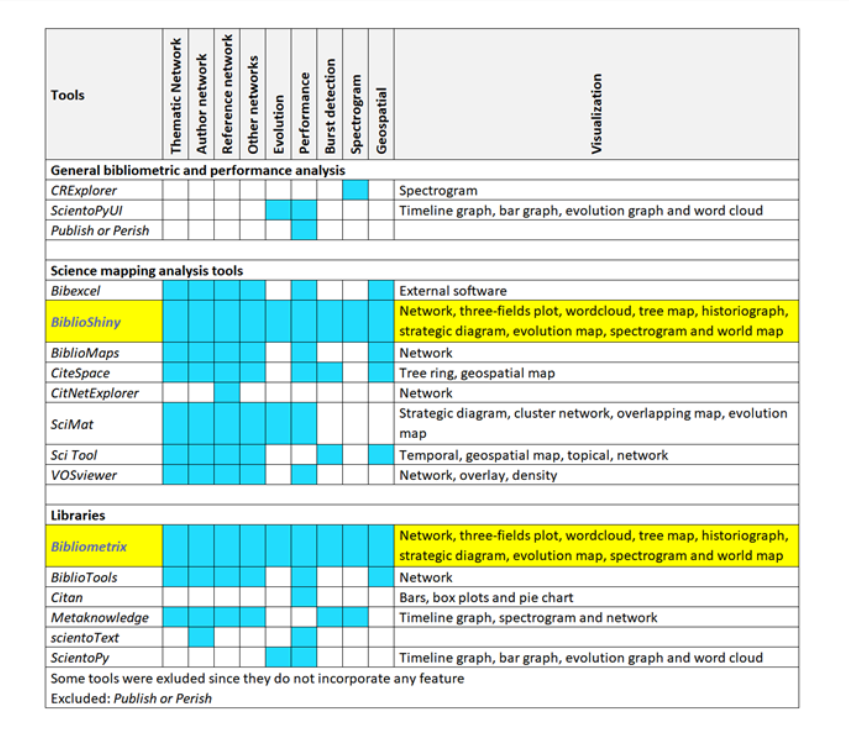
    A quick survey of the literature suggested the following were the most popular:

    • VOSviewer (our Research Radar piece)
    • Harzing’s Publish or Perish (our Research Radar piece)
    • CiteSpace
    • Bibliometrix/BiblioShiny

    The first three were no surprise to me, as they have been around for over a decade. For example, VOSviewer was launched in 2009, Harzing’s Publish or Perish launched in 2006 and Citespace has been around since 2003! There are many other bibliometric tools of course, but these three tools are not only free but have had a track record of been constantly updated with new features such as the ability to accept new sources of bibliometric data beyond Web of Science and Scopus. This probably explains their popularity.

    While other tools both free and commercial like Science of Science (Sci2) Tool, SciMAT and BibExcel exist but based on our analysis currently the fourth most popular tool is a relatively new tool, Bibliometrix , developed by Massimo Aria and Corrado Cuccurullo in 2017.

    Why is this tool so popular? In summary, compared to most other bibliometric tools, it provides a full suite of statistical techniques and visualisations (it is particularly strong in providing dynamic visualisations that show change across time) that you can use whether you are doing performance analysis or trying to determine the conceptual, intellectual or social structure of the field. This enables it to provide a full package for science mapping or bibliometric reviews.

    Being available as an R package and a Shiny app, it provides the flexibility that a coder can benefit from and yet has the option of supporting non-coders who want the user-friendliness of a graphical interface.

    Mostly importantly, Bibliometrix seems to be designed with the “end in mind”. Instead of just exposing dozens of possible bibliometric techniques and visualisations and letting the user decide how to use them, the interface Biblioshiny, groups these techniques under sections like “Conceptual structure”, “Intellectual structure” guiding the user to the appropriate techniques depending on what the user is trying to do.

    Setting up and running Bibliometrix and Biblioshiny

    Unlike VOSviewer, Citespace or Harzing’s Publish or Perish, Bibliometrix is made available as an open-source R package.

    By using the various functions from the Bibliometrix package, you will be able to carry out essential tasks needed for bibliometric analysis, from importing data into bibliographic data frames, running analysis and plot visualisations based on techniques like cocitation analysis.

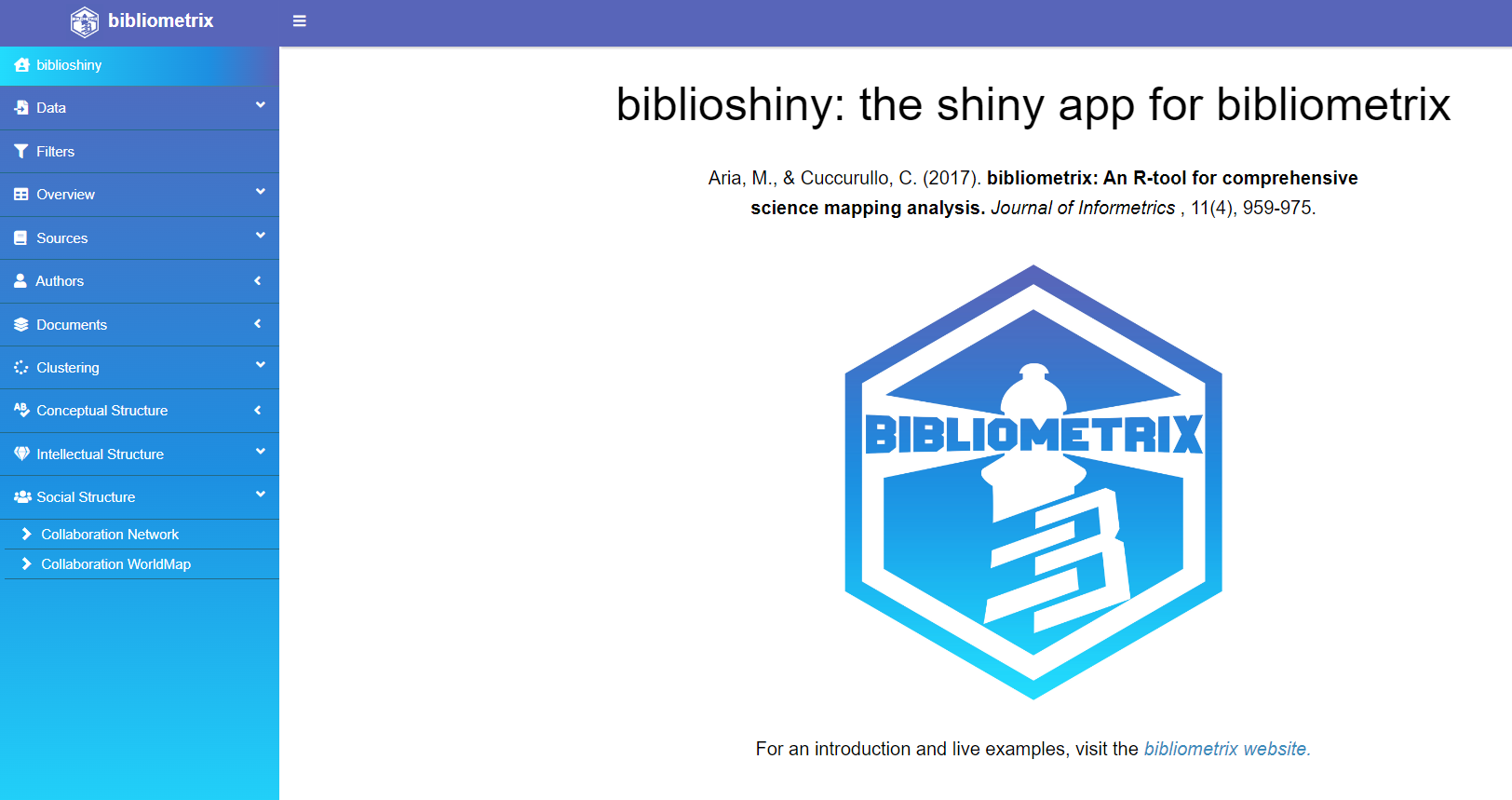
    Not comfortable with R? Use the Biblioshiny app, which will give you an easy to use the web interface to carry out almost all the functions available in Bibliometrix without coding. This makes it equivalent in experience to using VOSviewer, Citespace etc.

    The steps to run Biblioshiny are relatively simple, though you do have to install R on your machine. As always if you have problems with this, do approach me for assistance.

    NA

    Features of Biblioshiny

    According to the 2017 paper introducing the tool, Biblioshiny was designed to not only provide a complete suite of functions to support comprehensive bibliometric analysis but also supports a recommended workflow (with a template) for performing bibliometric studies.

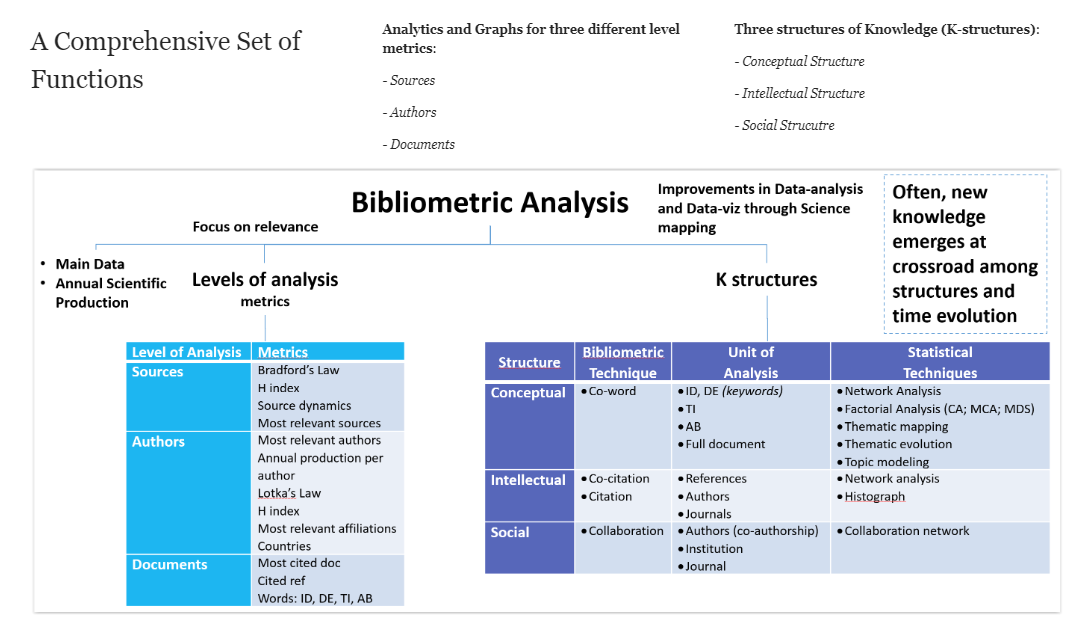
    The screenshot below provides an overview of the functions and types of analysis that Biblioshiny supports.

    Biblioshiny's functions include analytics and graphs for three different level metrics, namely Sources, Authors and Documents and three structures of knowledge - conceptual structure, intellectual structure and social structure.

    Compared to most other bibliometric tools out there, this tool does indeed provide a more comprehensive suite of statistical techniques and visualisations.

    NA
    https://www.bibliometrix.org/home/index.php/blog/129-from-bad-to-good-bibliometric-studies

    For example, compared to VOSviewer, this tool provides better support for impact performance analysis at multiple levels of analysis (sources, authors, documents) with a wider variety of visualisations. While a lot of these are simple line graphs or tables, this is still something you will not get out of VOSviewer, requiring the use of an additional visualisation tool.

    NA
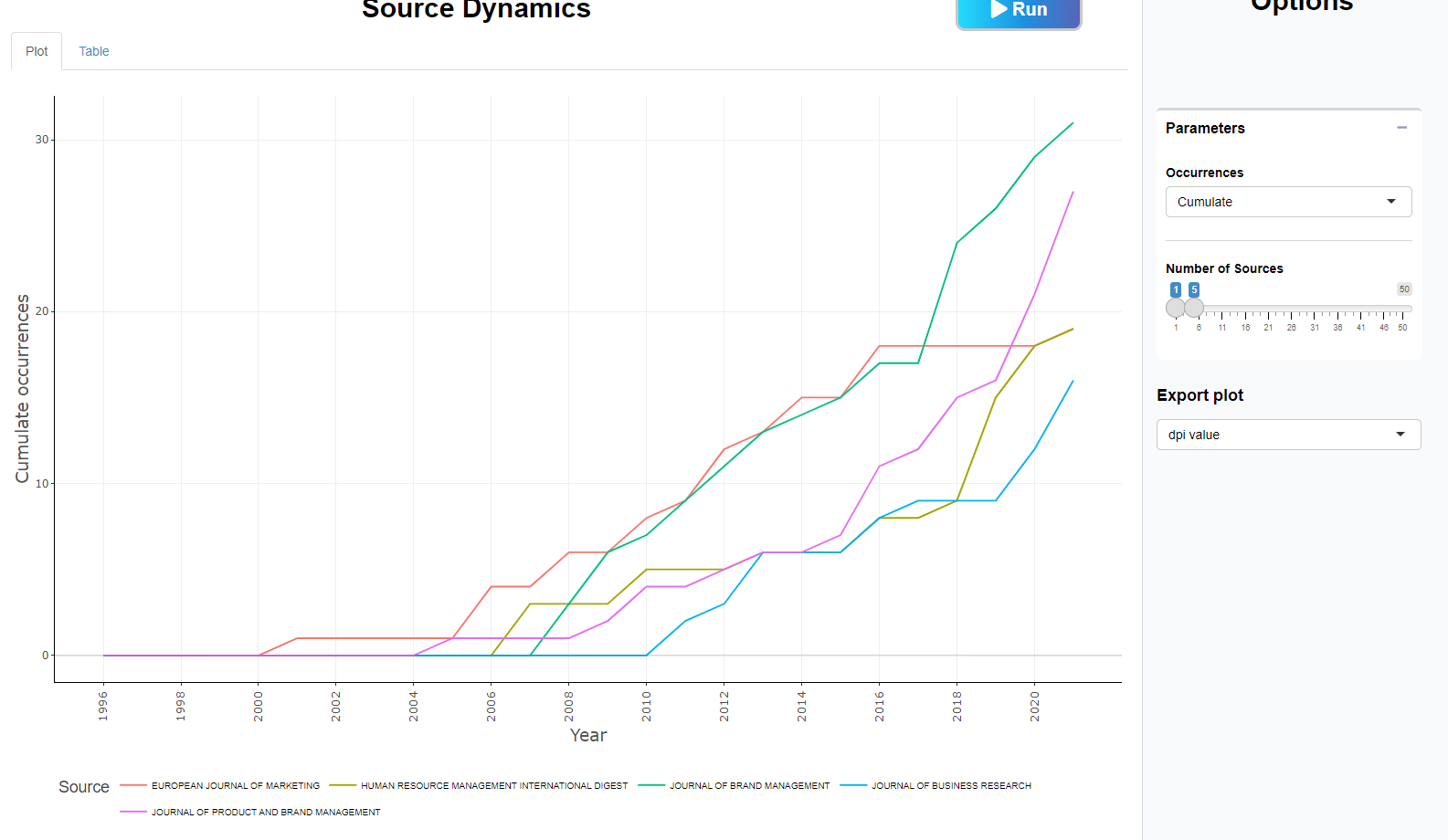
    Line graph showing cumulative frequency of sources/journals

    Moreover, unlike VOSviewer, it provides a wide variety of visualisations and techniques beyond just network graphs/maps.

    NA
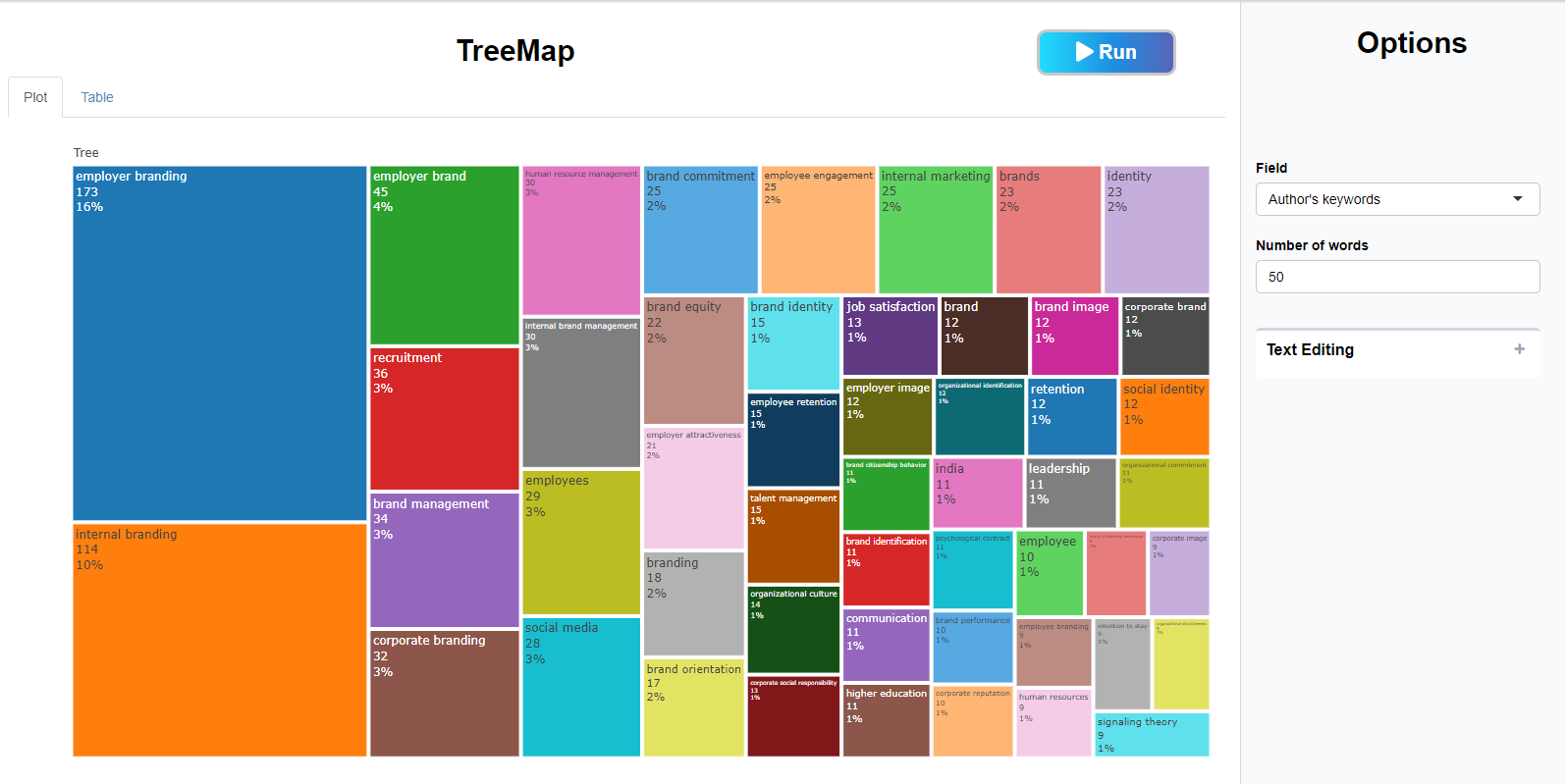
    Treemap visualisation of author keywords

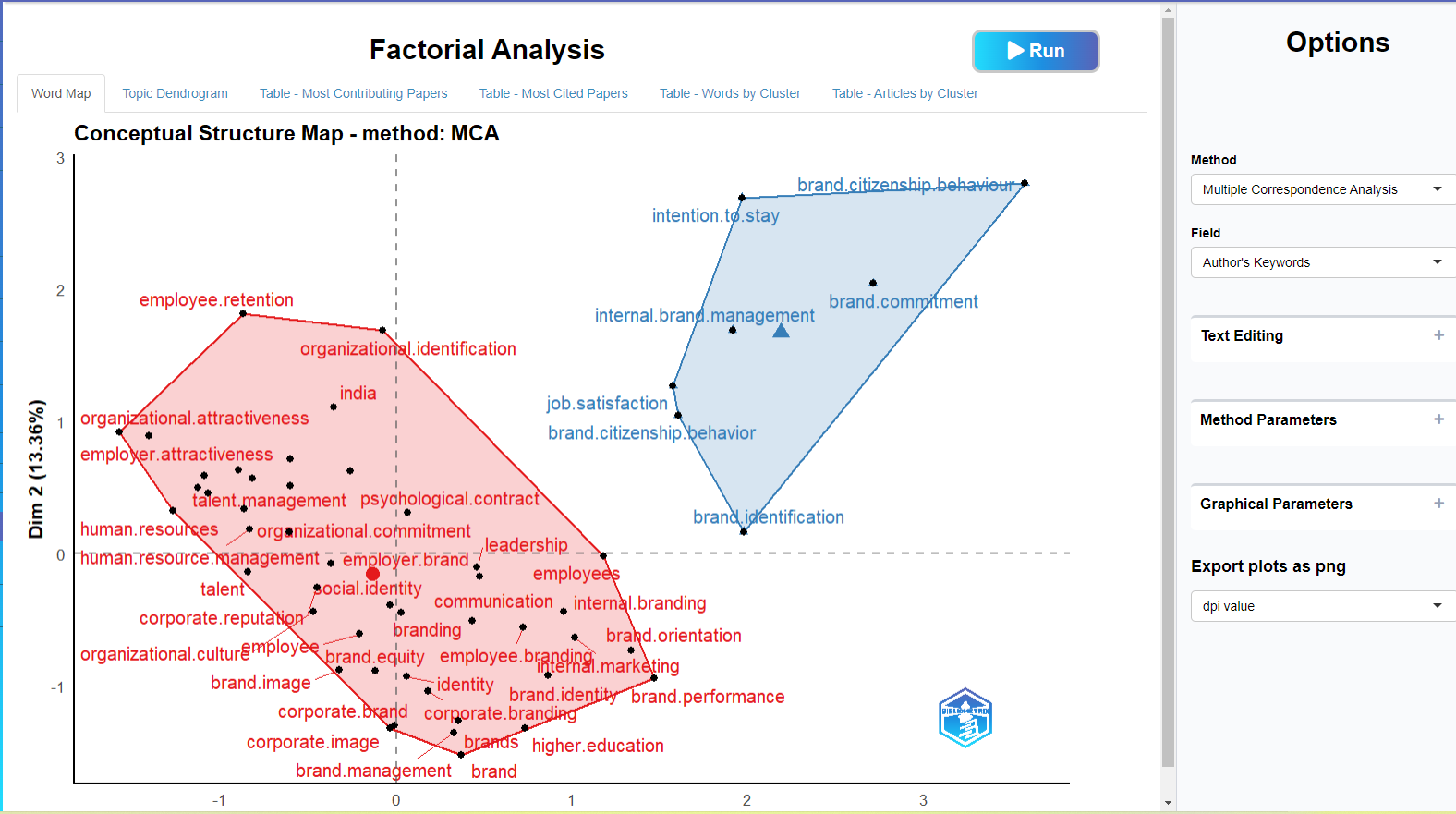
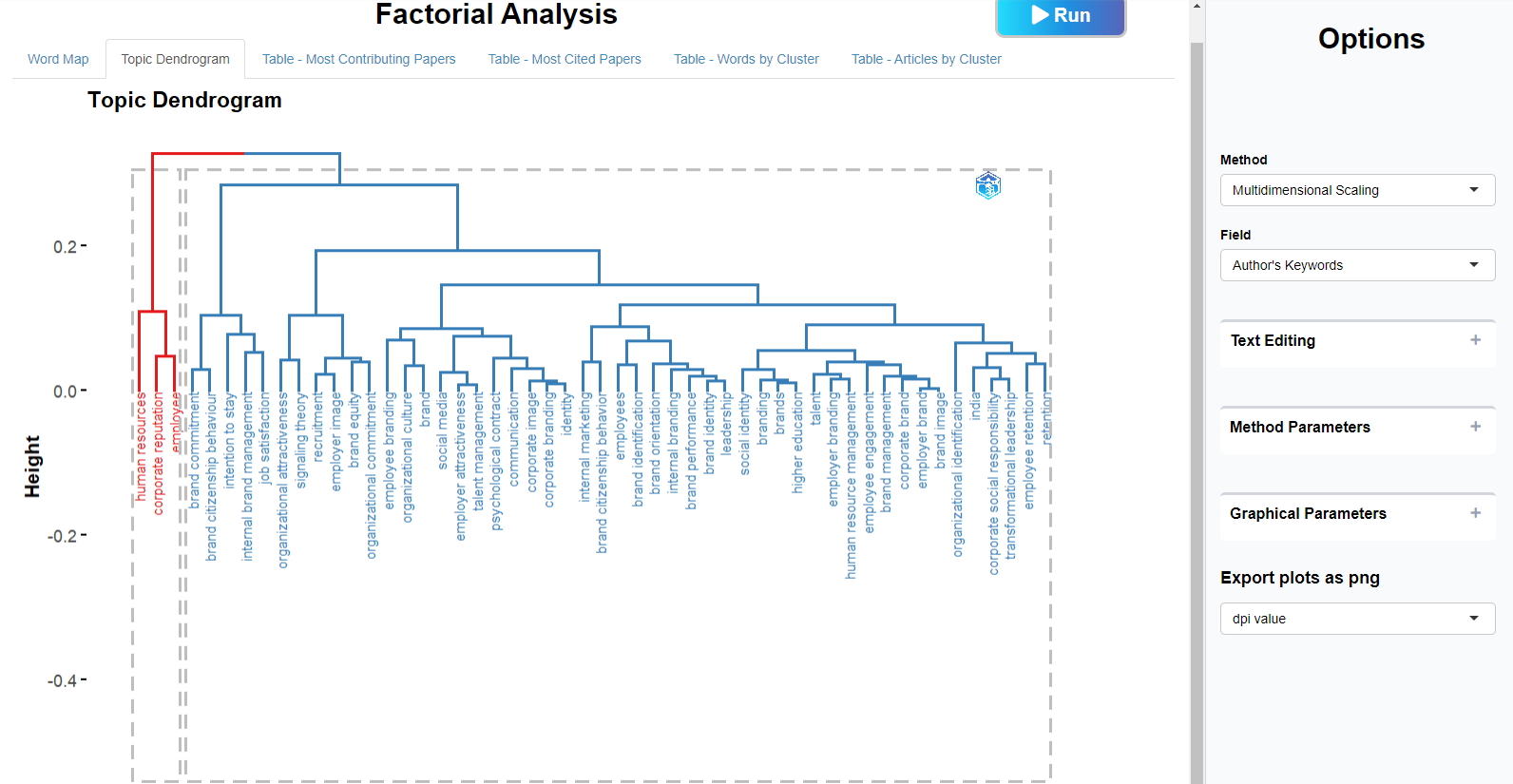
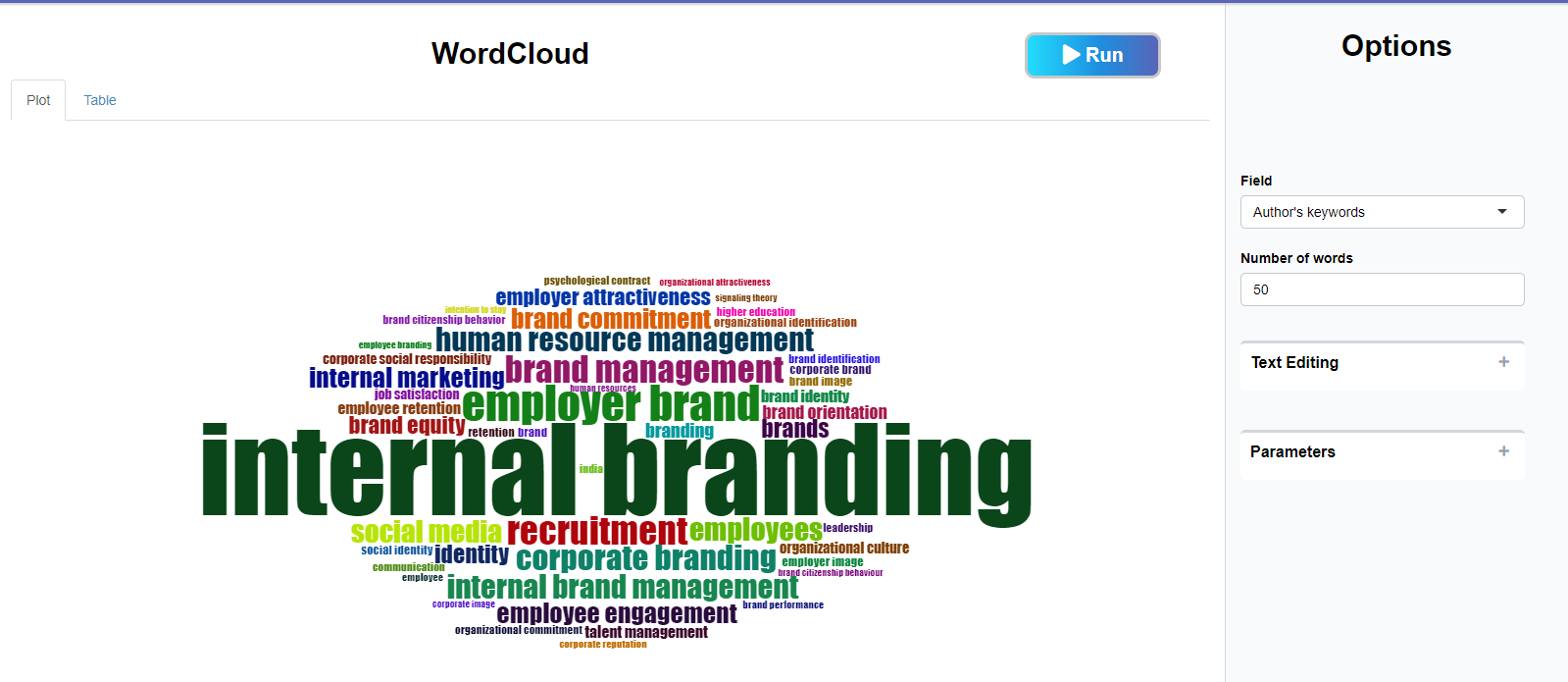
    Indeed, the types of visualisations you can do with this tool are impressive, beyond network graphs, it can generate tree maps, line graphs, word clouds, historiography, world maps, dendrograms and more.

    NA
    Clustering of Author keywords using Multiple Correspondence Analysis
    NA
    Topic Dendrogram of Author keywords
    NA
    Word Cloud of Author keywords

    Two statistical/visualisation features stand out for me. I was impressed to see it features techniques that support the relatively new Reference Publication Year Spectroscopy (RPYS) used to detect the historical roots of fields (the technique used to be available only via a specialised tool – CRExplorer).

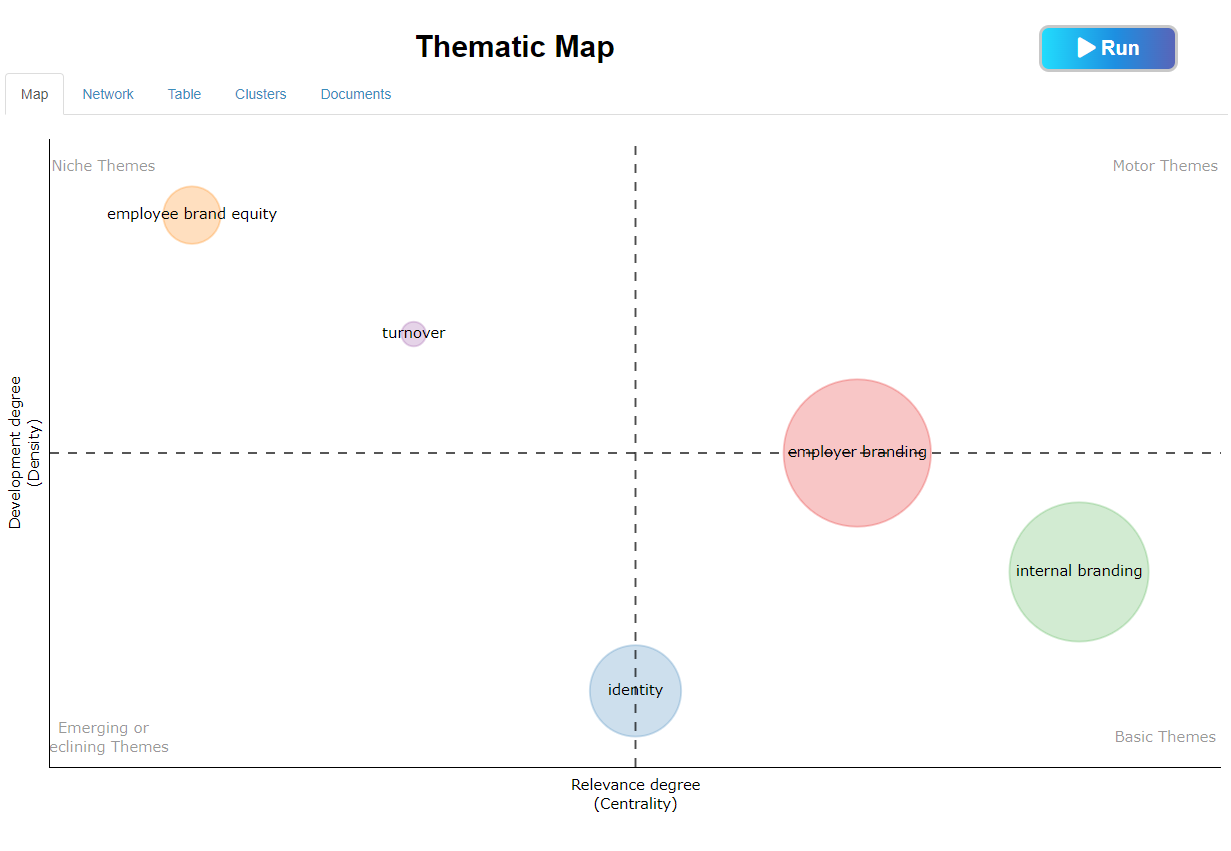
    It also supports the visualisation of thematic maps, which allows you to identify clusters along two clusters of centrality and density. This allows you to classify clusters in terms of the level of development (density of connections within clusters) and importance (Centrality measure of the cluster). This Technique is inspired by the proposal in “An approach for detecting, quantifying, and visualising the evolution of a research field: A practical application to the Fuzzy Sets Theory field”.

    This I suspect is one of the reasons why it is particularly popular in the business and management area.

    NA
    Sample Thematic Map

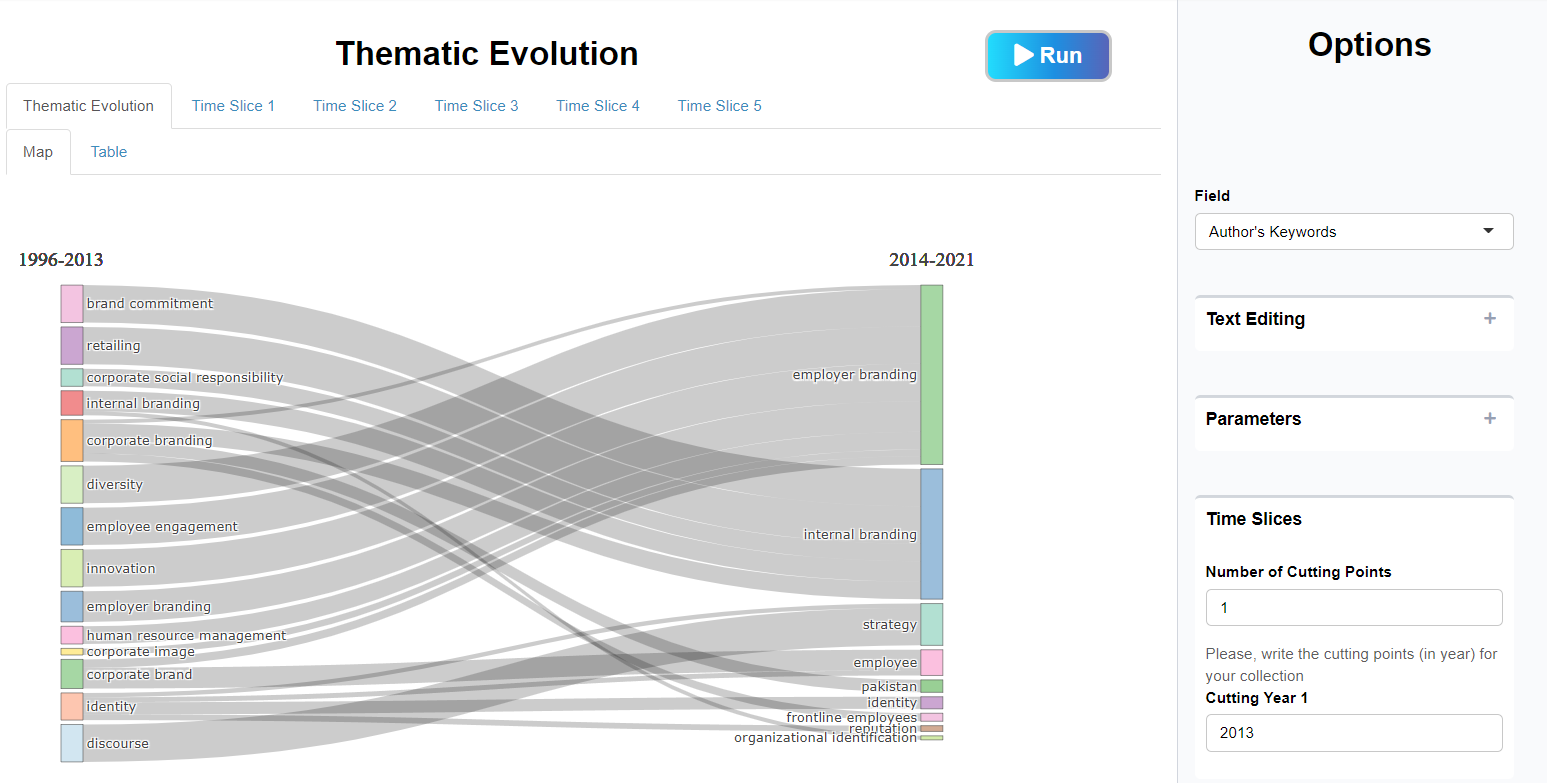
    In addition, you are not just limited to a static analysis of the themes, it also allows you to do a temporal analysis of the evolution of themes by choosing time slices (this is also a feature available in CiteSpace but not VOSviewer).

    NA
    Thematic Evolution of Keywords across 2 time slices 1996-2013 and 2014-2021

    Pros of Biblioshiny

    • Unlike tools like VOSviewer which generally specialise in a few visualisation types (in particular network graphs), this tool covers the whole spectrum of statistical techniques and visualisations.
    • Compared to VOSviewer and many other tools that present mostly static visualisations, Bibliometrix offers a variety of ways to do temporal or longitudinal analysis. Some examples include:
      • Simple line graphs to show changes in frequency
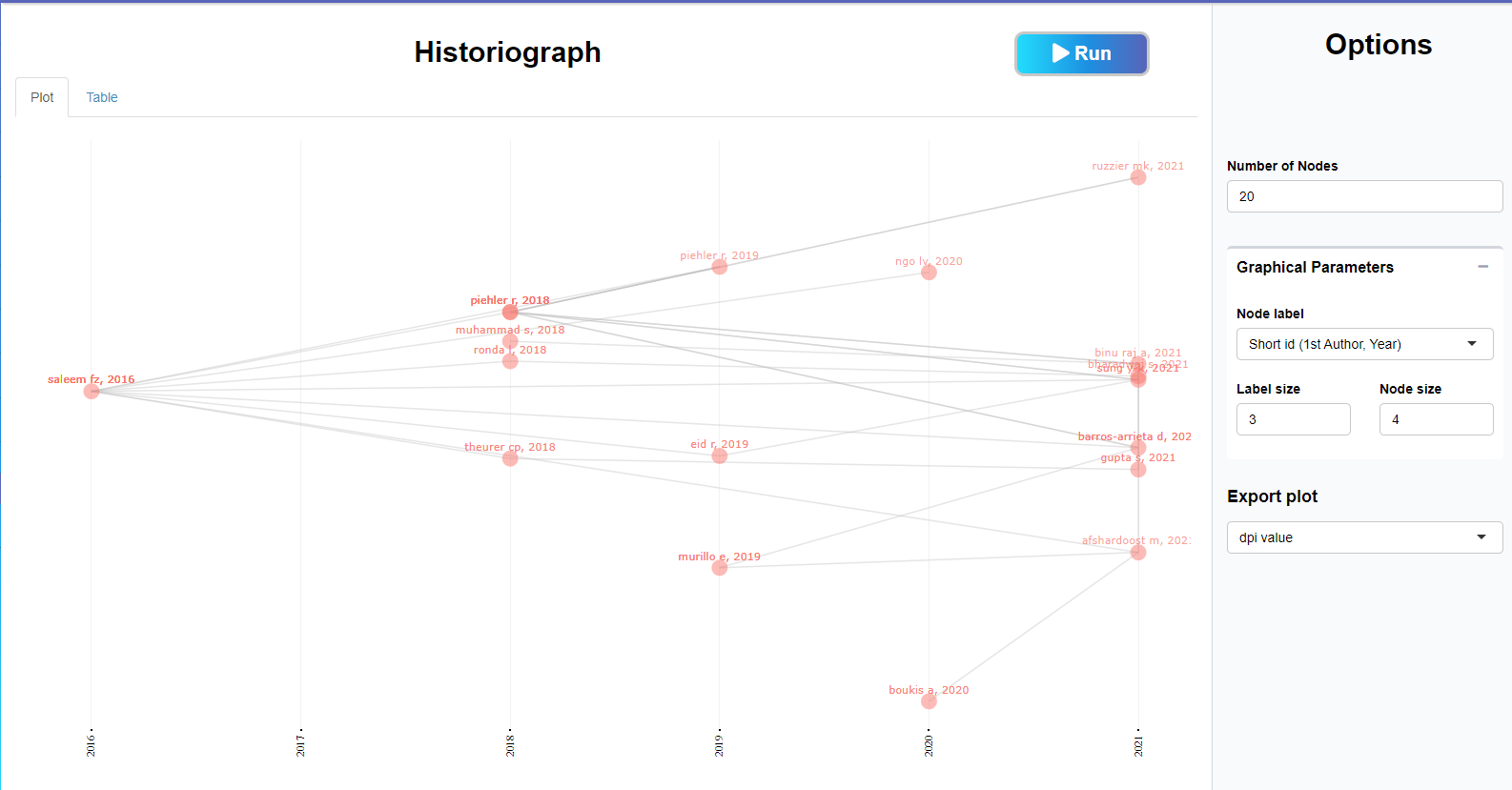
      • Historiograph visualisation
      • Thematic Map evolution
      • Reference Publication Year Spectroscopy
    NA
    Histriograph visualisation - a chronological network map of most relevant direct citations resulting from a bibliographic collection.
    • Lastly, beyond all the features, Biblioshiny uniquely provides a good framework on how to use these features. Most bibliometric analysis tools simply expose all the possible options (e.g., Co-citation analysis, Co-author analysis, Bibliometric coupling, Co-occurrence analysis etc) without guidance on how these analysis can be used. Biblioshiny instead categorises each technique based on purpose. For example, co-occurrence analysis of words or dimension reduction techniques are usually used to study the conceptual structure (what is talked about – themes etc), while co-citation analysis is used for studying intellectual structure (how different works influence each other) and analysis of collaborations is used for social structure (which authors, institutions, countries work with each other). For each one, the tool will suggest appropriate techniques you can try! This is of great help to the user who is not an expert in bibliometric analysis. They even have a recommended template report you can use!
    NA
    Types of analysis recommended depending on whether you are trying to study the Conceptual, Intellectual or Social Structure of a field.
    NA
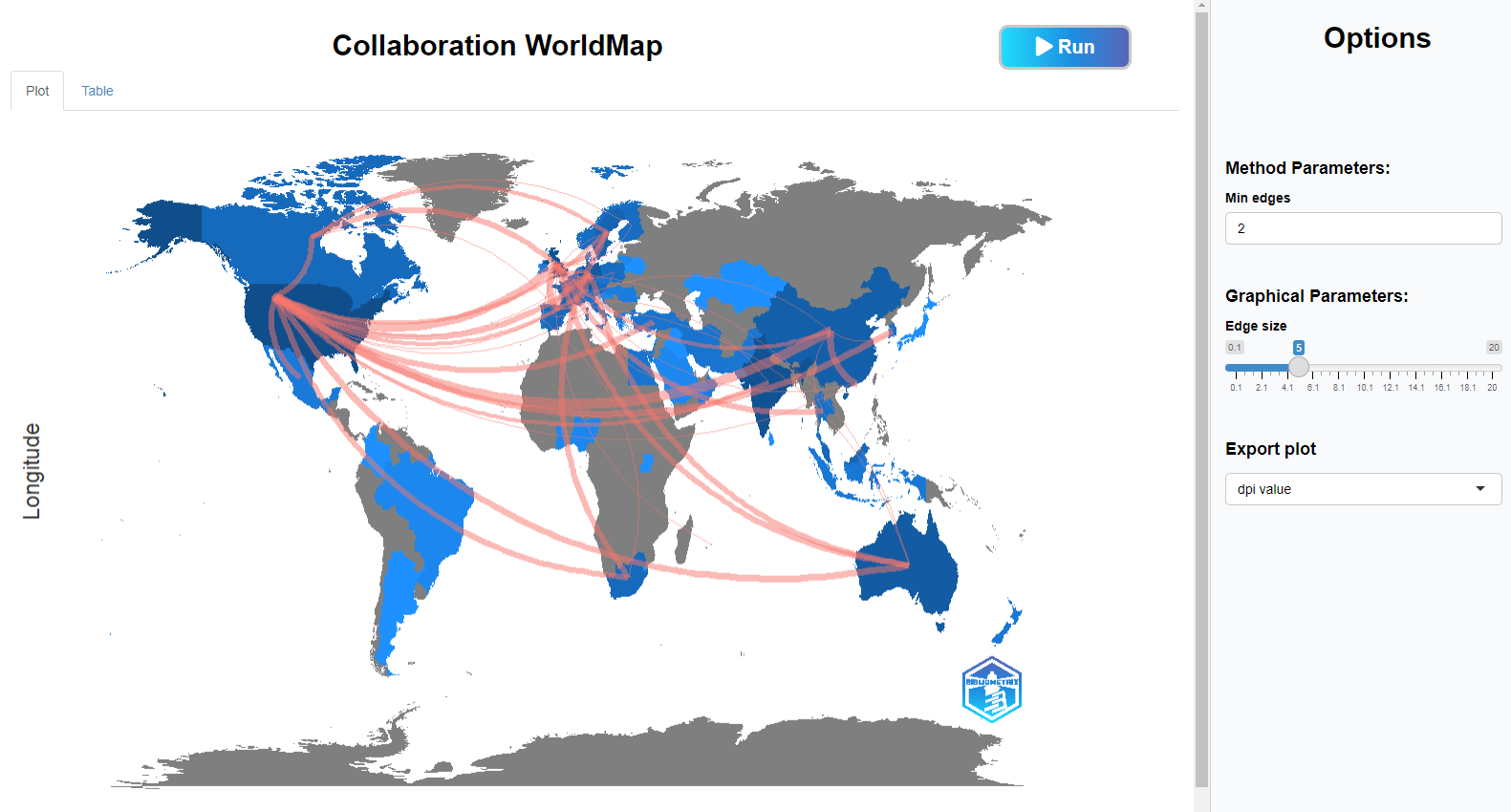
    Collaboration map visualisation

    Cons of of Biblioshiny

    • Requires R install which might be daunting if you have not used R
    • This tool provides support to a reasonable number of sources from the traditional Web of Science, Scopus to the up-and-coming Dimensions, Pubmed and the lesser known Lens.org. You can even use APIs for select sources like Dimensions, Pubmed, Scopus either directly via API or R packages. Still, VOSviewer, CiteSpace, Publish or Perish support still more sources currently.

    Conclusion

    Bibliometrix and its accompanying shiny app Biblioshiny aims to be “A full package for Science Mapping Workflow” and I believe it has indeed accomplished this. I highly recommend it as one of the tools to be considered when doing science mapping or bibliometric reviews.

    Related Articles

    • An approach for detecting, quantifying, and visualizing the evolution of a research field: A practical application to the Fuzzy Sets Theory field
    • bibliometrix: An R-tool for comprehensive science mapping analysis
    • Harzing’s Publish or Perish 8.0
    • Employer and internal branding research: a bibliometric analysis of 25 years
    • Using VOSviewer as a bibliometric mapping or analysis tool in Business, Management & accounting

    Posted by Nader Ale Ebrahim at 20:03 No comments:
    Email ThisBlogThis!Share to XShare to FacebookShare to Pinterest
    Labels: Bibliometrics, Nader Ale Ebrahim, Research Impact, Research Tools, Research Visibility
    Newer Posts Older Posts Home
    View mobile version
    Subscribe to: Posts (Atom)

    Search This Blog

    About Me

    My photo
    Nader Ale Ebrahim
    Nader Ale Ebrahim currently works as a “Research Visibility and Impact” freelancer consultant. Nader is also an adjunct lecturer at Alzahra University. He was working as a visiting research fellow with Institute of Management and Research Services (IPPP), University of Malaya from 2013 to November 2017. Nader holds a PhD in Technology Management from the Faculty of Engineering, University of Malaya. He has over 25 years of experience in the field of technology management and new product development in different companies. His current research interests are University rankings, Open access, Research visibility, Research Tools, and Bibliometrics.
    View my complete profile

    ORCID

    ORCID iD iconorcid.org/0000-0001-7091-4439

    Impact Analysis NADER ALE EBRAHIM

    Subscribe To "Research Tools"

    Posts
    Atom
    Posts
    All Comments
    Atom
    All Comments

    Translate

    @aleebrahim

    Tweets by @aleebrahim

    Nader Ale Ebrahim Publications on SCOPUS

    Research Tools Mind Map

    Research Tools Mind Map
    Research Tools

    Blog Archive

    • ▼  2025 (13)
      • ▼  August (2)
        • AI-Based Strategies to Enhance the Visibility and ...
        • Exploring Different Tactics to Increase Research V...
      • ►  June (1)
      • ►  May (3)
      • ►  April (1)
      • ►  February (4)
      • ►  January (2)
    • ►  2024 (25)
      • ►  December (1)
      • ►  November (4)
      • ►  October (1)
      • ►  June (1)
      • ►  May (5)
      • ►  April (6)
      • ►  March (2)
      • ►  February (4)
      • ►  January (1)
    • ►  2023 (157)
      • ►  December (4)
      • ►  November (2)
      • ►  October (7)
      • ►  September (8)
      • ►  August (4)
      • ►  July (6)
      • ►  June (7)
      • ►  May (17)
      • ►  April (18)
      • ►  March (19)
      • ►  February (18)
      • ►  January (47)
    • ►  2022 (250)
      • ►  December (18)
      • ►  November (45)
      • ►  October (50)
      • ►  September (10)
      • ►  August (18)
      • ►  July (13)
      • ►  June (15)
      • ►  May (33)
      • ►  April (10)
      • ►  March (27)
      • ►  February (7)
      • ►  January (4)
    • ►  2021 (107)
      • ►  December (20)
      • ►  November (22)
      • ►  October (2)
      • ►  September (5)
      • ►  August (18)
      • ►  July (16)
      • ►  June (8)
      • ►  May (2)
      • ►  April (5)
      • ►  March (3)
      • ►  February (1)
      • ►  January (5)
    • ►  2020 (63)
      • ►  December (4)
      • ►  November (3)
      • ►  October (7)
      • ►  August (22)
      • ►  July (5)
      • ►  June (6)
      • ►  May (3)
      • ►  April (4)
      • ►  March (2)
      • ►  January (7)
    • ►  2019 (227)
      • ►  December (14)
      • ►  November (9)
      • ►  October (12)
      • ►  September (13)
      • ►  August (23)
      • ►  July (28)
      • ►  June (30)
      • ►  May (2)
      • ►  April (4)
      • ►  March (9)
      • ►  February (18)
      • ►  January (65)
    • ►  2018 (22)
      • ►  December (21)
      • ►  January (1)
    • ►  2017 (325)
      • ►  November (5)
      • ►  October (25)
      • ►  September (23)
      • ►  August (10)
      • ►  July (5)
      • ►  June (33)
      • ►  May (55)
      • ►  April (41)
      • ►  March (24)
      • ►  February (26)
      • ►  January (78)
    • ►  2016 (503)
      • ►  December (75)
      • ►  November (45)
      • ►  October (49)
      • ►  September (41)
      • ►  August (27)
      • ►  July (36)
      • ►  June (20)
      • ►  May (42)
      • ►  April (23)
      • ►  March (37)
      • ►  February (51)
      • ►  January (57)
    • ►  2015 (486)
      • ►  December (50)
      • ►  November (44)
      • ►  October (41)
      • ►  September (31)
      • ►  August (24)
      • ►  July (20)
      • ►  June (52)
      • ►  May (67)
      • ►  April (41)
      • ►  March (48)
      • ►  February (55)
      • ►  January (13)
    • ►  2014 (105)
      • ►  December (14)
      • ►  November (9)
      • ►  October (5)
      • ►  September (6)
      • ►  August (8)
      • ►  July (3)
      • ►  June (9)
      • ►  May (8)
      • ►  April (7)
      • ►  March (15)
      • ►  February (10)
      • ►  January (11)
    • ►  2013 (26)
      • ►  December (26)

    Tweets by Nader Ale Ebrahim (@aleebrahim)

    Tweets by @aleebrahim

    SSRN Author: Nader Ale Ebrahim

    Loading...

    linking to SCOOP.IT profile

    Nader Kred Score

    Google Scholar Blog

    Loading...

    Visibility and Citation Impact

    Visibility and Citation Impact by Nader Ale Ebrahim

    Research Tools Box | Scoop.it

    Loading...

    Nader Ale Ebrahim's academic activities and relevant topics

    Loading...

    Citation to A comparison between ...

    Loading...

    Nader Ale Ebrahim in SCOPUS

    Loading...

    Cited " Effective strategies"

    Loading...

    Nader Ale Ebrahim

    Loading...

    Popular Posts

    • Beall's List of Predatory Journals and Publishers
      Source: https://beallslist.weebly.com/ Beall's List of Predatory Journals and Publishers ...
    • Copyright Checking and Pre-print / Post-print Preparations
      Copyright Checking and Pre-print / Post-print Preparations Copyright Checking and Pre-print / Post-print Preparations 16.03.2017, 13:21 ...
    • New Articles about Research Visibility, Impact and Evaluation
      Source: https://libraryguides.helsinki.fi/researchvisibility New Articles about Research Visibility, Impact and Evaluation ...
    • Writing the Results, Discussion and Conclusion chapters | Cecile Badenhorst
      Source: https://cecilebadenhorst.wordpress.com/carnegie-african-diaspora-workshops/writing-the-results-discussion-and-conclusion-chapters/ ...
    • 10 Chrome extensions to help manage references, notes, citations and capture information.
       Source: http://blogs.lse.ac.uk/impactofsocialsciences/2015/05/22/10-chrome-extensions-to-manage-references-notes-citations-and-capture-info...
    • IEEE - Search Engine Optimization (SEO) for IEEE Sites
      Source: https://www.ieee.org/about/webteam/resources/search_optimization.html Search engine optimization (SEO) is the act of modify...
    • Review of ResearchGate : Pros and cons and recommendations – Open Research Exeter
       Source: http://blogs.exeter.ac.uk/openresearchexeter/2013/11/06/74/ Review of ResearchGate : Pros and cons and recommendations Tags: ...
    • Starting an Open Access Journal: a step-by-step guide part 1 to 5 | Dr. Martin Paul Eve
       Source: 1- https://www.martineve.com/2012/07/10/starting-an-open-access-journal-a-step-by-step-guide-part-1/ 2- https://www.martineve....
    • Bad Titles Hurt Good Papers - IHS Academic
      Source: http://www.theihs.org/academic/2012/05/31/bad-titles-hurt-good-papers/ Bad Titles Hurt Good Papers By: Bi...
    • Research Preparation: Things to do Before Starting Library Research Projects
       Source: http://web.calstatela.edu/library/guides/rprep.htm Research Preparation Things to do Before Starting Library Research Projects ...

    Nader Ale Ebrahim's academic activities and relevant topics

    Loading...

    CiteSeerX Documents: Dr. Nader Ale Ebrahim

    Loading...

    Popular Posts (All time)

    • Beall's List of Predatory Journals and Publishers
      Source: https://beallslist.weebly.com/ Beall's List of Predatory Journals and Publishers ...
    • Copyright Checking and Pre-print / Post-print Preparations
      Copyright Checking and Pre-print / Post-print Preparations Copyright Checking and Pre-print / Post-print Preparations 16.03.2017, 13:21 ...
    • New Articles about Research Visibility, Impact and Evaluation
      Source: https://libraryguides.helsinki.fi/researchvisibility New Articles about Research Visibility, Impact and Evaluation ...
    • Writing the Results, Discussion and Conclusion chapters | Cecile Badenhorst
      Source: https://cecilebadenhorst.wordpress.com/carnegie-african-diaspora-workshops/writing-the-results-discussion-and-conclusion-chapters/ ...
    • 10 Chrome extensions to help manage references, notes, citations and capture information.
       Source: http://blogs.lse.ac.uk/impactofsocialsciences/2015/05/22/10-chrome-extensions-to-manage-references-notes-citations-and-capture-info...
    • IEEE - Search Engine Optimization (SEO) for IEEE Sites
      Source: https://www.ieee.org/about/webteam/resources/search_optimization.html Search engine optimization (SEO) is the act of modify...
    • Review of ResearchGate : Pros and cons and recommendations – Open Research Exeter
       Source: http://blogs.exeter.ac.uk/openresearchexeter/2013/11/06/74/ Review of ResearchGate : Pros and cons and recommendations Tags: ...
    • Starting an Open Access Journal: a step-by-step guide part 1 to 5 | Dr. Martin Paul Eve
       Source: 1- https://www.martineve.com/2012/07/10/starting-an-open-access-journal-a-step-by-step-guide-part-1/ 2- https://www.martineve....
    • Bad Titles Hurt Good Papers - IHS Academic
      Source: http://www.theihs.org/academic/2012/05/31/bad-titles-hurt-good-papers/ Bad Titles Hurt Good Papers By: Bi...
    • Research Preparation: Things to do Before Starting Library Research Projects
       Source: http://web.calstatela.edu/library/guides/rprep.htm Research Preparation Things to do Before Starting Library Research Projects ...

    Popular Posts (Last 30 days)

    • What are 'altmetrics'?
       Source: https://library.cranfield.ac.uk/mirc/research/altmetrics Altmetrics ...
    • AI-Based Strategies to Enhance the Visibility and Impact of Scientific Outputs – Part 2
       Source: https://doi.org/10.6084/m9.figshare.29833229.v1    
    • Enhance Research Visibility by Tracking Citations
      Enhance Research Visibility by Tracking Citations 31.05.2016, 15:42 (GMT) by Nader Ale Ebrahim Congratulation, you published a paper.  ...
    • IEEE - Search Engine Optimization (SEO) for IEEE Sites
      Source: https://www.ieee.org/about/webteam/resources/search_optimization.html Search engine optimization (SEO) is the act of modify...
    • The top 50 science stars of Twitter | Science | AAAS
       Source: http://www.sciencemag.org/news/2014/09/top-50-science-stars-twitte r Share on facebook 135 Share on twitter   Share on reddit   ...
    • Publishing Fast and Slow: A Review of Publishing Speed in the Last Decade
       Source: https://scholarlykitchen.sspnet.org/2022/11/08/guest-post-publishing-fast-and-slow-a-review-of-publishing-speed-in-the-last-decade/...
    • Writing for a Nature journal
      Source: https://www.nature.com/authors/author_resources/how_write.html How to write a paper Writing for a Nature journal Bef...
    • AI-Based Strategies to Enhance the Visibility and Impact of Scientific Outputs – Part 1
        🚀 AI-Based Strategies to Boost Research Visibility – Part 1 Released by Nader Ale Ebrahim (2025) In today’s data-saturated academic env...
    • Discover when your work is discussed & shared online - Raising Your Scholarly Profile - LibGuides at Duquesne University
       Source: http://guides.library.duq.edu/scholarlyprofile/7DICDay5 Discover when your work is discussed & shared online Okay, so you’re ...
    • Using Search Engine Optimization (SEO) for research publications | The Orb
       Source: h ttp://www.open.ac.uk/blogs/the_orb/?p=1243 Research Data: Working with Social Media Getting to grips with RDM → Usin...

    Popular Posts (Last 7 Days)

    • Benefits of Digital Repositories
      Source: h ttps://qcc.libguides.com/c.php?g=301716&p=2019401 Academic Works: Your Institutional Repository: Benefits of Digit...
    • Cranfield University Blogs | An open science checklist - Cranfield University Blogs
       Source: https://blogs.cranfield.ac.uk/is/library/open-science-checklist An open science checklist ...
    • 10 Chrome extensions to help manage references, notes, citations and capture information.
       Source: http://blogs.lse.ac.uk/impactofsocialsciences/2015/05/22/10-chrome-extensions-to-manage-references-notes-citations-and-capture-info...
    • Publishing Fast and Slow: A Review of Publishing Speed in the Last Decade
       Source: https://scholarlykitchen.sspnet.org/2022/11/08/guest-post-publishing-fast-and-slow-a-review-of-publishing-speed-in-the-last-decade/...
    • AI-Based Strategies to Enhance the Visibility and Impact of Scientific Outputs – Part 2
       Source: https://doi.org/10.6084/m9.figshare.29833229.v1    
    • Writing for a Nature journal
      Source: https://www.nature.com/authors/author_resources/how_write.html How to write a paper Writing for a Nature journal Bef...
    • Review of ResearchGate : Pros and cons and recommendations – Open Research Exeter
       Source: http://blogs.exeter.ac.uk/openresearchexeter/2013/11/06/74/ Review of ResearchGate : Pros and cons and recommendations Tags: ...
    • Sharing Output and Tracking Impact | Digital Curation Centre
       Source: http://www.dcc.ac.uk/resources/external/tools-services/sharing-output-and-tracking-impac t haring Output and Tracking Impact ...
    • Digital tools for researchers | Connected Researchers
       Source: http://connectedresearchers.com/online-tools-for-researchers/ Digital tools for researchers Find out how digital tools ca...
    • Bibliometric Analysis and Visualization of Academic Procrastination
       Source: https://www.frontiersin.org/articles/10.3389/fpsyg.2021.722332/full R...

    CITATIONS BLOGS

    Loading...

    ScienceGate | Blog

    Loading...

    Kate Lindsay Blogs-Teaching in Digital Spaces

    Loading...

    A-cademic news

    Loading...

    Dr Asma Jabeen

    Loading...

    The Academic Designer

    Loading...

    drmarkgriffiths

    Loading...

    University Ranking Watch

    Loading...

    The Graduate Institute Library Blog

    Loading...

    Library & Learning Services

    Loading...

    Musings about librarianship

    Loading...

    World Ranking Guide

    Loading...

    University Ranking Watch

    Loading...

    BASE: Results for Nader Ale Ebrahim

    Loading...

    Musings about librarianship

    Loading...

    Musings about librarianship

    Loading...

    Research Tools Workshop Photos

    Research Tools

    Improve Citations Workshops Photo

    Improve Citations

    Latest publications

    Loading...

    Nader Ale Ebrahim Profile on PlumX

    Nader Ale Ebrahim Profile on PlumX

    Introduction to the “Research Tools”

    Google Scholar Blog

    Loading...

    CWTS

    Loading...

    Webometric Thoughts

    Loading...

    GlobalHigherEd

    Loading...

    Introduction to Webometrics

    Loading...

    Productive Scholar

    Loading...

    Things You Should Know.....

    Loading...

    BodWiser

    Loading...

    Academic Visibility

    Loading...

    Research Information

    Loading...

    How to publish in journals

    Loading...

    Getting your paper noticed

    Elsevier Connect

    Loading...

    University of Queensland Library UQ Library Guides: Getting Published

    Loading...

    Science Publication Network

    Loading...

    The Scientist Videographer

    Loading...

    Impact of Social Sciences

    Loading...

    Retraction Watch

    Loading...

    Open Science

    Loading...

    Kudos News

    Loading...

    Scholastica Blog

    Loading...

    InfoDoc MicroVeille

    Loading...

    APA Style Blog

    Loading...

    Impactstory blog

    Loading...

    Bodleian iSkills blog

    Loading...

    Open Access News

    Loading...

    WisBlawg

    Loading...

    Press Releases

    Loading...

    ScienceOpen Blog

    Loading...

    Comments on Reference Management Software

    Loading...

    openingscience.org

    Loading...

    Open Access @ CUNY

    Loading...

    Popular Posts

    • Beall's List of Predatory Journals and Publishers
      Source: https://beallslist.weebly.com/ Beall's List of Predatory Journals and Publishers ...
    • Copyright Checking and Pre-print / Post-print Preparations
      Copyright Checking and Pre-print / Post-print Preparations Copyright Checking and Pre-print / Post-print Preparations 16.03.2017, 13:21 ...
    • New Articles about Research Visibility, Impact and Evaluation
      Source: https://libraryguides.helsinki.fi/researchvisibility New Articles about Research Visibility, Impact and Evaluation ...
    • Writing the Results, Discussion and Conclusion chapters | Cecile Badenhorst
      Source: https://cecilebadenhorst.wordpress.com/carnegie-african-diaspora-workshops/writing-the-results-discussion-and-conclusion-chapters/ ...
    • 10 Chrome extensions to help manage references, notes, citations and capture information.
       Source: http://blogs.lse.ac.uk/impactofsocialsciences/2015/05/22/10-chrome-extensions-to-manage-references-notes-citations-and-capture-info...
    • IEEE - Search Engine Optimization (SEO) for IEEE Sites
      Source: https://www.ieee.org/about/webteam/resources/search_optimization.html Search engine optimization (SEO) is the act of modify...
    • Review of ResearchGate : Pros and cons and recommendations – Open Research Exeter
       Source: http://blogs.exeter.ac.uk/openresearchexeter/2013/11/06/74/ Review of ResearchGate : Pros and cons and recommendations Tags: ...
    • Starting an Open Access Journal: a step-by-step guide part 1 to 5 | Dr. Martin Paul Eve
       Source: 1- https://www.martineve.com/2012/07/10/starting-an-open-access-journal-a-step-by-step-guide-part-1/ 2- https://www.martineve....
    • Bad Titles Hurt Good Papers - IHS Academic
      Source: http://www.theihs.org/academic/2012/05/31/bad-titles-hurt-good-papers/ Bad Titles Hurt Good Papers By: Bi...
    • Research Preparation: Things to do Before Starting Library Research Projects
       Source: http://web.calstatela.edu/library/guides/rprep.htm Research Preparation Things to do Before Starting Library Research Projects ...

    AUNILO

    Loading...

    Connected Researchers

    Loading...

    LIASA Higher Education Libraries Interest Group

    Loading...

    Plum Analytics - Tell the Story.

    Loading...

    Open Access News

    Loading...

    ScienceDirect Search: Top cited paper

    Loading...

    The SSRN Blog | The SSRN Blog

    Loading...

    The Sociological Imagination

    Loading...

    Scientific American Blog Posts

    Loading...

    Newsletter SciELO in Perspective (EN) Archive Feed

    Loading...

    Repository of the Academy's Library:

    Loading...

    Research Support Hub

    Loading...

    Exchanges

    Loading...

    Wiley Asia Blog

    Loading...

    Cited reference searching

    Loading...

    smartsciencecareer blog

    Loading...

    The Thesis Whisperer

    Loading...

    Academic Visibility

    Loading...

    Academic Evolution

    Loading...

    BodWiser

    Loading...

    Michael Habib | Product Manager and Librarian | Nudging Serendipity

    Loading...

    Pinboard (pigsonthewing)

    Loading...

    Scholarship 2.0: An Idea Whose Time Has Come

    Loading...

    Science in the Open

    Loading...

    Webometric Thoughts

    Loading...

    White Rose Research Online

    Loading...

    Research Trends

    Loading...

    Substantia Mea

    Loading...

    Sciencebite

    Loading...

    BioMed Central blog

    Loading...

    smartsciencecareer blog

    Loading...

    BioMed Central blog

    Loading...

    Research Trends

    Loading...

    QS Intelligence Unit

    Loading...

    The Plainspoken Scientist

    Loading...

    Exchanges

    Loading...

    Altmetric.com

    Loading...

    TIB|Blog

    Loading...

    How to publish in journals

    Loading...

    ThinkWrite Blog » citations

    Loading...

    HighWire

    Loading...

    Exchanges

    Loading...

    Google Scholar Digest

    Loading...

    Popular Posts

    • Benefits of Digital Repositories
      Source: h ttps://qcc.libguides.com/c.php?g=301716&p=2019401 Academic Works: Your Institutional Repository: Benefits of Digit...
    • Cranfield University Blogs | An open science checklist - Cranfield University Blogs
       Source: https://blogs.cranfield.ac.uk/is/library/open-science-checklist An open science checklist ...
    • 10 Chrome extensions to help manage references, notes, citations and capture information.
       Source: http://blogs.lse.ac.uk/impactofsocialsciences/2015/05/22/10-chrome-extensions-to-manage-references-notes-citations-and-capture-info...
    • Publishing Fast and Slow: A Review of Publishing Speed in the Last Decade
       Source: https://scholarlykitchen.sspnet.org/2022/11/08/guest-post-publishing-fast-and-slow-a-review-of-publishing-speed-in-the-last-decade/...
    • AI-Based Strategies to Enhance the Visibility and Impact of Scientific Outputs – Part 2
       Source: https://doi.org/10.6084/m9.figshare.29833229.v1    
    • Writing for a Nature journal
      Source: https://www.nature.com/authors/author_resources/how_write.html How to write a paper Writing for a Nature journal Bef...
    • Review of ResearchGate : Pros and cons and recommendations – Open Research Exeter
       Source: http://blogs.exeter.ac.uk/openresearchexeter/2013/11/06/74/ Review of ResearchGate : Pros and cons and recommendations Tags: ...
    • Sharing Output and Tracking Impact | Digital Curation Centre
       Source: http://www.dcc.ac.uk/resources/external/tools-services/sharing-output-and-tracking-impac t haring Output and Tracking Impact ...
    • Digital tools for researchers | Connected Researchers
       Source: http://connectedresearchers.com/online-tools-for-researchers/ Digital tools for researchers Find out how digital tools ca...
    • Bibliometric Analysis and Visualization of Academic Procrastination
       Source: https://www.frontiersin.org/articles/10.3389/fpsyg.2021.722332/full R...

    Dr. Nader Ale Ebrahim's Publications on SCOPUS

    Loading...

    Science and the Web

    Loading...

    The SSRN Blog

    Loading...

    JOURNALS CLUB & CO.

    Loading...

    Teachers Mobile Technology

    Loading...

    Postgrad Blog

    Loading...

    The Research Whisperer

    Loading...

    Impactstory blog

    Loading...

    Altmetric.com

    Loading...

    Wiley Asia Blog

    Loading...

    Article RSS Feed | Elsevier Library Connect

    Loading...

    Text and Academic Authors Association Blog

    Loading...

    The Comics Grid (Blog)

    Loading...

    DiRT News

    Loading...

    Kudos News

    Loading...

    Scopus

    Loading...

    Publishing blog

    Loading...

    Scopus - BrightTALK

    Loading...

    Walt at Random

    Loading...

    A librarian abroad

    Loading...

    University Ranking Watch

    Loading...

    ResearchImpact

    Loading...

    The Writing Reader

    Loading...

    SciTechSociety

    Loading...

    Publication Stages – Enago Academy

    Loading...

    Open Research Exeter

    Loading...

    Google Scholar Blog

    Loading...

    News feed

    Loading...

    Research Visibility and Impact

    Loading...

    Nader Ale Ebrahim @ Twitter

    Tweets by aleebrahim

    Global Academy Jobs Blog

    Loading...

    Australasian Open Access Strategy Group

    Loading...

    Blog on Crossref

    Loading...

    University Ranking Watch

    Loading...

    Prof Hacker - Blogs - The Chronicle of Higher Education

    Loading...

    Compound Interest

    Loading...

    Total Pageviews

    Subscribe To

    Posts
    Atom
    Posts
    All Comments
    Atom
    All Comments
    Simple theme. Powered by Blogger.