Saturday, 4 December 2021

Ways to Increase Your Research Visibility

 Source: https://en.library.ipm.edu.mo/research-tips-16

Research Tips 16: Ways to Increase Your Research Visibility
Tuesday, August 03, 2021 Research Tips 16

Nowadays, promoting research activities are increasingly important in researchers’ work. By making your research more visible you could potentially open up future collaboration / job / publication opportunities, increase citations to your work and increase the number of people finding, reading and building on your work. Thus, increasing your own reputation and chances of success in your academic work.

Here are some tips you can improve the visibility and impact of your research activity.

Get an ORCID

An ORCID is a persistent digital identifier that distinguishes you from every other researcher. Having a unique identifier ensures that the bibliometric data about you and your body of work is accurate and correctly linked to your researcher profile. Once you register an ORCID iD, you can add your personal identifiers (for example Scopus Author ID, WoS ResearcherID) to your ORCID record. ORCID also improves the visibility of the research. (Read more…)

ORCID training video

Promote Your Research at Conferences

Conferences are a great opportunity to promote yourself and your research. You can take the opportunity to meet other researchers and start to develop your research network even if you aren’t presenting your work. Remember to take hard copies of your papers and circulate at conferences.

Use Social Media

Share your publications using social networking tools such as Mendeley, ResearchGate, Academia, Twitter, Slideshare, blogs, etc.

Create an Online Presence

Utilizing tools such as ORCID iD, Scopus Author ID, ResearcherID, Google Scholar Profile, or LinkedIn and link to your profile on institution webpages, vitae to increase your online visibility on the Internet.

Create Your Personal Email Signature

Your personal email signature can provide a serious marketing opportunity to promote your research. It is easily to create your own professional email signature with free Email Signature Generators, including:

Email SignaturesFreelancingGigCocoSign

Further Reading

Developing a plan for communicating your research

 Source: http://blogs.sun.ac.za/libraryresearchnews/category/research-visibility/

Developing a plan for communicating your research

The following steps might be a good way to improve your online visibility as a researcher and assist you with communicating about your research:

  1.  Create and maintain online profiles (e.g. Google Scholar, ResearchGate, Academia).
  2.  Use persistent identifiers (e.g. ORCID, Researcher ID in Publons, DOIs) to disambiguate yourself as an author or to link to your work.
  3.  Publish in Open Access journals or choose Open Access options.
  4.  Use Creative Commons licenses for your work for re-use.
  5.  Self-archive pre- or post-prints to institutional repositories (SUNScholar).
  6.  Publish your data to data repositories (SUNScholarData).
  7.  Make social media engagement about your research a regular habit (LinkedIn, Facebook, Twitter)
  8.  Engage your audience in meaningful conversations about the topics that you are interested in.
  9.  Connect with other researchers by means of academic network tools (ResearchGate, Mendeley, etc)
  10.  Appeal to various audiences via multiple publication types (academic articles, news items, blog posts, magazine articles)

It will be important to check in on your goals often, at least once in six months, or when you have published a new article.

Get help:
Marié Roux
Faculty Librarians
Research Commons Librarians

Sources:
Library guide: Research Impact & Scholarly Profiles, University of California, Berkeley Library
Library guide: The Research Process: Improve your impact, Stellenbosch University 

Increase your visibility as a researcher

“Thanks to the internet, we all have our Gutenberg presses and the privileges they accord. For academic institutions, the internet is a largely untapped resource for shaping and sharing scholarly research.”  This quote by Amanda Alampi (in an article in the Guardian) highlight the transformative influence of social media and the internet, which allows researchers “to reach new audiences that previously couldn’t be accessed”.

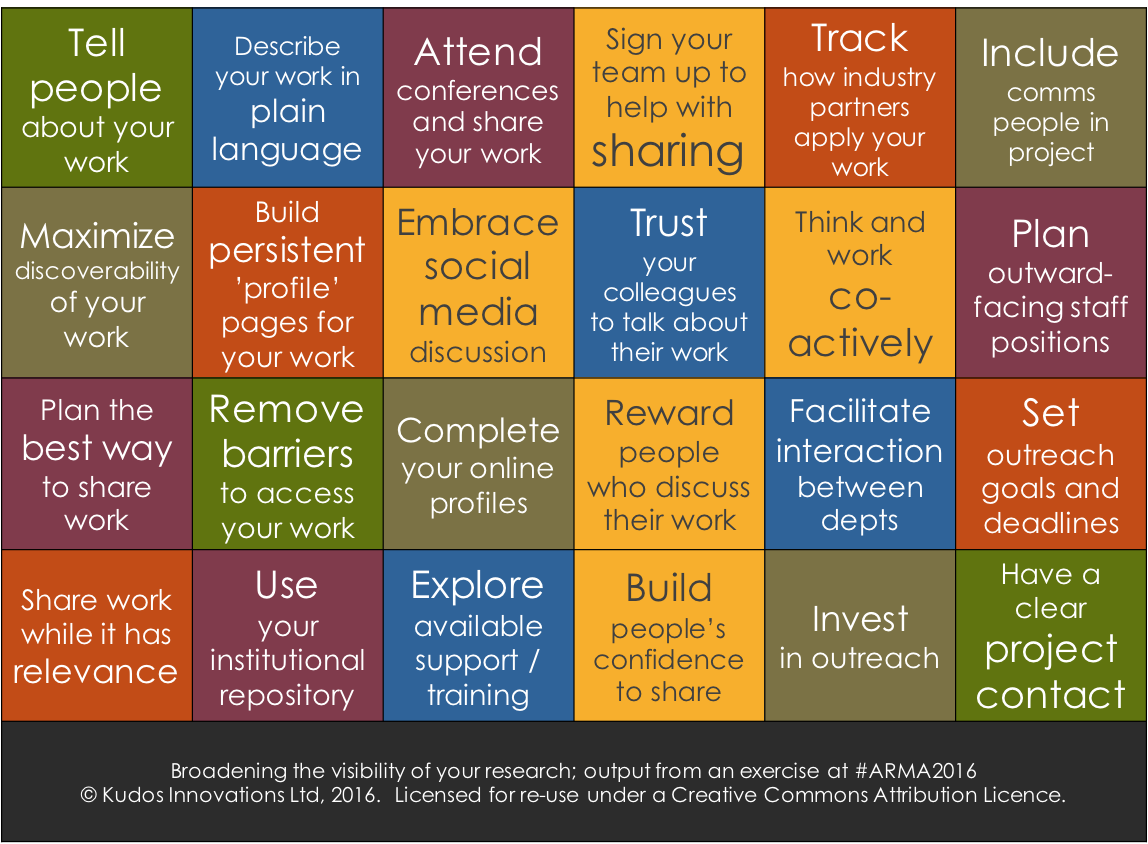
A great tool to assist you in using researcher profiles and social media to share your research to a wider audience is this “peddle pad” created by the La Trobe Graduate Research School.

Next week the Library will present two ONLINE WORKSHOPS on how to increase your visibility as a researcher (follow the links to register):

Increase the visibility of your research (Tuesday 21 April, 14:00-16:00)

Learn the following:

  • Find and navigate social research networks (ResearchGate, Academia.edu, Mendeley, etc.)
  • Develop research profiles
  • Understand how to increase your visibility as researcher
  • Understand the role of science communication and social media

Enhancing the visibility of your research output through self-archiving (Thursday 23 April, 12:30-13:30)

Learn the following:

  • Understand the purpose of the University’s policy on the self-archiving of research output
  • Learn about the benefits of self-archiving as a means of green open access
  • Better understand publishers’ policies regarding self-archiving
  • Learn about the different versions of research output suitable for self-archiving
  • Learn about the different options of self-archiving research output

You are welcome to contact your librarians if you need any assistance on these topics:

Faculty Librarians / Research Impact Services / Digital Scholarship (self-archiving)

Developing your digital researcher profile

This video might be helpful in developing your digital research profile. It’s been published by the Open Science MOOC.

Think of this as a way of creating an online CV for showcasing your research. It teaches four tools:

1. ORCID – A persistent identifier for you and your research.

2. ImpactStory – A place to document how your research has been shared and re-used online.

3. Publons – A place to document your peer review activities.

4. Open Science Framework – A place to openly collaborate on your research.

The Library can also assist with this and a few other tools to develop your digital online presence. Attend the workshop Increase your online research visibility on 8 May to find out more or contact the librarians at the Research Commons.

Subscribe to Blog via Email

Enter your email address to subscribe to this blog and receive notifications of new posts by email.

Join 51 other subscribers


Increasing Visibility & Impact

 Source: https://www.utwente.nl/en/service-portal/university-library/research-impact/increasing-visibility-impact

Increasing Visibility & Impact

Bookmark this page
Remove bookmark

To improve your academic and societal impact as a researcher, visibility of your work and a deliberate strategy with regard to publishing and grant applications are key. Below, you will find advice and links to relevant services and sources. 

  • Making your work more visible

    By making your research visible and accessible your it is more likely to be noticed and used, thus increasing your own reputation and chances of success in your academic work. A selection of tools and activities is presented below:

    1. Get a unique author identifier
    Getting an ORCID iD helps to distinguish yourself and your work from that of other researchers. It is a widely used author identifier, recognized by publishers, funding organizations and research institutions. To learn more about ORCID iD please visit this page.

    2. Share your research output
    Making your work (e.g. publications, posters, research data, code, video) openly available to others increases your visibility. Many public funders require that publications, as well as underlying data, are made available to the public. Besides publishing your work via for example Open Access or hybrid journals, you can make closed publications openly available after six months, through the universities’ repositories. For more information please visit this page. For more information making available data sets, please visit this page. After publication, update the academic platforms you use and share the news via these platforms, social networks or for example as a by-line in your email signature.

    3. Create and maintain online profiles
    Personal or institutional webpages can be used to highlight your accomplishments and fields of expertise. Various platforms allow you to list your research outputs and provide visitors with information about usage and impact of your work. Suggested platforms on an author level are University of Twente Research Information, ORCID, and Google Scholar. It is important to maintain the profiles that you choose to create, so that the information is correct and up to date. Besides personal pages, your research unit’s webpage could help to increase your visibility and impact. Clear responsibilities within your research unit or institute can help to keep this web page up to date, findable and easily accessible for others. For technical questions regarding the University of Twente website (e.g. editing rights, requesting new pages) please contact Marketing & Communication via onlinemedia@utwente.nl.

    4. Engage in academic social networks
    Besides showcasing your research output some academic/professional platforms function as a social network. Suggested social networks are LinkedIn, ResearchGate, Academia and Mendeley. Again, it is important to at least provide correct and up-to-date information on created profiles. In the case of these social networks, interacting with other users of the platform will increase your visibility and serve as proof of your commitment and expertise in the field.

    5. Blogs, Tweets  & more
    Research findings can be shared in various forms and degrees of complexity, depending on the audience and the purpose of communicating. ‘Non-traditional’ ways of communicating your research are often not required by any standard or procedure, so the choice is very much up to you. Determining the goal of your communication activities (e.g. raising awareness among broad audience, receiving feedback from certain communities, educating children) and personal strengths (e.g. writing, talking, visualizing, video editing) will help you find the means of communication that positively attribute to your visibility and impact. To highlight news via the University of Twente communication channels, reach out to the Marketing & Communication staff of your faculty.

  • Refining your publication strategy

    When selecting journals for publication of your research findings, a number of factors come into play. The list below is an adaptation of a list that is part of the ‘Research Handbook’ published by Karlstad University.   

    • Authorship: If you collaborate with other researchers, decide early on who should be listed as authors or contributors to your work. Check the publication outlet’s guidelines for authorship. Some journals demand very detailed accounts on authors and contributors, make sure you can comply with them. 
    • Publication type: Should you opt for writing a book, book chapters, journal articles, conference papers, or a mix of these? The answer to this depends on the nature of your project, and funder requirements. It is easy to promise a funder ‘too much’ when writing a grant application, remember that you have to deliver on your promises. 
    • Aims and scopes of the journal/publisher: Can you deliver what the publisher wants? Do not hesitate to ask the publisher whether your idea for a paper suits the journal. Do not waste time writing up research in a way that does not meet the requirements of the publication channel and the funder. 
    • Complying with submission guidelines: Many articles are rejected because authors have not followed submission guidelines. Read them thoroughly, and double-check before submission.
    • Submission to publishing time: Publishing is often a slow process. Check the estimated publishing time with publisher
    • Rejection rate: Many prestigious research outlets have long turn-around and high rejection rates. Account for this in your publication strategy. Also, rejection is normal, plan for it. It is a good idea to make a ranking list of publication outlets, so you have a Plan B.
    • Trustworthiness of publisher: Sadly, there are many publishers trying to profit from researchers by luring them with short publishing times and fast peer-review. As a general rule, serious publishers will not contact you by e-mail.
    • Language: While many disciplines disseminate research mainly in English, sometimes it can be a good idea to use other languages to communicate with the particular stakeholders you want to reach.
    • Indexing: Will your research be published in outlets indexed by major databases such as Web of Science or Scopus? Indexing can be of importance for funders, for bibliometric purposes, and for gaining visibility for your research.
    • Publication model: Open access or traditional journal? How important is it for you to keep your copyright and the ability to freely disseminate your research? Do your financers request open access? Even when you don’t publish open access, you can still open up your closed publications afterwards. For more information, visit this page. 
  • Improving your grant applications

    Communicating the impact of your work in grant applications helps to increase your chances of getting research funding. There is more to impact than metrics such as citation count and h-index. Moreover, funders such as NWO no longer allow bibliometrics in grant applications. Impact sections will require you to think about impact goals, beneficiaries (organizations, groups, sectors, etc.) and pathways that ensure the impact goals will affect the potential beneficiaries positively. The Grants Office provides strategic advice and support on developing a grant proposal, applying for different funding programmes and managing granted projects. For more information, please visit this page.

  • Training & Support

    A course on how to increase the visibility and impact of your work is provided by the University Library for PhD candidates. For more information and enrollment, please visit this page. Support activities regarding grant applications are facilitated by the Grants Office, and can be found via this page.


How to Improve Research Visibility and Impact: Session 8, Citation tracking

 Source: https://doi.org/10.6084/m9.figshare.17125526.v1

#researchtools  #researchimpact #researchvisibility #openaccess #rankings #universityrankings


Wednesday, 1 December 2021

Increasing Visibility & Impact

 Source: https://www.utwente.nl/en/service-portal/university-library/research-impact/increasing-visibility-impact

Increasing Visibility & Impact

Bookmark this page
Remove bookmark

To improve your academic and societal impact as a researcher, visibility of your work and a deliberate strategy with regard to publishing and grant applications are key. Below, you will find advice and links to relevant services and sources. 

  • Making your work more visible

    By making your research visible and accessible your it is more likely to be noticed and used, thus increasing your own reputation and chances of success in your academic work. A selection of tools and activities is presented below:

    1. Get a unique author identifier
    Getting an ORCID iD helps to distinguish yourself and your work from that of other researchers. It is a widely used author identifier, recognized by publishers, funding organizations and research institutions. To learn more about ORCID iD please visit this page.

    2. Share your research output
    Making your work (e.g. publications, posters, research data, code, video) openly available to others increases your visibility. Many public funders require that publications, as well as underlying data, are made available to the public. Besides publishing your work via for example Open Access or hybrid journals, you can make closed publications openly available after six months, through the universities’ repositories. For more information please visit this page. For more information making available data sets, please visit this page. After publication, update the academic platforms you use and share the news via these platforms, social networks or for example as a by-line in your email signature.

    3. Create and maintain online profiles
    Personal or institutional webpages can be used to highlight your accomplishments and fields of expertise. Various platforms allow you to list your research outputs and provide visitors with information about usage and impact of your work. Suggested platforms on an author level are University of Twente Research Information, ORCID, and Google Scholar. It is important to maintain the profiles that you choose to create, so that the information is correct and up to date. Besides personal pages, your research unit’s webpage could help to increase your visibility and impact. Clear responsibilities within your research unit or institute can help to keep this web page up to date, findable and easily accessible for others. For technical questions regarding the University of Twente website (e.g. editing rights, requesting new pages) please contact Marketing & Communication via onlinemedia@utwente.nl.

    4. Engage in academic social networks
    Besides showcasing your research output some academic/professional platforms function as a social network. Suggested social networks are LinkedIn, ResearchGate, Academia and Mendeley. Again, it is important to at least provide correct and up-to-date information on created profiles. In the case of these social networks, interacting with other users of the platform will increase your visibility and serve as proof of your commitment and expertise in the field.

    5. Blogs, Tweets  & more
    Research findings can be shared in various forms and degrees of complexity, depending on the audience and the purpose of communicating. ‘Non-traditional’ ways of communicating your research are often not required by any standard or procedure, so the choice is very much up to you. Determining the goal of your communication activities (e.g. raising awareness among broad audience, receiving feedback from certain communities, educating children) and personal strengths (e.g. writing, talking, visualizing, video editing) will help you find the means of communication that positively attribute to your visibility and impact. To highlight news via the University of Twente communication channels, reach out to the Marketing & Communication staff of your faculty.

  • Refining your publication strategy

    When selecting journals for publication of your research findings, a number of factors come into play. The list below is an adaptation of a list that is part of the ‘Research Handbook’ published by Karlstad University.   

    • Authorship: If you collaborate with other researchers, decide early on who should be listed as authors or contributors to your work. Check the publication outlet’s guidelines for authorship. Some journals demand very detailed accounts on authors and contributors, make sure you can comply with them. 
    • Publication type: Should you opt for writing a book, book chapters, journal articles, conference papers, or a mix of these? The answer to this depends on the nature of your project, and funder requirements. It is easy to promise a funder ‘too much’ when writing a grant application, remember that you have to deliver on your promises. 
    • Aims and scopes of the journal/publisher: Can you deliver what the publisher wants? Do not hesitate to ask the publisher whether your idea for a paper suits the journal. Do not waste time writing up research in a way that does not meet the requirements of the publication channel and the funder. 
    • Complying with submission guidelines: Many articles are rejected because authors have not followed submission guidelines. Read them thoroughly, and double-check before submission.
    • Submission to publishing time: Publishing is often a slow process. Check the estimated publishing time with publisher
    • Rejection rate: Many prestigious research outlets have long turn-around and high rejection rates. Account for this in your publication strategy. Also, rejection is normal, plan for it. It is a good idea to make a ranking list of publication outlets, so you have a Plan B.
    • Trustworthiness of publisher: Sadly, there are many publishers trying to profit from researchers by luring them with short publishing times and fast peer-review. As a general rule, serious publishers will not contact you by e-mail.
    • Language: While many disciplines disseminate research mainly in English, sometimes it can be a good idea to use other languages to communicate with the particular stakeholders you want to reach.
    • Indexing: Will your research be published in outlets indexed by major databases such as Web of Science or Scopus? Indexing can be of importance for funders, for bibliometric purposes, and for gaining visibility for your research.
    • Publication model: Open access or traditional journal? How important is it for you to keep your copyright and the ability to freely disseminate your research? Do your financers request open access? Even when you don’t publish open access, you can still open up your closed publications afterwards. For more information, visit this page. 
  • Improving your grant applications

    Communicating the impact of your work in grant applications helps to increase your chances of getting research funding. There is more to impact than metrics such as citation count and h-index. Moreover, funders such as NWO no longer allow bibliometrics in grant applications. Impact sections will require you to think about impact goals, beneficiaries (organizations, groups, sectors, etc.) and pathways that ensure the impact goals will affect the potential beneficiaries positively. The Grants Office provides strategic advice and support on developing a grant proposal, applying for different funding programmes and managing granted projects. For more information, please visit this page.

  • Training & Support

    A course on how to increase the visibility and impact of your work is provided by the University Library for PhD candidates. For more information and enrollment, please visit this page. Support activities regarding grant applications are facilitated by the Grants Office, and can be found via this page.