In order to improve the quality of systematic researches, various tools have been developed by well-known scientific institutes sporadically. Dr. Nader Ale Ebrahim has collected these sporadic tools under one roof in a collection named “Research Tool Box”. The toolbox contains over 720 tools so far, classified in 4 main categories: Literature-review, Writing a paper, Targeting suitable journals, as well as Enhancing visibility and impact factor.
A paper by Nader Ale Ebrahim, reviewing relevant articles, extracted 33 different ways for
increasing citation possibilities. Below some of the ways we would like
to recommend (excluding the ways already mentioned in the list above):
Visibility is the key to higher citations
Use a standardised institutional affiliation and address, using no abbreviations
Before sharing your published output, make sure you understand its
copyright status. Many journal publishing agreements, for example,
prevent you from sharing copies of your article except in places and
formats specified by the publisher. Ensure that you have considered
these implications before making your decision about where to publish
and that you comply with any conditions as you share your work online.
Make an open access copy of your research output available in a repository
Archiving a copy of your research output in a repository allows
audiences who don’t have access to subscription resources or can’t
attend performances, events or exhibitions themselves the opportunity to
access your work.
Subject-based repositories, which have become central to some disciplines. Search and browse repositories through the Directory of Open Access Repositories.
When sharing a copy of your work or supporting materials as part of
your outreach, make sure your audience can find the work easily and you
can track engagement by using DOIs.
What is a DOI?
A digital object identifier (DOI) is a unique identifier which
provides a persistent link that is used to identify an object, such as a
publication or a dataset. Publishers often assign a DOI when an article
or book is published and made available electronically.
Why should I get a DOI?
A DOI ensures that audiences will be able to find your work through
the same link over time, even if it is moved to a different URL.
A DOI is permanent and cannot be removed but it is possible to remove the public right to access the resource.
Metrics tools, like Altmetric, use DOIs and other persistent
identifiers to follow your work to see how often it’s being accessed,
used or talked about.
A DOI can often be used to help you manage your work in various scholarly systems e.g. populating your ORCiD profile.
Who can get a DOI?
DOIs are not just for journal articles but can be assigned to other
research outputs that form part of the scholarly record, for example
datasets, grey literature and non-traditional research outputs.
How do I get a DOI?
To maintain the integrity of DOIs, they are only issued by registered
agencies and you will need to comply with requirements of that agency
in order to get a DOI for your work (i.e., you can’t make an item
available from your own website and then register it for a DOI
yourself).
The University Library can provide a DOI for work made
available through the Sydney eScholarship Repository provided the work
meets requirements. For further information or if you require DOIs for more than 5 items, please contact ses.admin@sydney.edu.au for further information.
If you use a LabArchives eNotebook to collect and record
your research and you want to make it available to the public, then you
can get a DOI for your eNotebook through the LabArchives system. More information.
The number of papers you publish is important to your career.
“Publish early and often” is heard over and over again in research.
However, the number of times your work is cited is important as well
because it can indicate the impact that your research has on the field.
Increasing your citation count can also have a positive impact on
your career because funding agencies often look at a combination of the
number of papers and the number of citations when making grant
decisions.
To boost your citation count to maximize impact, consider these 10 simple techniques:
Cite your past work when it is relevant to a new manuscript. However, do not reference every paper you have written just to increase your citation count.
Carefully choose your keywords. Choose keywords that researchers in your field will be searching for so that your paper will appear in a database search.
Use your keywords and phrases in your title and repeatedly in your abstract.
Repeating keywords and phrases will increase the likelihood your paper
will be at the top of a search engine list, making it more likely to be
read.
Use a consistent form of your name on all of your papers.
Using the same name on all of your papers will make it easier for
others to find all of your published work. If your name is very common,
consider getting a research identifier, such as an ORCID.
You can provide your ORCID in your email signature and link that ID to
your publication list so that anyone you email has access to your
publications.
Make sure that your information is correct. Check
that your name and affiliation are correct on the final proofs of your
manuscript and check that the paper’s information is accurate in
database searches.
Make your manuscript easily accessible. If your paper is not published in an open-access journal, post your pre- or post-publication prints to a repository. Check SHERPA RoMEO to find your publisher’s copyright and self-archiving policies regarding sharing your published manuscript.
Share your data. There is some evidence that sharing your data can increase your citations. Consider posting to data sharing websites, such as figshare or SlideShare, or contributing to Wikipedia and providing links to your published manuscripts.
Present your work at conferences. Although
conference presentations are not cited by other others, this will make
your research more visible to the academic and research communities.
Check out these tips for making the most of your next research conference.
Actively promote your work. Talk to other
researchers about your paper, even ones not in your field, and email
copies of your paper to researchers who may be interested. Create a blog
or a website dedicated to your research and share it.
This
bibliometric study investigated the public trends in the fields of
nanoparticles which is limited to drug delivery and magnetic
nanoparticles’ literature published from 1980 to October 2017. The data
were collected from the Web of Science Core Collections, and a network
analysis of research outputs was carried out to analyse the research
trends in the nanoparticles literature. Nanoparticles and its
applications are progressing in recent years. The results show that
documents in the field of nanoparticles in chemistry and material
science have improved in citation rate, as the authors were researching
in multidisciplinary zones. Top-cited documents are mainly focusing on
drug delivery, magnetic nanoparticles and iron oxide nanoparticles which
are also the top research keywords in all papers published. Top-cited
papers are mostly published in Biomaterials journal which so far has
published 12% of top-cited articles. Although research areas such as
contrast agents, quantum dots, and nanocrystals are not considered as
the top-ranked keywords in all documents, these keywords received
noticeable citations. The trends of publications on drug delivery and
magnetic nanoparticles give a general view on future research and
identify potential opportunities and challenges.
Introduction
Nowadays, nanoscale structures are widely proposed and attracted many researchers’ attention for usage in cellular biology [1].
The significant advances in nanotechnology are the reason for this
attraction. Between various issues in the pharmacological field,
developing beneficial drug delivery systems is one of the important key
factors [2].
The main concern is focused on improving drug delivery efficiencies
which are generally described in low disruptions, sustainability, and
accurate and precise targeted delivery control [3].
In
the past few decades, drug delivery systems based on the usage of
magnetic behaviour of magnetic nanoparticles have been studied, and
several types of research have been accomplished in this field [4,5,6,7].
Regarding the recent studies in drug delivery system, many methods have
been proposed. Carbon-based nanotubes (CNTs) are a new method of drug
translocating into targeted places inside the human body which are
functionalised with proteins and peptides. Concerning low toxicity and
high biocompatibility of functionalised CNTs, they are widely used in
many nanobiotechnology application [3].
Beside the nanocarriers method, some researchers used bare
nanoparticles as a novel method for brain disorder detection. They have
crossed bare nanoparticle through the blood-brain barrier [8,9,10]
towards the brain, and regarding the magnetic behaviour of the
epileptic area, magnetic nanoparticles are aggregated in the defined
area [11].
This bibliometric study investigated the public trends in the fields of
nanoparticles, which is limited to drug delivery and magnetic
nanoparticles’ literature.
Bibliometrics refers to the
implementation of statistical methods for evaluating the research
productivity, for individuals, institutes, and countries [12].
Bibliometrics is measuring academic performance based on various
indices such as the number of publications, number of citations, and
average citation per year [13].
The results of the bibliometric analysis can shed light on the factors
that strengthen the contribution of studies in a research area and guide
scholars towards producing impactful studies [14].
Bibliometric study analysis research productivity [15], top-cited publications [16], countries’ scholarly outputs [17], assessment of scientific activity [18], keywords selections effect on citations [19], effect of social media on research impact [20,21,22], international collaborations [23, 24], and increasing visibility and enhancing impact of research [25, 26], and compares the relative scientific contributions of specific research area, groups, or institutions [27].
Top-cited or highly cited papers are defined as those papers that
received the highest number of citations in a certain period [28]. There has been an emerging interest in using top-cited papers as indicators in research assessments during the last decade [29].
The limited bibliometric study has been investigated on the publication
patterns in nanoparticles, specially “magnetic nanoparticles” and “drug
delivery”. A search on the Web of Science database for all bibliometric
publications in the field of nanoparticles reveal seven documents [30,31,32,33,34,35,36]. Only one study [30]
evaluated the scientific literature on drug delivery in the fields of
nanoparticles which the study limited to 1974–2015. So, a comprehensive
and up-to-date bibliometric study on “nanoparticles” is needed. This
paper reports on the use of a bibliometric approach to analyse the
productivity and development of publications on the title of
nanoparticles in the period 1980–2017.
Web-based citation databases such as Scopus and Web of Science (WoS) are frequently used for deriving bibliometric data [37]. Since WoS is the oldest citation database, it has strong coverage with bibliometric data which goes back to 1900 [38].
The Web of Sciences Core Collection (as a part of WoS) is a leading
database with high-quality and multidisciplinary research information,
by the subscribed from the Institute of Scientific Information (ISI),
also known as Thomson Reuters [13].
Bibliometrics
cannot be a substitute for qualitative peer evaluation. Therefore, it
should be used with precautions to evaluate the scholarly outputs [39]. So, qualitative analysis beside bibliometric study will elaborate more insight into scholarly outputs [40].
Therefore, in this study, the growing trend of documents published in
recent years in the field of nanoparticles is considered. The Web of
Science database was used to make a bibliometric analysis of
nanoparticles research references during the years 1980–2017. However,
the first article on drug delivery and magnetic nanoparticles was
published in the year 2003. The main goal of this paper is to identify
and analyse the top-cited papers researching on the field of
nanoparticles to find a pathway for future research. The quantitative
and qualitative analysis of the top-cited papers on drug delivery and
magnetic nanoparticles gives a general view on current research and
guideline for future research. Variant bar charts were plotted based on
terms such as publication year, author, publication, keyword, and
country to provide additional insights. The goal is to demonstrate the
research status of the nanoparticles research field during this recent
period.
Methodology
The
data were collected from the Web of Science Core Collection database on
17 October 2017. All Web of Science Core Collection citation indexes
including Science Citation Index Expanded, Social Sciences Citation
Index, Arts & Humanities Citation Index, Emerging Sources Citation
Index, and relevant conference proceedings citation index were searched
for “Nanoparticle*” in the title of documents. The results refined by
“Magnetic Nanoparticle*”, and “Drug delivery” in the topic of documents.
The results consisting 2066 documents, which includes all bibliometric
data during the interval between the year of publication and 17 October
2017, were collected. To compare the differences between data collection
from SCOPUS and WoS databases, the researchers run (TITLE
(“Nanoparticle*”)) AND (TITLE-ABS-KEY (“Magnetic Nanoparticle*” AND
“Drug delivery”)) search on SCOPUS database and found 1368 documents.
Therefore, the WoS database is more comprehensive and the final analysis
is carried out on WoS data sets.
After collecting the final data, a networking visualisation software called VoSViewer (http://www.vosviewer.com/)
was used to demonstrate the publication output based on each grouping
colour code. The abbreviation “VOS” in the VOSViewer stands for
“visualisation of similarities” [41].
VOSviewer is a computer programme that plotted a relevance
distance-based map and clustered keywords from the text in titles and
abstracts of documents [42].
There are many softwares for mapping and visualisation, such as
BibTechMon, Bibexcel, CiteSpaceII, CoPalRed, IN-SPIRE, Leydesdorff’s
Software, Network Workbench Tool, Sci2 Tool, Vantage Point, and VOS
Viewer [43]. The VOSviewer is one of them that is dedicated for bibliometric maps, scientific research, and graphical representation.
In
order to analyse scholarly outputs in the area of the research, a
web-based software called HAMMER was used. HAMMER is a web-based server
for automating a network analysis for literature study scripts [44].
In the quality analysis of the documents, the top 100 documents with
the most citation per year were investigated. There were 42 research
papers and 57 review papers on the top of highly cited ratio documents.
In this study, the 42 research articles were analysed qualitatively.
To
map the present subtopics of the nanoparticle-based research field,
especially drug delivery and magnetic nanoparticles, data tables are
drawn to identify all 42 references in 2 dimensions. At first, the
subjects focused on these studies are surveyed individually and the
second dimension is the research methods applied in these documents. The
data is produced by focusing on the article text, especially the
abstract section. The outcomes of this set of top-cited references
identify openings for future research.
Result and Discussion
Analysis of Publication Years
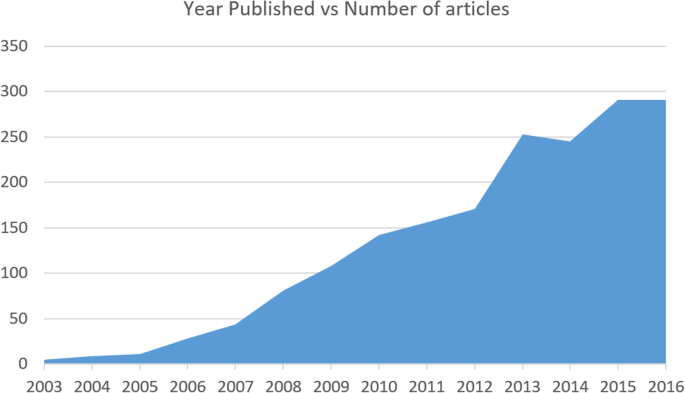
Figure 1
shows the dispensation of published articles from the year 2003 to the
first half of 2017. There are a different number of publications in
variant sections. As it is shown in Fig. 1,
in 2003–2012 period, the number of publications grows gradually with an
upward curve trend from five articles published in 2003 to about 171
articles in 2012. There is a prompt rise around 2013 reaching to
approximately 253 publications in that year. We can notice a rare
decrease in 2014 coming down from 253 to 245. But after that, in 2015,
the reduction has been compensated and the number of articles published
has reached to nearly 291. This number of articles is 14% of all
articles published in all times.
Fig. 1
Publication years sorted by the number of articles published
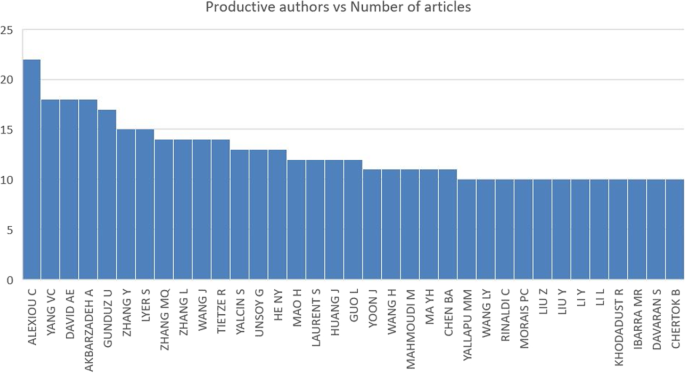
As Fig. 2
shows, the most active author is Alexiou C who has taken part in over
22 articles out of the overall number of 2066 in the field of
nanoparticles. This huge number of publication equals to above 1% of
publications at all times. Table 1
has the first 10 authors listed with their article count. Authors such
as Yang VC, David AE, and Akbarzadeh A have participated in as high as
18 articles and Gunduz U in 17 publications relating to drug delivery
and nanoparticles. They appear on the second to the fifth row of Table 1.
According to our research, more productive authors such as Zhang Y and
Lyer S are owing as far as 15 articles published about nanoparticles.
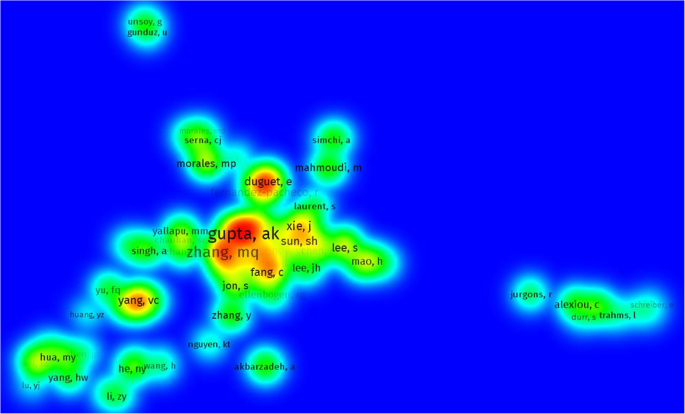
Figure 3
illustrates the most cited author in the world, AK Gupta, that has the
highest article citations with a great difference. His papers are
generally about the narrow size of particles which leads them to their
fantastic uniform physical and chemical characteristics [45] and the way they are nowadays used for variant biomedical applications [46].
As we can see in the figure Zhang MQ, Duguet E, Yang VC, and Jin Xie
have earned the most citations after Prof. AK Gupta prospectively.
Fig. 2
Important authors with the number of articles published
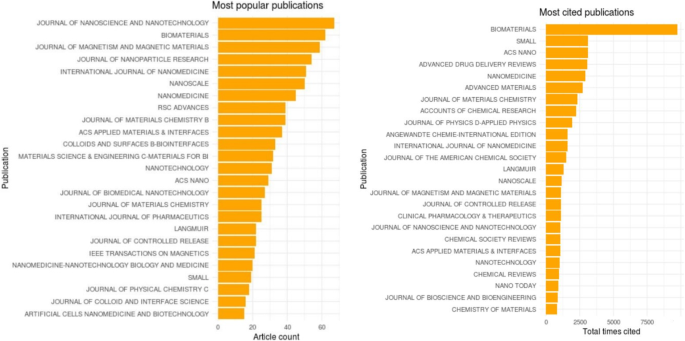
In Fig. 4, the Journal of Nanoscience and Nanotechnology [16]
with over 65 articles in the field of nanoparticles has the most
articles published. Nearly 62 articles have been published in
Biomaterials. This journal has the most cited publications with 10,000
total times cited. Journal of Magnetism and Magnetic Materials from the
Netherlands holds third place for the most popular publications with
approximately 60 articles. A German journal called Small and ACS Nano
along with Advanced drug delivery reviews are at the top owing about
3000 citations.
Fig. 4
Important publications with the number of articles in their dataset and their citations
Analysing
different keywords assists researchers to explore dominant research
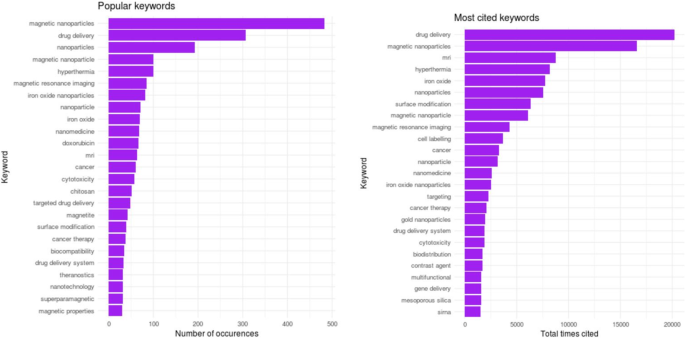
topics. Top 10 keywords with the most citation are shown in Fig. 5.
The word “Magnetic Nanoparticles” occurred more than 475 times with
around 16,000 citations. The second common searched keywords are “Drug
Delivery” which was used just above 300 and mentioned over 20,000 times.
In summary, the most popular keywords in our research area, as Fig. 5
informs, are drug delivery, magnetic nanoparticles, MRI, hyperthermia,
iron oxide, nanoparticles, surface modification, magnetic nanoparticle,
magnetic resonance imaging, and cell labelling cited from 20,000 to 4000
times. Words such as siRNA, mesoporous silica, gene delivery, and
multifunctional are the least cited ones with less than 2000 citations.
Fig. 5
Important keywords mentioned and the number of their citations
Figure 6
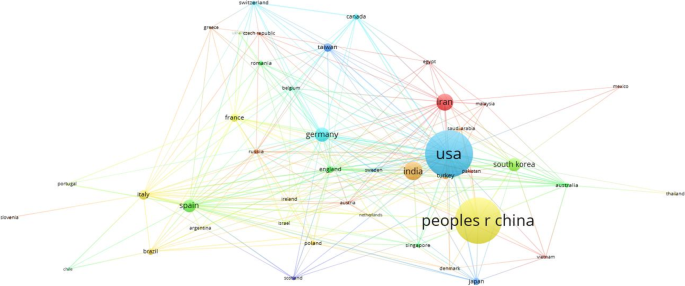
gives a complete picture of nanoparticle research all around the world.
This repartition guide presents such important data for analysts to
discover the place which they should start working on or building up
some cooperation. Researches illustrate that 2066 papers were written in
73 countries. The top 10 countries in this field with their number of
publications are shown in Table 2
as they represent 87.71% of all publications. The USA, China, India,
and Iran have the greatest noteworthy number of publications compared to
other nations. Japan, as a developed country, has not been focusing on
this branch, but countries such as Italy, Taiwan, and France are shining
in the eighth, ninth, and tenth rows, respectively. Germany has 123
published articles from the total number of 2066 papers in
nanoparticles, this makes it ranked fifth. South Korea and Spain both
have accounted for 5.3% of total publications, holding sixth and seventh
place, respectively.
Fig. 6
Countries sorted by the number of articles published
There
are 2066 documents analysed quantitatively in this study. By sorting
them with their number of citations per year, it is understood that
there are only 7 papers which have been cited over 100 times per year.
Setting the threshold to 21 citations per year results in the top 100
papers. According to [47,48,49,50]
papers, it is conventional to analyse the top 100 with the most
citations per year. This analysis will emphasise the top 100 journals,
top related keywords, top countries, and top sub-research areas in the
field of nanoparticles. After that, the reader would be able to choose
from the keywords and research areas before starting his/her research in
order to aim for a great number of citations per year. The other
benefit of this analysis is the idea of which journal is more suitable
for submitting the nanoparticle-based article or review papers.
Most review papers gain a higher number of citations per year compared to the articles in the same field [20].
Review papers talk about the background of studies and give the reader a
general idea of what he/she should do further in this area; this is one
of the reasons for using the review paper more than articles which
rises their citation number. The document types for the top 100 papers
with the most citation/year ratio are 42% articles, 57 review papers,
and only 1 review paper from a book chapter. In this study, we are going
to analyse the data both in quantitative and qualitative ways based on
the 100 top-cited papers and 42 top-cited articles, respectively.
Quantitative Analysis
Analysis of Keywords in the Top 100 Cited Papers
One
of the most important factors in a quantitative analysis is keywords
analysis. There were 457 different keywords used in these top 100
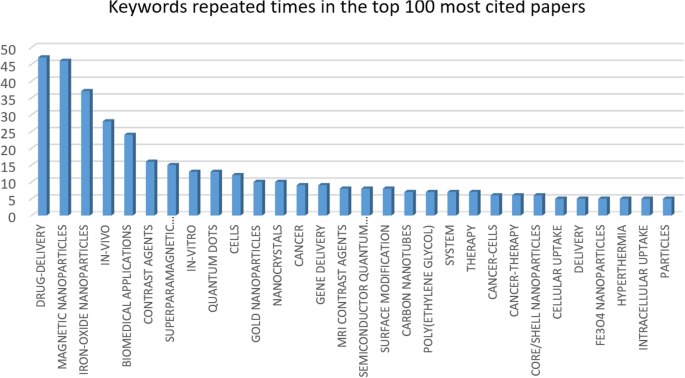
papers. The graph in Fig. 7
shows keyword’s popularity, keywords repeated above 5 times, in the top
100 citation/year papers. As it is illustrated, the words Drug-Delivery
and Magnetic Nanoparticles as keywords have the most popularity among
455 others, repeated 47 and 46 times, respectively. Iron oxide
nanoparticles is by a big difference in the third place recurred 37
times in 100 papers.
Fig. 7
Keywords sorted by the number of articles published
Recently, utilizing magnetic nanoparticles has become the objective drug delivery technique [51].
Furthermore, iron oxide nanoparticles have superparamagnetic
characteristics, and it is used for MRI monitoring targeting the brain
tumour or breast cancer as a drug delivery vehicle [52,53,54].
In conclusion, these three keywords are intertwined and together on the
top of the most used keywords’ list. In-VIVO and Biomedical
Applications are included in a quite same number of papers, 28 and 24,
respectively. Contrast agents, Superparamagnetic nanoparticles,
In-VITRO, and Quantum Dots are the keywords with almost the same
popularity from 16 to 13 papers among the 100 most cited papers.
Nowadays,
health is the most important factor in our lives, and any issue
relevant to health like methods of drug combination for a therapeutic
effect or any disease treatment for living creatures based on
nanoparticles is of interests [55].
Drug delivery holds the first place among keywords in all papers and in
the top 100 citations/year papers. The keyword Magnetic Nanoparticles
is in second place in both rankings (Table 3).
The reason is the popularity of all sorts of the application via
magnetic nanoparticles such as boosting MRI data and tissue engineering
methods, modifying drug delivery along with cancer diagnosis [56].
Iron oxide nanoparticles are ranked third via their useful utilisation
in medical and biomedical applications. IO nanoparticles as an
eco-friendly and non-toxic material have superparamagnetic
characteristics and biomedical applications helping the world these days
[57, 58].
Table 3 Comparing keywords ranking in the top 100 best cited papers with keywords ranking in all papers
Keywords
number four and five from the top 100 citations/year papers have
switched places in the ranking in all papers’ column. This means that
although biomedical applications are more useful in comparison with
In-VIVO experimentations, top 100 cited papers have used the keyword
In-VIVO more than Biomedical Applications. Since In-VIVO is more limited
and it has its own biomedical applications in other words the word
Biomedical Applications contains subtopics such as In-VIVO, the top 100
citations/year papers have focused on the particular field called
In-VIVO more than Biomedical Applications.
One of the interesting
points of this comparison is the keyword Contrast Agents. Particular
contrast agents are advanced for MRI, sonography, or X-ray tests [59].
An ideal future medical imaging, as contrast agents’ applications, is
necessary in order to achieve treatments without side effects [60].
So, nowadays contrast agents and their medical imaging application are
more important and conventional researches and the papers related to
them will be cited more than papers with the topic called Cancer.
Superparamagnetic nanoparticles such as IO nanoparticles, which is
ranked 3, are used in variant biomedical applications. This is a quite
common research topic holding the seventh position in the 100 top
citation papers’ ranking and the 12th position in all papers’ ranking
In-VIVO
keyword’s ranking is followed by In-VITRO keyword in the ranking of
total papers, but there are three topics in between In-VIVO and In-VITRO
in the top 100 ranking list. Overall, the benefit of In-VIVO
experiments compared to IN-VITRO is that researchers are able to spot
the effects on a living objective in its natural home and the upcoming
results will be accurate [61]. This is the reason why nowadays In-VIVO researches are one of the highly cited researches.
Analysis of Research Area in the Top 100 Most Cited Papers
In
this analysis, we are going to analyse the data based on 100 top-cited
papers and compare the rankings of research areas in 100 top-cited
papers with research areas in all papers. There are respectively 13 and
37 different research topics used in top 100 best cited papers and in
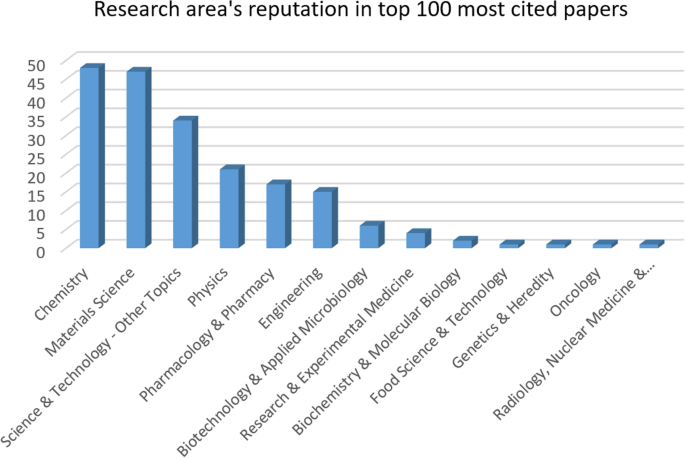
all papers. The graph in Fig. 8
shows the research area’s popularity, research area’s reputation, in
the top 100 citations/year papers. In 100 papers including 42 articles
and 57 review papers and a review on a book chapter, the most common
research area is “Chemistry”. “Material Science” is in fact the second
favourite research area with slight difference of only one paper.
Fig. 8
Research areas sorted by the number of articles published
Nanoparticles
have variant applications in chemistry, for example, they are used as
catalyst to enhance chemical reactions, as industrial water pollutant
remover through chemical reactions, etc. [62].
So, these different researches have made chemistry number 1 of all, and
48 top-cited papers [out of 100] related to nanoparticles have been
researched in chemistry. It is analysed that authors of the chemistry
papers are not just experts in the single field of chemistry, but also
they are different authors skilled in different categories such as
biomedical engineering, molecular genetics and microbiology, physics,
and radial diagnostics. The same pattern exists for material science
research topic. Surprisingly, only few of the authors, as professors,
were in the department of material science. For writing these sort of
papers in the field of material science, it is necessary to gather
authors with variant expertise in some of the field of medical physics,
biological sciences, physics, chemistry and biochemistry, radiology,
pharmacy, etc.
Science and technology–other topics are researched
by 34 papers out of 100. By analysing the authors’ address, it is found
that the phrase “other topics” in this research area mostly means areas
such as bioengineering, biomedical engineering, and microelectronic.
Physics, pharmacology and pharmacy, and engineering are the subjects
which have been used 21, 17, and 15 times in 100 most cited papers,
respectively. As it is shown in Fig. 8,
chemistry, material science, and science and technology seems to be
really involved with nanoparticles. Recently, they are much more
controversial topics compared to physics, pharmacy, or engineering.
As
it was discussed above, the key goal for the top 100 papers in order to
get a high citation is researching in multidisciplinary zones and not
just in pure physics, pharmacy, or even engineering alone. Table 4
compares research area’s rankings in 100 top-cited papers and the
ranking in all papers. Overall, research topics such as chemistry and
material science are at the same level, and somehow, they will switch
places in the ranking list. The other areas for example physics,
pharmacology and pharmacy, engineering and biotechnology and applied
microbiology are ranked the same in both analyses.
Table 4 Comparing research areas repeated times in the top 100 best cited papers with research areas in all papers
Analysis of Journals in the Top 100 Most Cited Papers
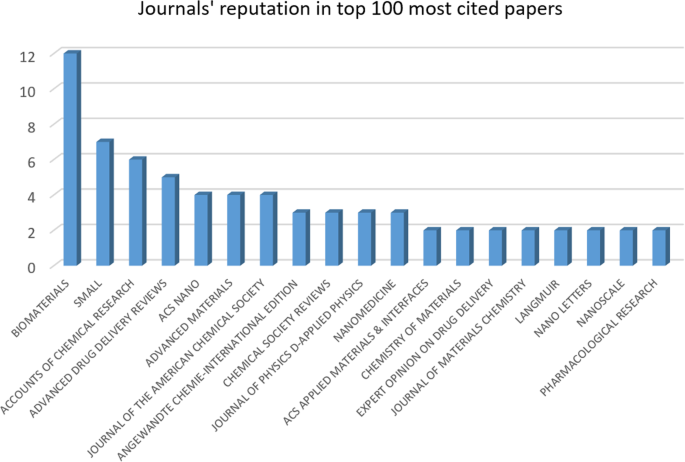
Journals’ reputation in the top 100 most cited papers is shown in Fig. 9.
The bar chart illustrates famous journals which have published at least
2 papers from the top 100 most cited papers in the field of
nanoparticles. The journal of Biomaterials has, by far difference, the
most papers published in comparison with other journals. It is obvious
that this journal is more appropriate for a related paper to get a high
citation per year rate. The journal of Small is the second most popular
journal in this study, which has published 7 papers from the top 100
cited list. The journal of Accounts of Chemical Research along with the
journal of Advanced drug delivery reviews is at the next places with the
lower number of papers published in this area.
Fig. 9
Journals sorted by the number of papers published (journals are used least two times)
At
this stage, the abovementioned journals are compared with journals
which published the most papers in all nanoparticle-based references. It
can be seen in Table 5
that the journal of Biomaterials remains the best, and it is considered
as the second most articles published journal in the area of
nanoparticles. Surprisingly, other journals are ranked completely
different. Generally, the journals with the most cited papers in the
field of nanoparticles are not the top 10 mostly used journals in all
documents. So, this issue must be considered when finding an appropriate
journal to submit in the field of nanoparticles, drug delivery, or
magnetic nanoparticles.
Table 5 Comparing top 100 best cited papers’ journals with all journals
In
this study, we are going to analyse the data in a qualitative way based
on 42 top-cited articles. The idea is to know the important topics in
nanoparticles which have been studied the most or the least used topics
that have been making progress (shown in Table 6).
Table 6 Summary of the top 42 most cited articles in the field of study
This
analysis endeavours to discuss materials, drug delivery, therapeutic
and diagnostic, coating, targeting, and imaging perspectives of
nanoparticles’ studies. The most used topics and their subtopics are
considered in this study. Most articles in the top 42 most cited
articles’ list, in our data set, focus on superparamagnetic iron oxide
nanoparticles. This material is commonly used as nanoparticles with
magnetic properties which is also called magnetic nanoparticles,
superparamagnetic nanoparticles, or iron oxide nanoparticles. Half of
the magnetic nanoparticle-based articles have been using magnetic
resonance imaging as their imaging process. There is only a single
article using therapeutic MNPs [63].
Multifunctional
mesoporous nanoparticles are the second most popular materials which
sometimes overlaps with the magnetic nanoparticles in some references [64,65,66,67,68].
Silver is used as a nanoparticle material only once in the 42 most
cited articles. The silver nanoparticle-based article has its unique way
of drug delivery, a chitosan nanocarrier (NC)-based delivery using
fluorescence imaging. It has been used in cancer therapy along with
magnetic nanoparticles and multifunctional mesoporous nanoparticles [69].
Drug
delivery is a popular study among nanoparticle studies. Subtopics such
as targeting anticancer drugs, delivering drugs to cancer cells, or
controlled-release drug delivery has allocated over a quarter of our
database articles’ subjects. It is found that as rare as one research is
based on a thermotherapy or chemotherapy of cancer [70]
and other cancer therapy articles have researched on the help of
controlled-released drug delivery or magnetic resonance imaging or even
both on cancer therapy. Fluorescence imaging and near-infrared
fluorescence imaging methods are used in articles published from 2009 to
2011. This is a proof that the method has had its progress and its
citation per year rating is downgrading in recent years.
Among all
different research and experiments on coated nanoparticles, coating
superparamagnetic iron oxide nanoparticles has become famous. It is
interested that none of the coating superparamagnetic iron oxides have
been using MRI imaging unlike other types.
Methods of Nanoparticles Studies
The
analysis of variant methods used by 42 top-cited articles shows the use
of either common or particular different methods of nanoparticle-based
studies. Each popular method has been utilised in 5 to as low as 1
article among all 42 top-cited articles. Methods such as hydrothermal
methods, coprecipitational method, modified solvent method, quantitative
analysis, decomposition method, water-based method, solvothermal
method, hetero-interparticle coalescence strategy, thermodynamic
modelling, film hydration method, and solid-phase biopanning methods are
used in this set of papers.
Hydrothermal methods are quite
popular using superparamagnetic iron oxide nanoparticles. Solvothermal
methods are considered hydrothermal where the solvent is water. There
are researches done by both hydrothermal and solvothermal methods based
on superparamagnetic iron oxide nanoparticles [67, 71]. Modified solvent methods along with solvothermal methods are applied in recent experiments [70,71,72,73].
In
this study, 42 references with the highest citation/year rate on
nanoparticles were reviewed. Most of the references have nominated
superparamagnetic iron oxide nanoparticles as the nanoparticles’
materials, followed by a few references focusing on targeting anticancer
drugs or drug delivery for cancer therapy. A certain number of articles
have been using magnetic resonance imaging, following a few considered
fluorescence imaging, near-infrared fluorescence imaging,
molecular-targeted imaging, and positron emission tomography as their
imaging agents. In general, references’ arrangement has a connection
with a wide scope of research goals. Nevertheless, the techniques used
for nanoparticle-based researches are just divided into a few.
The
limitation of this study is collecting data from the Web of Science
Core Collection based on title search for “Nanoparticle*” with “Magnetic
Nanoparticle*”, and “Drug delivery” in the topic. Therefore, documents
in other databases such as SCOPUS were not considered. Although, the
number of documents in the WoS database is higher than that in the
SCOPUS database in this research area. There might be some relevant
articles which talk about “Nanoparticle”, but the word “Nanoparticle” is
not in the title of the paper. Such papers and also low-cited documents
were not included in the quantitative and qualitative analysis. One of
the merits of this study is to encourage the researchers to start their
research in multidisciplinary zones and not just in pure physics,
pharmacy, or even engineering alone. The 42 top-cited documents which
were analysed qualitatively give an insight into the drug delivery and
magnetic nanoparticles research area.
Conclusions
In
summary, an extensive bibliometric analysis of nanoparticles-based
research documents was made with the help of the Web of Science
database. Nanoparticle-based researches were characterised
quantitatively and qualitatively from 2003 to 2017. The result shows an
increase in the number of articles published during these years.
Researchers from the USA and China contributed most of the publications.
Analysis of keywords shows the stressed points in nanoparticle research
field which guides to a direct and inform future. Chemistry and
material science research areas are the most common areas using
nanoparticles. The key factor for this success is researching in
multidisciplinary zones and not just in pure physics or pharmacy or even
engineering.
Abbreviations
ISI:
Institute of Scientific Information
ACS:
American Chemical Society
CNTs:
Carbon-based nanotubes
IO nanoparticles:
Iron oxide nanoparticles
MNPs:
Magnetic nanoparticles
MRI:
Magnetic resonance imaging
NC:
Nanocarrier
NSET:
National Society for Earthquake Technology
siRNA:
Small interfering RNA
VOS:
Visualisation of similarities
WoS:
Web of Science
References
1.
Liu
F, Wu D, Kamm RD, Chen K (2013) Analysis of nanoprobe penetration
through a lipid bilayer. Biochim Biophys Acta-Biomembr.
1828(8):1667–1673
Al-Jamal
WT, Kostarelos K (2011) Liposomes: from a clinically established drug
delivery system to a nanoparticle platform for theranostic nanomedicine.
Accounts Chem Res. 44(10):1094–1104
Agiotis
L, Theodorakos I, Samothrakitis S, Papazoglou S, Zergioti I, Raptis YS
(2016) Magnetic manipulation of superparamagnetic nanoparticles in a
microfluidic system for drug delivery applications. J Magnet Magn Mater
401:956–964
Kilinc
E. γ-Fe2O3 magnetic nanoparticle functionalized with carboxylated multi
walled carbon nanotube: synthesis, characterization, analytical and
biomedical application 2015.
6.
Abbasi
Pour S, Shaterian HR, Afradi M, Yazdani-Elah-Abadi A (2017)
Carboxymethyl cellulose (CMC)-loaded Co-Cu doped manganese ferrite
nanorods as a new dual-modal simultaneous contrast agent for magnetic
resonance imaging and nanocarrier for drug delivery system. J Magnet
Magn Mater 438:85–94
Mair
L, Evans B, Nelson Nacev A, Stepanov P, Hilaman R, Chowdhury S, et al.
Magnetic microkayaks: propulsion of microrods precessing near a surface
by kilohertz frequency, rotating magnetic fields 2017.
8.
Pedram M, Shamloo A, GhafarZadeh E, Alasty A. Dynamic analysis of magnetic nanoparticles crossing cell membrane 2016.
9.
Shamloo
A, Pedram M, Heidari H, Alasty A. Computing the blood brain barrier
(BBB) diffusion coefficient: a molecular dynamics approach 2016.
10.
Pedram
MZ, Shamloo, Amir, Alasty, Aria, Ghafar-Zadeh, Ebrahim, editor Optimal
magnetic field for crossing super-para-magnetic nanoparticles through
the brain blood barrier: a computational approach. Biosensors; 2016.
11.
Pedram
M, Shamloo A, Alasty A, Ghafar-Zadeh E. Toward epileptic brain region
detection based on magnetic nanoparticle patterning. 2015. 24409-24427
p.
12.
Niu
BB, Hong S, Yuan JF, Peng S, Wang Z, Zhang X (2014) Global trends in
sediment-related research in earth science during 1992–2011: a
bibliometric analysis. Scientometrics. 98(1):511–529
Jamali
SM, Md Zain AN, Samsudin MA, Ale Ebrahim N (2015) Publication trends in
physics education: a bibliometric study. Jurnal Penyelidikan
Pendidikan. 35:19–36
Akhavan
P, Ale Ebrahim N, Fetrati MA, Pezeshkan A (2016) Major trends in
knowledge management research: a bibliometric study. Scientometrics.
107(3):1249–1264
Rakhshandehroo
M, Yusof MJM, Ale Ebrahim N, Sharghi A, Arabi R (2015) 100 most cited
articles in urban green and open spaces: a bibliometric analysis. Curr
World Environ 10(2):445–455
Uuskula
A, Toompere K, Laisaar KT, Rosenthal M, Purjer ML, Knellwolf A et al
(2015) HIV research productivity and structural factors associated with
HIV research output in European Union countries: a bibliometric
analysis. BMJ Open. 5(2):7
Ale
Ebrahim N, Salehi H, Embi MA, Habibi Tanha F, Gholizadeh H, Motahar SM
et al (2013) Effective strategies for increasing citation frequency. Int
Educ Stud 6(11):93–99
Haustein
S, Costas R, Larivière V (2015) Characterizing social media metrics of
scholarly papers: the effect of document properties and collaboration
patterns. PLoS ONE. 10(3):e0120495
Bong
YB, Ale Ebrahim N (2017;aid/10563(cid/6) The rise of alternative
metrics (altmetrics) for research impact measurement. Asia Research
News.:1–3
23.
Kazakis
NA (2015) The research activity of the current faculty of the Greek
chemical engineering departments: a bibliometric study in national and
international context. Scientometrics. 103(1):229–250
Zhai
L, Yan X, Shibchurn J, Song X (2014) Evolutionary analysis of
international collaboration network of Chinese scholars in management
research. Scientometrics. 98(2):1435–1454
Rosas
SR, Kagan JM, Schouten JT, Slack PA, Trochim WMK (2011) Evaluating
research and impact: a bibliometric analysis of research by the
NIH/NIAID HIV/AIDS Clinical Trials Networks. Plos One. 6(3):12
Abedini
A, Rahman R, Sadeghi Naeini H, Ale Ebrahim N (2017) The 100 most cited
papers in “industrial design”: a bibliometric analysis. Exacta –
Engenharia de Produção. 15(3):515–526
Robert
C, Wilson CS, Venuta A, Ferrari M, Arreto CD (2017) Evolution of the
scientific literature on drug delivery: a 1974–2015 bibliometric study. J
Control Release. 260:226–233
Wang
ZJ, Zhang TC, Huang FY, Wang ZP (2018) The reproductive and
developmental toxicity of nanoparticles: a bibliometric analysis.
Toxicol Ind Health 34(3):169–177
Tang
YL, Xin HJ, Yang F, Long X (2018) A historical review and bibliometric
analysis of nanoparticles toxicity on algae. J Nanopart Res. 20(4)
33.
Zivkovic
D, Niculovic M, Manasijevic D, Minic D, Cosovic V, Sibinovic M (2015)
Bibliometric trend and patent analysis in nano-alloys research for
period 2000–2013. Recent Pat Nanotechnol 9(2):126–138
Lavrik
OL, Busygina TV, Shaburova NN, Zibareva IV. Nanoscience and
nanotechnology in the Siberian Branch of the Russian Academy of
Sciences: bibliometric analysis and evaluation. J Nanopart Res.
2015;17(2).
35.
Dong
XF, Qiu XC, Liu Q, Jia J (2013) Bibliometric analysis of nanotechnology
applied in oncology from 2002 to 2011. Tumor Biol 34(6):3273–3278
Menendez-Manjon
A, Moldenhauer K, Wagener P, Barcikowski S (2011) Nano-energy research
trends: bibliometrical analysis of nanotechnology research in the energy
sector. J Nanopart Res. 13(9):3911–3922
Das
A-K (2015) Introduction to research evaluation metrics and related
indicators. In: Sen BK, Mishra S (eds) Open Access for Researchers,
Module 4: Research evaluation metrics. UNESCO, Paris, 7, place de
Fontenoy, 75352 Paris 07 SP. United Nations Educational, Scientific and
Cultural Organization, France
Aghaei
Chadegani A, Salehi H, Yunus MM, Farhadi H, Fooladi M, Farhadi M et al
(2013) A comparison between two main academic literature collections:
Web of Science and Scopus databases. Asian Soc Sci 9(5):18–26
Franceschini
F, Maisano D (2011) Regularity in the research output of individual
scientists: an empirical analysis by recent bibliometric tools. J Inform
5(3):458–468
Maghami
M, Navabi Asl S, Mi R, Ale Ebrahim N, Gomes C (2015) Qualitative and
Quantitative analysis of solar hydrogen generation literature from 2001
to 2014. Scientometrics. 105(2):759–771
Khalil
GM, Crawford CAG (2015) A bibliometric analysis of US-based research on
the behavioral risk factor surveillance system. Am J Prev Med.
48(1):50–57
Sangam
S, Mogali MSS. Mapping and visualization softwares tools: a review.
International conference on Content Management in Networked; Tumkur
2012.
44.
Knutas
A, Hajikhani A, Salminen J, Ikonen J, Porras J (2015) Cloud-based
bibliometric analysis service for systematic mapping studies. In:
Proceedings of the 16th International Conference on Computer Systems and
Technologies, vol 2812442. ACM, Dublin, Ireland, pp 184–191
Gupta
AK, Naregalkar RR, Vaidya VD, Gupta M (2007) Recent advances on surface
engineering of magnetic iron oxide nanoparticles and their biomedical
applications. Nanomedicine. 2(1):23–39
Luo
P, Xu D, Wu J, Chen YH, Pfeifer R, Pape HC (2017) The top 100 cited of
injury-international journal of the care of the injured: a bibliometric
analysis. Injury 48(12):2625–2633
Nadri
H, Rahimi B, Timpka T, Sedghi S (2017) The top 100 articles in the
medical informatics: a bibliometric analysis. J Med Syst 41(10)
49.
Nasir
SAR, Gilani JA, Fatima K, Faheem U, Kazmi O, Siddiqi J et al (2018) Top
100 most-cited articles on spontaneous intracerebral hemorrhage: a
bibliometric analysis. World Neurosurg 110:445
Lipsman
N, Lozano AM (2012) Measuring impact in stereotactic and functional
neurosurgery: an analysis of the top 100 most highly cited works and the
citation classics in the field. Stereotact Funct Neurosurg
90(3):201–209
Chertok
B, Moffat BA, David AE, Yu F, Bergemann C, Ross BD et al (2008) Iron
oxide nanoparticles as a drug delivery vehicle for MRI monitored
magnetic targeting of brain tumors. Biomaterials. 29(4):487–496
Marcu
A, Pop S, Dumitrache F, Mocanu M, Niculite CM, Gherghiceanu M et al
(2013) Magnetic iron oxide nanoparticles as drug delivery system in
breast cancer. Applied Surface Science. 281:60–65
Heo
DN, Min KH, Choi GH, Kwon IK, Park K, Lee SC (2014) Chapter 24 -
Scale-up production of theranostic nanoparticles. Cancer Theranostics.
Academic Press, Oxford, pp 457–470
Williams
HM (2017) The application of magnetic nanoparticles in the treatment
and monitoring of cancer and infectious diseases. Biosci Horiz
10:hzx009–hzxhzx
Caschera
L, Lazzara A, Piergallini L, Ricci D, Tuscano B, Vanzulli A (2016)
Contrast agents in diagnostic imaging: present and future. Pharmacol Res
110:65–75
Liu
H-L, Hua M-Y, Yang H-W, Huang C-Y, Chu P-C, Wu J-S et al (2010)
Magnetic resonance monitoring of focused ultrasound/magnetic
nanoparticle targeting delivery of therapeutic agents to the brain. Proc
Natl Acad Sci U S A 107(34):15205–15210
Giri
S, Trewyn B, Stellmaker MP, S-Y Lin V. Stimuli-responsive
controlled-release delivery system based on mesoporous silica nanorods
capped with magnetic nanoparticles. 2005. 5038-44 p.
65.
Ruiz-Hernández
E, Baeza A, Vallet-Regí M (2011) Smart drug delivery through
DNA/magnetic nanoparticle gates. ACS Nano. 5(2):1259–1266
Yallapu
M, Othman F, Curtis E, K Gupta B, Jaggi M, C Chauhan S.
Multi-functional magnetic nanoparticles for magnetic resonance imaging
and cancer therapy. 2011. 1890-905 p.
67.
Guo
S, Li D, Zhang L, Li J, Wang E (2009) Monodisperse mesoporous
superparamagnetic single-crystal magnetite nanoparticles for drug
delivery. Biomaterials. 30(10):1881–1889
Singamaneni
S, Bliznyuk VN, Binek C, Tsymbal EY (2011) Magnetic nanoparticles:
recent advances in synthesis, self-assembly and applications. J Mater
Chem 21(42):16819–16845
Sanpui
P, Chattopadhyay A, Ghosh SS (2011) Induction of apoptosis in cancer
cells at low silver nanoparticle concentrations using chitosan
nanocarrier. ACS Applied Mater Interfaces. 3(2):218–228
Thanh N, Hervault A. Magnetic nanoparticles-based therapeutic agents for thermo-chemotherapy treatment of cancer. 2014.
71.
Liu
R, Guo Y, Odusote G, Qu F, Priestley RD (2013) Core–shell Fe3O4
polydopamine nanoparticles serve multipurpose as drug carrier, catalyst
support and carbon adsorbent. ACS Appl Mater Interfaces 5(18):9167–9171
Ling
D, Park W, S-j P, Lu Y, Kim KS, Hackett MJ et al (2014) Multifunctional
tumor pH-sensitive self-assembled nanoparticles for bimodal imaging and
treatment of resistant heterogeneous tumors. J Am Chem Soc
136(15):5647–5655
The authors declare that they have no competing interests.
Publisher’s Note
Springer Nature remains neutral with regard to jurisdictional claims in published maps and institutional affiliations.
Rights and permissions
Open Access This article is distributed under the terms of the Creative Commons Attribution 4.0 International License (http://creativecommons.org/licenses/by/4.0/),
which permits unrestricted use, distribution, and reproduction in any
medium, provided you give appropriate credit to the original author(s)
and the source, provide a link to the Creative Commons license, and
indicate if changes were made.
Ale Ebrahim, S., Ashtari, A., Zamani Pedram, M. et al. Publication Trends in Drug Delivery and Magnetic Nanoparticles.
Nanoscale Res Lett14, 164 (2019). https://doi.org/10.1186/s11671-019-2994-y