Saturday, 22 August 2020

Maximising Research Visibility Through Open Access

 Source: https://blogs.unimelb.edu.au/23researchthings/2020/06/24/thing-03-maximising-research-visibility-through-open-access/

Thing 03: Maximising Research Visibility Through Open Access

In response to the current COVID-19 crisis, a lot of research formerly locked behind paywalls has been made available freely. But open scholarship shouldn’t rely on a pandemic – whether you already have publications, or are planning to publish, making your work available through open access may help with increased discoverability and wider dissemination. In this post, Dimity Flanagan outlines some benefits of open access, and how you can make it work for you.


Getting started

Before you start thinking about your research dissemination strategy, ask yourself: who is my audience? Who do I want to read my research? Where do these groups search for information? Open access – that is, making your research outputs freely available – may be the answer. In fact, open access should be viewed not as an administrative burden but as a vital part of your research dissemination strategy.

While many universities offer access to thousands of academic journals and monographs, such privileged access to information is not a reality for most people – not if you’re an independent scholar, a school teacher, a policy maker, an architect, an NGO worker, a business owner, a journalist… the list goes on. Research impact is more than your citation count; it is about providing research to influence change. There is also increasing evidence that pursuing open access leads to a citation advantage when comparing different access types, as illustrated by a random sample of Web of Science articles and reviews with a DOI published between 2009 and 2015:
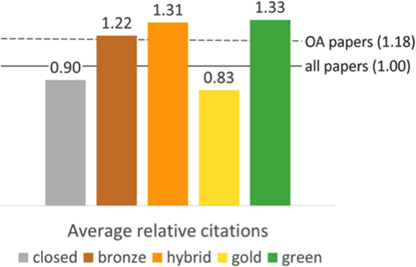
Bar graph showing on average higher citation counts for open access published papers (green open access at 1.33 citations compared to all papers with average 1.00 citation count)
Piwowar et al (2018) ‘The state of OA: a large-scale analysis of the prevalence and impact of Open Access articles’ PeerJ, DOI: 10.7717/peerj.4375.

Types of open access explained

Closed Article is behind a paywall
Bronze Article is free to read but copyright is all rights reserved
Hybrid Author pays to make article OA in a subscription (paywalled) journal
Gold Author publishes article in an OA journal, under an OA license such as CC-BY
Green Author makes their accepted manuscript available in a repository

For more information on the above types of open access, see the 2017 “Things” post on Open Access – Green, Gold and Black?

That Thing you do: integration into practice

Stages of sharing

Pre-publication

If you’re at the pre-publication stage of your work, preprint servers offer a way to share your publication while it is still in progress, before it is formally published in a journal. Preprint servers are often subject to disciplinary norms. For physicists, arXiv has been serving their needs since the early 1990s, ensuring research is disseminated as rapidly as possible and encouraging feedback and collaboration. arXiv now serves a wider range of disciplines such as mathematics and computer science and provides access to over one million papers. Research Papers in Economics (RePEc) is also an early example of researchers leading the way in the promotion of open access. The past few years have seen rapid growth in the number of disciplinary preprint platforms, with bioRxiv and medRxiv being more recent success stories, and providing a vital service during the COVID-19 pandemic.

Publishing open access

When publishing a journal article, you may want to explore the open access journals available in your discipline. The Directory of Open Access Journals indexes quality, open access, peer-review journals published around the world. You can also filter your search to exclude journals that have an Article Processing Charge (APC) if you do not have funds available for publication.

Often when publishing open access, your article (or book) will be released under an open access license such as a Creative Commons license. These licenses permit the redistribution of your work. This makes it easy for you to upload your work to your university repository, personal website, academic social network or anywhere else that can enhance the discoverability of your work.

When it’s not possible to publish in an open access journal

The best journal for your academic audience and career prospects may not be open access. The publisher may offer open access for a fee (hybrid open access) but there are other solutions available that won’t cost you any money, just a little time.

Conversely, if your article is already published, you will likely have signed a copyright transfer agreement. What rights have you retained? You may only be able to do very little with the final published version of your work, but your publisher should allow you to make your accepted manuscript (also called postprint) open access. This version incorporates peer review changes but has not yet been through the proof stage. The accepted manuscript is of great use to a wider audience because it has been through peer review.

Are you a University of Melbourne researcher?

The University of Melbourne expects its researchers to make their accepted manuscripts open access through the University repository, Minerva Access, or an appropriate subject repository. The advantage to using Minerva Access is that there is an expert team working behind the scenes to check copyright permissions. Many journals and book publishers have their policies online, and for policies that cannot be found, the Minerva Access team will contact the publisher directly for permission.

While many researchers are already in the habit of depositing their accepted manuscripts of journal articles into university or subject repositories, it is important to disseminate your other outputs just as widely. Providing access to a book chapter helps promote the entire monograph. Adding copies of reports ensures that if the original falls subject to link-rot, the University repository can be relied upon for long-term access.
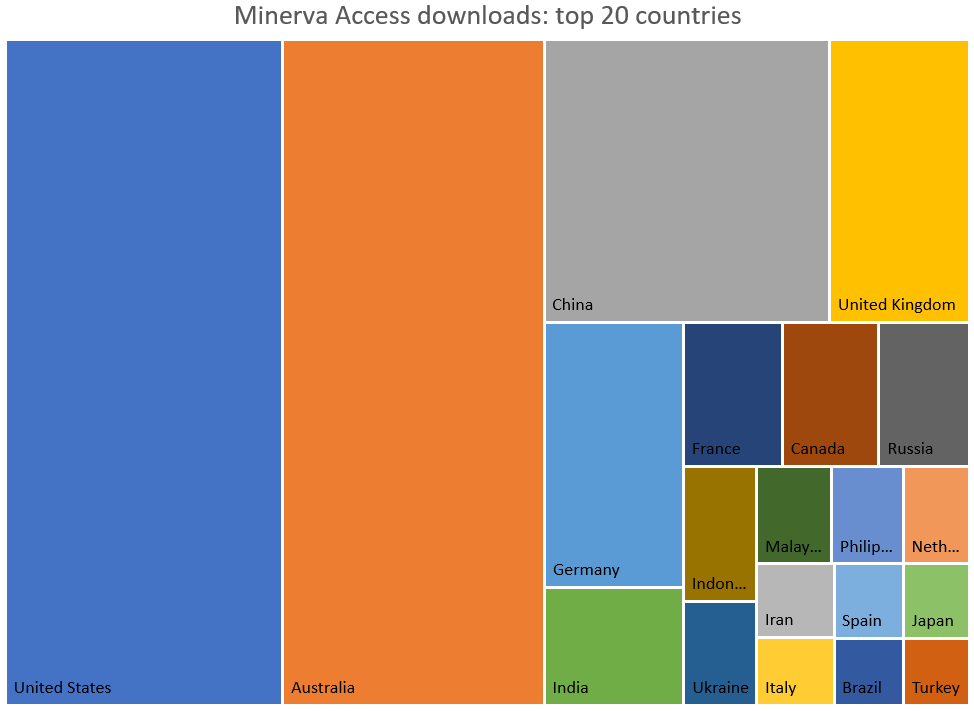
Colourful diagram showing the top 20 countries with the most downloads from Minerva Access (in order of size): United States, Australia, China, United Kingdowm, Germany, India, France, Canada, Russia, Indonesia, Ukraine, Malaysia, Phillippines, Netherlands, Iran, Spain, Japan, Italy, Brazil, Turkey

Once your content is in Minerva Access, you can see the downloads for your output, and the country in which it is being downloaded. Over 70% of traffic to Minerva Access comes via Google and Google Scholar (including all the various national iterations), so it is highly discoverable across the world. In 2019, Minerva Access content received over 1.5million downloads.

Learn more

About the author

Dimity Flanagan is the Manager, Scholarly Communications at the University of Melbourne. Dimity has contributed another post on open access publishing, and presents ‘Public Access and Your Thesis’ session for the Researcher@Library Program.


Want more from 23 Research Things? Sign up to our mailing list to never miss a post.


Image Credit: Five bulb lights by Pexels


One more Thing …

You can learn more about maximising your research visibility from this recording of a webinar presented by Thing 3 author, Dimity Flanagan:

Webinar: Seeking the citation advantage: Open Access publishing
Date and time: Wednesday 24 June, 2020 from 10am-11am
Description: A recent study puts the citation advantage of Open Access articles at 18%. This webinar will dig a little deeper into the evidence to look at and which types of Open Access are likely to bring the most benefits. You’ll leave this session with practical advice on how you can make your past and future research more widely available.

These online events are a part of Researcher Connect – an online program for University of Melbourne researchers (9 June – 3 July 2020). (Explore more resources)

Explore more

Want more from 23 Research Things? Sign up to our mailing list to never miss a post.

Choosing Where To Publish

 Source: https://blogs.unimelb.edu.au/23researchthings/2020/06/24/thing-04-choosing-where-to-publish/

Thing 04: Choosing Where To Publish

Ready to publish but not sure where to start? You’re not alone! To help you find the right journal or publisher for your research, in this post Gerry Fahey and Kathryn Lindsay introduce a number of tools you can use to investigate and compare the options available.


Getting started

Deciding on where to publish can be daunting, but luckily there are many resources to guide you through the process. The University of Melbourne has subscriptions to several tools that you can use to select possible publications, while others are freely available. Using these tools to analyse the information available on journals, conferences, book publishers, or other scholarly publishing options, can help you to:

  • Target the right publications to maximise your chances of acceptance.
  • Reach the audience you want to share your research with.
  • Increase the impact of your research and the citations it receives.
  • Build a track record for future grants, employment opportunities and promotions.
  • Avoid predatory, deceptive and low-quality journals or publishers.

Below we provide some suggestions for how you can use these tools to analyse and select scholarly publishing options for your work.

That Thing you do: integration into practice

Search for sources of similar work

Are you regularly searching the literature to keep up with new research on your topic? Use your searching skills to analyse where work similar to yours is being published. Both Web of Science and Scopus have analysis tools that allow you to view the sources where papers on your topic are most frequently published. Want to have a go? The videos Web of Science: Discover Trends Using Analyze Results and Scopus Tutorial: How to analyze your search results will get you started.

Have you been building a library of references in reference management software to write your thesis or paper? You can also use it to find where work similar to yours is being published, by viewing the most frequently occurring source publications in your library. For example, in EndNote select: Tools > Subject Bibliography > Secondary Title.

Investigate impact

Thinking of publishing in a journal? It’s a good idea to look at ranked lists of journals in your subject area, so you can identify high impact journals where, on average, papers are more likely to be cited. One tool the university subscribes to that you can try is InCites Journal Citation Reports (JCR). Watch the video Journal Citation Reports – Journal Impact Factor for tips on how to use it.

You may also want to view the journal rankings by subject area on these freely available websites: CiteScore, Scimago Journal & Country Rank (SJR) or Google Scholar Metrics.

Dig deeper with databases

Through the library, you have access to further databases with information on journals, including the UlrichsWeb Global Serials Directory This directory is an authoritative source which provides information such as whether a journal is peer reviewed, which databases it is indexed in, how frequently it is published, and details on its publisher.

Cabell’s Scholarly Analytics has two components: “Journalytics” index over 11,000 reputable journals, while “Predatory Reports” flag likely deceptive or fraudulent academic journals for selected disciplines. It also includes journal acceptance rates and typical time taken to review and publish articles.

Manuscript matchers

Some tools will automatically suggest a list of journals with metrics for you to consider and compare, based on details from your manuscript, such as the title, keywords, abstract or references.

Try EndNote Manuscript Matcher, which you can access via EndNote Online. Just enter your manuscript title, abstract, and optionally select your references, and it will suggest publications for you. You may also wish to try tools such as Elsevier Journal Finder, Springer Journal Suggester, and JournalGuide.

Considerations

There is no single and absolute authority to determine the best or worst scholarly publishing outlet.  As mentioned above, you need to consider what is right for your paper. Who will your audience be? Will you be using Open Access? How will you avoid predatory and poor-quality journals?

Learn more

The Committee on Publication Ethics (COPE) has members worldwide from all academic fields. Membership is open to editors of academic journals and others interested in publication ethics. If you find the COPE logo on a journal’s website, it is an indication that the journal has been critiqued by COPE as a prerequisite for membership. Together with the Open Access Scholarly Publishers Association (OASPA), Directory of Open Access Journals (DOAJ), and the World Association of Medical Editors (WAME), minimum criteria have been set that journals will be assessed against when they apply for membership of the respective organisations. Here is a link to the full criteria on principles of transparency and best practice.

Another useful online tool to help you understand the process and make a good publishing choice is Think, Check Submit for journals, and its companion site, Think, Check, Attend for conferences.

Still hungry for more information? Read about Thirty one things to consider when choosing which journal to submit your paper to, and New web services are helping authors make data-driven decisions when choosing which journal to submit to.

About the authors

Gerry Fahey (B.Ed Deakin, GradDipLibrarianship, GradDipStudentWelfare, GradCertUniversityManagement UoM) is a Liaison Librarian in the Science and Engineering Liaison team, based at the Creswick Campus. He is also the manager of the Creswick Campus Historical Collection, and has written about the collection and the history of Forestry education in Victoria.

Kathryn Lindsay (BSc BE(Hons) Melb, GradDipInfoMgt RMIT) is a Senior Liaison Librarian and supervises the Science and Engineering Library team at the University of Melbourne, where she has worked for over 10 years. Kathryn previously worked as a Software Engineer and enjoys finding ways to use technology effectively to support research.


Image Credit: Woodtype printing font letterpress by Pixabay

23 Research Things - Digital tools to support your research

 Source: https://blogs.unimelb.edu.au/23researchthings/

23 Research Things

Digital tools to support your research


Podcasting

 Source: https://blogs.unimelb.edu.au/23researchthings/2020/07/08/thing-08-podcasting/

Thing 08: Podcasting

There has been a resurgence in the popularity of podcasts in recent years, largely due to their ability to convey information in a short, engaging and entertaining way. Podcasts allow your expert knowledge to be discovered by a broad audience, while raising your profile within a particular research community. Good podcasts are equally entertaining and informative, offering a great opportunity for storytelling. They can also showcase your personality and communication style. In this post, Andrea Hurt and Ashley Sutherland explore how you can use podcasting to your research advantage. 

Getting started

As a researcher, you are the expert on your topic. The real skill with podcasting is taking your niche idea and crafting it into something that connects with a broad audience. Consider the narrative or story behind your original idea: how does this flow through each episode? Great research communicators are able to engage, entertain, and educate their audience. 

You might have a great idea for a series, but creating a podcast is more complicated than getting people in a room and hitting ‘record’. It’s always best to plan or script each episode. This doesn’t mean reading directly from a page, but rather creating a list of discussion points. Podcasts are guided conversations rather than rambling chats or formal reading of documents. Similarly, if you’ve chosen to interview someone, asking questions created from your background research should sound like natural conversation. This can take practice. 

That Thing you do: integration into practice

There are six stages in creating a podcast: 

1. Planning your series

Some important questions to ask yourself before you begin are why would someone listen to my podcast? and who is my audience? If you are going to put time and effort into creating a podcast, you want people to listen. So, it’s essential to begin by doing some homework. Find a style of podcast you like, such as conversational, interview, co-hosted, humorous, or documentary. Next, identify who your primary and secondary audience is. Be specific! Perhaps your primary audience is 30-40 year-old women, with a secondary audience of 20-30 year-old women. The ABC report on podcasting (especially pp. 18-19) is a great resource for this. 

Understanding your preferred style and target audience will help shape the way you communicate. Remember, not everyone has a background in your field, so explaining jargon, technical terms and concepts clearly is key.  

2. Planning your episodes

Question for consideration: 

  • How many episodes in your series? 
  • How long is each episode? 
  • How regularly will episodes be released? E.g. weekly, fortnightly, monthly. 
  • Are you booking guests to interview? What questions will you ask them? 
  • Is each episode on a different topic, or part of a broad narrative across the series? 

3. Recording

Turning an idea into a podcast requires some basic equipment and software: 

  • Recording equipment (good quality mic) 
  • Sound recording and editing software (free options include Audacity and GarageBand) 
  • Music and sound effects 
  • Graphic design tools 

Campus facilities for podcasting 

Self-service studios are available in the Baillieu Library (staff use only) and Giblin Eunson Library (staff and student use). Some faculties provide equipment hire – for instance, the Faculty of Arts has audio equipment for hire to Arts Graduate Students.   

Public libraries 

Many public libraries have audio recording facilities, so get in touch with your local library for more information. Two locations close to campus are the Library at the Dock and Kathleen Syme Library (note: a small hourly fee applies for non-commercial use). 

Please note that restrictions during COVID-19 may reduce your options, so check relevant websites for updates on access. 

4. Editing

Editing is going to take longer than you think, so it’s vital to factor this into your planning. You can watch online tutorials demonstrating how to use editing software, while others explain piecing together the components of you podcast. Think intro, music, sound effects, interviews etc. Also check out ebooks on podcast editing from your favourite library. 

Remember, the choices you make when editing will shape the narrative of your episodes. After editing a first draft, you may need to revisit the recording studio to add connecting voiceovers to help the storytelling.  

5. Hosting platforms and aggregators

Once you have your episodes ready for release, you’ll need to have somewhere to host your podcast. A number of services offer limited free hosting. Be sure to investigate the types of accounts available. Options include SoundCloud, Whooshka, and Podbean, but there are many more. 

The hosting platform will require a description of the series and a summary of each episode. An ABC survey showed this information was the strongest factor influencing listeners to try a new podcast. Make sure your description is interesting, to hook people into listening. 

Podcasts also require cover art. This, along with the summary, will help entice people to listen, so spend time creating something eye catching. This image can be used to promote your podcast through social media. Images can be found through Creative Commons, and edited in free software like Canva. 

With regards to aggregators, you will want your podcast to be available on popular platforms such as Apple Podcasts, Spotify, Stitcher, and others. Note that some of these services have criteria for inclusion, so do read the information carefully. 

6. Promotion

Once your podcast is hosted, how do you get people to find it? Here’s some suggestions for promoting your podcast: 

  • Social media channels – remember to use rich media, sound bites, video, images, teasers, anything you can think of to entice people to engage with your link. 
  • Release multiple episodes on launch day to create a buzz, and get people interested in your series.  
  • If you’ve interviewed someone, you can leverage your guest’s audience. By sharing your social media content through their own networks, you’ll reach an already interested audience. 

Considerations

Music and sound effects 

Copyright applies to any music and sound effects you use, so make sure you have permission or look for Creative Commons licensed options: 

Transcripts 

Create a transcript for accessibility and also to help you in the editing process. Tools you can use to automate this process include: 

Learn more

About the authors  

Andrea Hurt is focussed on outreach and the user experience. People and spaces are her priority as the Senior Librarian, Library Services and Spaces in the Baillieu Library. With over 30 years’ experience, she has grown up in academic libraries. Andy is a lover of social media, digital communication, and spends a lot of time on Instagram. She is also the Library Social Media Coordinator. Andy is currently studying a Master of Communication with a specialisation in Digital Media. She was an Associate Producer on the A Third Place podcast. 

Ashley Sutherland has been called many things over the years, and recently added Associate Producer on the A Third Place podcast to the list. She is currently the Arts Faculty Librarian at the University of Melbourne, Mum, and her other varied job titles have included Orchestral Musician, Music Teacher, Professional Library Cadet, Liaison Librarian, and Senior Librarian (Digital Technologies). When not in the library, Ashley is usually playing the clarinet, reading, taking her daughter to ballet, singing, or listening to a podcast. 


Want more from 23 Research Things? Sign up to our mailing list to never miss a post.


Image credit: StockSnap from Pixabay

Academic research support

 Source: https://www.wgtn.ac.nz/library/research/getting-started-in-research

Academic research support

Optimise your research visibility, enhance your research profile, access research tools, and discover library resources.

The Library provides a range of help services to academic and PhD researchers.  Services include resource discovery, how to increase your research visibility, enhancing your researcher profile, open access publishing, publishing strategies and advice, analytics and advice about identifying potential collections.

Research services and support

Contact your subject librarian to discuss any of the following:

Postgraduate study spaces

The Library has dedicated study rooms for Postgraduate students at the Kelburn and Law libraries.

You can also book one of our group study rooms.

University research software

The University offers a range of supported software. Contact the Centre for Academic Development for advice and support.

Workshops

We run group help sessions throughout the year – keep an eye on our workshops and events page.