Saturday, 18 January 2020

Friday, 17 January 2020

Top Tips to make Your Article Discoverable

Source: https://guides.library.ucla.edu/c.php?g=180830&p=1188059

SEO for Authors: A How-to Guide

Search Engine Optimization can help researchers who publish drive usage, readership and citations of their articles to raise the visibility of their research. Whether an article is being indexed by the academic search engines is crucial, but it is also important where an article lands in the ranked search results list as that ranking will greatly impact the visibility of an author’s research. Items high on the list are more likely to be read.

Access and Citations

Is your article being indexed by academic search engines like Google Scholar, IEEE Xplore and PubMed or is it only accessible via subscription databases the search robots can’t access to index so the contents do not show in academic search engines?
When submitting an article for publication, authors should consider how easily discoverable their research will be to their audience and enhance opportunities for citation. Open-access articles receive more citations than articles accessible only by purchase or subscription.
Authors will benefit from selecting publishers and journals with policies that cooperate with Google Scholar (and other search academic engines) because it makes their published research articles available to more readers and facilitates more citations. Citations are a significant factor in determining rank in results pages of Google Scholar and many other academic search engines. If a journal is not online, authors should favor those who allow authors to put their articles on their or their institutions’ home pages and/ or repositories.
Top Tips to make Your Article Discoverable

  1. Find the Keywords and search phrase to optimize your document
    1. Think about the most important words that are relevant to the article.
    2. Consider looking up specific keywords on Google Trends or the Google Adwords Keywords tool to find out which search terms are popular.
    3. Try out your keywords in Google Scholar, etc. and if too many results are returned, it may be better to consider a keyword with less competition.
  2. Make sure you have a SEO-friendly title for your article
    1. The title needs to be descriptive and must contain a key phrase related to your topic.
    2. Put your keywords within the first 65 characters of the title.  Google Scholar considers the length of a title.  In a search for the phrase ‘SEO for Authors: A How-to Guide’ would be ranked higher than one titled ‘Search Engine Optimization (SEO) for Authors: Ranking Information and Publishing Tips’.   Although in general titles should be fairly short, we suggest choosing a longer title if there are many relevant keywords.
  3. Write your abstract using keywords, phrases and synonyms
    1. Include the keywords and phrases in your abstract that a researcher might search on to find your article.  Provide additional relevant keywords and synonyms for those keywords as they relate to your article keeping in mind those keywords are also used by the abstracting and indexing services as a method to tag the research content. 
  4. Stay consistent
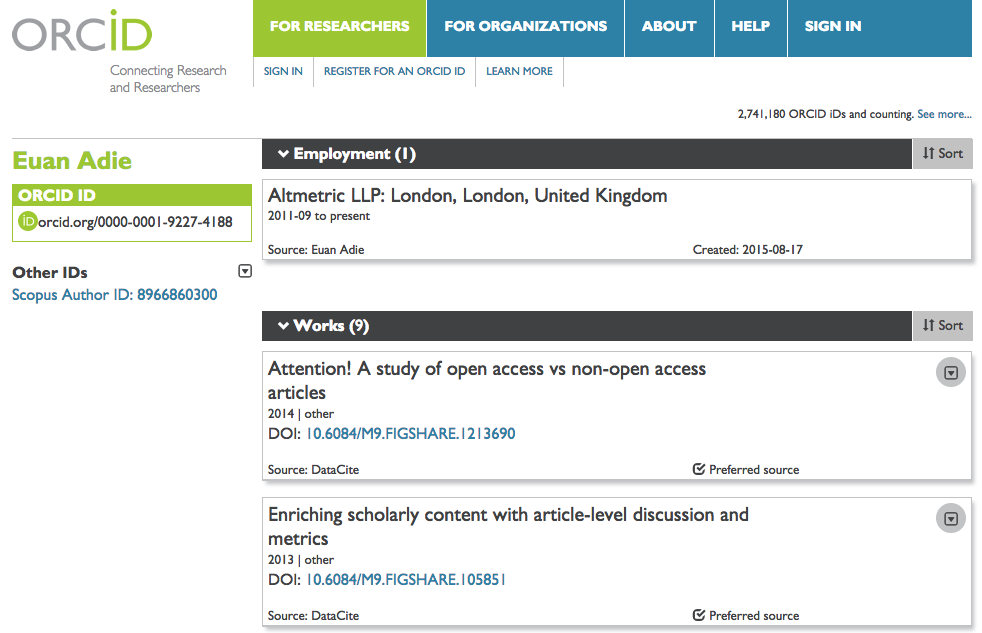
    1. Refer to authors names and initials in a consistent manner throughout the paper and in the same way they’ve been referred to in the past online publications.  If names are used inconsistently, search engines may not be able to id articles or citations correctly; as a consequence, citations may be assigned incorrectly, and articles will not be as highly ranked as they should be.  For instance, Jöran, Joeran, and Joran are all correct spellings of the same name (given different transcription rules), but Google Scholar sees them as three different names. Obtain an ORCID and use it when submitting works to publishers to aid dissambiguation.
  5. Use headings
    1. Headings for the various sections of your article tip off search engines to the structure and content of your article.  Incorporate your keywords and phrases in these headings wherever it’s appropriate.
  6. Cite your own, or your co-authors, previous publications
    1. Academic search engines, and especially Google Scholar, assign significant weight to citation counts.  Citations influence whether articles are indexed at all, and they also influence the ranking of articles.  When referencing your own published work, it is important to include a link where that work can be downloaded .  This helps readers to find your article and helps academic search engines to index the referenced articles’ full text. 
  7. Text in figures and tables should be machine readable
    1. Vector graphics containing font based text should be used instead of rasterized images so it can be indexed by academic search engines.  Graphics stored as JPEG, BMP, GIF, TIFF, or PNG files are not vector graphics.
    2. When documents are converted to PDF, all metadata should be correct (especially author and title).  Some search engines use PDF metadata to identify the file or to display information about the article on the search engine results page.

Three Ways to Optimize Articles after Publication

  1. Publish article on the author’s home page and upload it to eScholarship (if author is a UC Faculty it will most likely be harvested via the Publication Management System and then presented to the author for inclusion in the eScholarship repository) so it can be indexed by Google Scholar and other academic search engines. However, it is important to determine that posting or uploading the article does not constitute a violation of the author’s agreement with the publisher. Remember to save your final drafts (pre-publication) so you can submit it to the repository.
  2. An article that includes outdated words might be replaced by either updating the existing article or publishing a new version on the author’s home page as Google Scholar considers all versions of an article available on the web. Updated articles should be clearly labeled as such so a reader is aware it is a modified version. This procedure may be a violation of an author’s publisher copyright policy so be sure to check first.
  3. It is important to create meaningful parent web pages for PDF files. This means that Web pages that link to the PDF files should mention the most important keywords and the PDFs metadata (title, author, and abstract).

Promoting your Article Using the Internet and Social Media

Once your article is published, employ social media to enhance visibility of the research.  Update everyone in your academic and social networks about your published article.  The number of in-bound links is a factor in search engine ranking.  Share your article within the following social media tools (as appropriate for the research topic):
  • LinkedIn 
  • Facebook
  • Twitter
  • Your blog or websites that you contribute to
  • Your institution's repository (eScholarship University of Califormia)
  • Mendeley
  • ResearchGate
  • Your website
  • Your academic  institution's website
  • Wikipeadia (as an appropriate external link)

References

This guide is a compilation of three documents:

Want To Peer Review? Top 10 Tips To Get Noticed By Editors

Source:  https://publons.com/blog/10-things-you-need-to-know-to-get-noticed-by-editors/

Want To Peer Review? Top 10 Tips To Get Noticed By Editors

Ever awkwardly listened to your colleagues complain about too many peer review requests? Do you desperately nod your head in agreement despite the fact no journal editor has ever approached you?
It’s ok. You’re not alone: There’s a paradox in peer review and you’re probably caught up in it.
Academic journal editors say that getting reviewers to accept review invitations is the hardest part of their job. At the same time, there is an abundance of researchers like you, who have the motivation and determination to break into the world of peer review, but aren't given the opportunity.
This isn’t an ideal or sustainable scenario, and it’s causing a bottleneck in scientific research. One that, according to our Global State of Peer Review report, researchers believe can be solved with more training and better recognition for peer review.

Recognition is something we focus on a lot here at Publons -- but we also offer free, on-demand peer review training, too.
Find out more about gaining practical experience in peer review with the Publons Academy. You'll write real reviews with one-to-one guidance from your mentor, and gain exclusive access to our Review Template and examples. Also, upon graduation from the course, you’ll be a certified peer reviewer, ready to connect with top journal editors in your field.
Learn to peer review with confidence in the Publons Academy today.

Why learn to peer review?

We’ve interviewed numerous award-winning peer reviewers about what they get out of the process. Here are a few stand out quotes:
Those involved in peer review recognize how important the process is to maintain the quality and integrity of scientific literature. It can be daunting -- but it comes with huge benefits.
The benefits of peer review include staying abreast of the latest research trends in your field, improving your own writing skills and learning how to better present your own research to journal editors. Peer review also helps you to forge those critically important relationships with editors at the elite journals in your field, which can work in your favor when you submit your own work for publication.
Learn how to advance your career with peer review.
So with all of these benefits on offer, what can new academics do to get onto an editor’s peer review database? Check out our top 10 tips.

Top tips to become a peer reviewer


1. Contact editors directly: Email the managing editor of journals that interest you, describe your area of expertise and ask to be added to their reviewer database. You can also do this directly on Publons. Register for a free account and volunteer to review for any journal that partners with us. We’ll let the editors know and they will contact you when your skills match their needs.
2. Join researcher networks: Sign up to the online networks associated with your field and reach out to editors on there. For example, there’s ResearchGate for connecting with researchers, ORCiD so you have a unique researcher identifier and, of course, Publons - the home of peer review - to build your profile as an expert peer reviewer and be discovered by editors from elite journals.
3. Attend conferences: Go to conferences related to your field and seek out editors in the panel or audience to volunteer in person. Better yet, accept discussant roles for conference papers.
4. Complete Peer Review training: Attend in-person workshops to learn from and network with experienced reviewers and editors. You can also join the Publons Academy - our free, on-demand, practical peer review training course to master peer review. You’ll use our review template and example reviews to write real peer reviews, and you’ll have one-to-one support from a mentor of your choice. You’ll be a certified peer reviewer once you finish the course, and we’ll help you get break into the world of review by putting you in front of editors in your field.
5. Get recommendations: Similar to the above, talk with senior colleagues in your institution and ask if they can recommend you to editors in your field.
6. Try it out: Work with your colleague on their next peer review or, subject to the editor’s approval, do it for them. You can even get an independently verified record for helping with the review on Publons, and start building your profile as an expert reviewer.
7. Publish, publish, publish: Submitting your research to journals is a good way to get noticed. Once your paper is accepted take the opportunity to ask the editor about peer review.
8. Talk to other authors: Increase your academic visibility in a general sense. Journals often ask authors to suggest reviewers, and so if you make yourself known to authors you’ll eventually make yourself known to editors.
9. Follow up with editors: Follow up with any editors you’ve had contact with in the past and let them know your availability. Ask them to extend your offer to their co-editors.
10. Don’t give up: Timing is key to getting noticed. If your skills don’t match the immediate skills required by the editor, that doesn’t necessarily mean they won’t in the future so try again in a few months.
Let us know how you get on - we’re keen to hear your feedback. And if you’re an editor looking for more peer reviewers - check out our guide to help you just that!

Want to learn more? Become a master of peer review and connect with top journal editors as a graduate of the Publons Academy -- your free online course designed by expert reviewers, editors and Nobel Prize winners. Publons Academy

Jo Wilkinson

Jo Wilkinson is the Head of Communications at Publons, helping to bring researchers' stories and peer review news to the world.

17 tips for promoting your article

Source: https://academic.oup.com/journals/pages/authors/promoting_your_article

17 tips for promoting your article

Congratulations on the publication of your article. At OUP, we ensure that your article is highly discoverable and can be found by the people who need to read it.
We also encourage you to be involved in promoting your article. As the author, you can make a real difference by raising the profile of your research and talking to your peers, the public, and other potential readers. What you do may depend on your research, your field, and how much time you have, but we encourage you to think about how you can support the promotion of your work.
If you are interested in improving the visibility of your work more actively, take a look at our recommendations below.

Top tips

If you have less than an hour: use your existing networks – online and in real life.
  1. Use your toll-free link to share your article with your colleagues and friends. Your toll-free link will be sent directly to you by email once your article has published. It provides permanent, free access to your article, even if your article is updated. Open Access articles are always freely available to all readers.
  2. Add the toll-free link to your email signature for colleagues and friends.
  3. Update your professional and/or institutional websites with information about your article and the toll-free link.
  4. Include information about your article in relevant seminars or conference presentations.
  5. Share news about your article on any social media that you use: Facebook or Twitter for example. You might include a summary in plain English, a video, or a snappy headline. Please note that the toll-free link should not be shared via social media.
  6. Do you use LinkedIn? Share news about your article in your newsfeed, and be sure to add it to the publications section of your profile.
  7. Recommend the journal where your article is published to your institutional or university librarian, if they do not already subscribe.
  8. Sign up for an ORCID author identifier to distinguish yourself from any other researchers with the same name, create an online profile showcasing all your publications, and increase the visibility of your work.
If you want or have time for an ongoing commitment: find a niche and get involved.
  1. Discuss and promote your article at conferences.
  2. Think about which social network would suit you; you may find like-minded people on Twitter, Tumblr, Medium, Reddit, or Instagram, for instance. Every platform has distinct communities and interest-groups; take some time to find what you enjoy. If you’re not sure which platform is right for you, there are a lot of websites out there designed to help you choose, like this one.
  3. If you want to use a new platform to talk about your work, you should join and try to build up a following at least several months before publication. Use the opportunity to talk, share ideas, and get involved in the conversations before you begin promoting your article.
  4. Get in touch with leading bloggers in your subject or discipline and offer to write a guest post about your research.
  5. Consider starting your own blog to explore and share your ideas, communicate with a wider audience, and raise your online profile.
  6. If you are interested in wider dissemination among non-specialists, such as policy-makers and the general public, get advice from your institution, faculty, or funding body about public engagement.
If you want to track the impact your research is making: use our free tools to track article-level metrics.
  1. Find out how many people are reading, downloading and citing your article by clicking ‘View Metrics’ on the article page.

  2. The ‘Citations’ metric is the number of citations attributed to the article in the ‘Web of Science Core Collection’ database.
  3. You can also track Altmetrics for your article, to understand how it is being received more widely. Altmetrics (alternative metrics) track mentions and shares across traditional and social media channels, blogs, public policy documents, post-publication peer-review forums, and online reference managers.

  4. Click on ‘See more details’ to explore metrics in depth, including demographic breakdowns and links to blogs, news articles and other references.

Article metrics

See this page for information about article-level metrics, including usage, citation and Altmetric data.

Social media

See this page for information about promoting your article via social media.

10 tips for promoting your research online

Source: https://blogs.biomedcentral.com/bmcblog/2017/10/18/10-tips-for-promoting-your-research-online/

10 tips for promoting your research online

How do you make sure the right people are seeing your research? Is it being read as much as you’d like? In this guest blog, Joshua Clark, Marketing Executive at Altmetric shares some useful tips.
Promoting your research online is vital if you need to provide evidence of the reach and potential broader influence of your work, particularly when applying for promotion or tenure and funding. Here are some top tips to help you get started:
1. Put together a strategy
Begin by thinking about which researchers and other audiences will be interested in your research, the disciplines they work in, and where they can be found. Are they within your institution, or somewhere further afield?
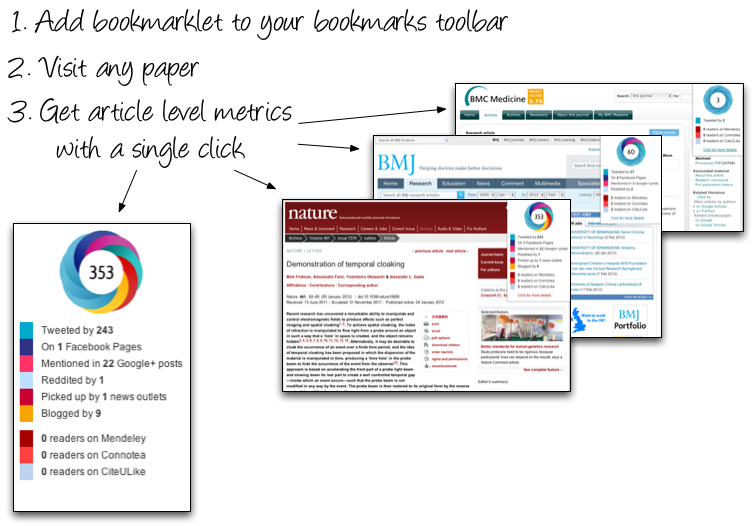
Next, think about the channels that would be most suitable for to promoting your work to your intended audience. It can be a good idea to start by looking at the channels that other researchers publishing in your field have used to get their work noticed. One way to do this is to use the Altmetric Bookmarklet.
2. Write a summary
You might want to consider writing a plain English summary of your work, focused on making it more accessible to a wider audience. This will provide a good lead into your research and encourage more people to read your article.
You could then post the summary to online discussion groups and forums that you think might find it relevant. Or, if you’d rather go that extra mile, why not put together a short video summarising your work and sharing it via websites such as Wesharescience.com.
3. Make your data available
Publishing an article doesn’t tell the full story of your research. You can make images, files and other outputs associated with it available through a digital repository such as Figshare. When you upload your research to a repository they will give it a unique identifier. This makes citing your research easier, as well as tracking online attention with services such as Altmetric.
4. Post on social media
Post links to your work via any social media accounts you have. You could also focus your promotion around any significant events that are happening, such as conferences that may be interested in your research topic, by using the event’s hashtag.
As well as using your own social profiles you may find you get more engagement from using your department’s accounts.
5. Start a blog
Think about starting your own blog and posting about your work. It doesn’t need to be a huge task and creating a simple schedule can help you post regularly.
You could also look into contacting some established bloggers that are writing about your subject area (easily identifiable via the Altmetric details pages for other publications in your field), or anyone who has a big following on Twitter that may be interested in sharing your work.
6. Link out from your email signature and profiles
It might seem obvious, but adding a link to your work to your email signature is a must! By doing this you are ensuring that your contacts are kept up to date with your latest research.
7. Use your Research Office
If you feel your work could benefit from an extra promotional push why not get in touch with your Research Office, as they may be able to help make your work more visible.
They might have access to channels such as email lists or have contacts that could be used to get your research noticed by news outlets or government agencies. Having your research mentioned on higher profile websites will increase your readership and look great on future applications. Also consider providing your research office with some key points of why your work matters and what the key outcomes were, as this can help them build a pitch for a broader audience.
8. Register for an ORCID ID
Register for an ORCID ID so that you have a unique identifier which will tie you to your work and distinguish you from other researchers. It’s easy, free and will come in useful for any manuscript or grant submissions.
9. Make your research open
Having your work freely available to read may mean that your research reaches a wider audience and see a higher level of citations. If you would like to publish your research in this way visit your Research Office who will be able to advise on the best course of action.
10. Unique Identifiers
Make sure that whenever you mention your research online you use or link to a page that includes your work’s unique identifier, this can be a DOI, arXiv ID or PubMed ID. This is vital to ensure that your work is tracked by us at Altmetric so that you can keep on top of the conversations surrounding your research. It will also mean that your work becomes easily discoverable and so is more likely to be read and cited by other academics.
Track the results of your efforts!
Find out the impact of your promotional efforts by using stats provided on publisher websites, such as Altmetric badges, and by using tools like the Altmetric Bookmarklet.
If you’d like to read the original version of this post why not visit the Altmetric blog here.