Saturday, 2 March 2019

Canada uses blockchain to make research grants more transparent

Source: http://www.digitaljournal.com/tech-and-science/technology/canada-s-national-research-council-trials-blockchain-technology/article/513117

Canada uses blockchain to make research grants more transparent

By James Walker     Jan 25, 2018 in Technology
The Canadian government has begun trialling blockchain technology as a way to improve the transparency of research grants. The National Research Council (NRC) is currently using an Ethereum-based system to publish funding information in real-time.

In a blog post, the NRC explained how blockchain technology could help to make government contracts more transparent. The blockchain's public ledger means data recorded on the system is unalterable and open to everyone. This provides transparency into the workings of government, which in turn promotes trust.
To implement the trial project, the NRC has partnered with Canadian blockchain SME Bitaccess. It's also working with the Industrial Research Assistant Program (IRAP), a body that generates a large volume of transactions each year and which would benefit from improved transparency.
Using funding from the Build in Canada Innovation Program, the NRC and Bitaccess are piloting a blockchain record-keeping system for the IRAP's financial activities.
The program is part of the Canadian government's wider efforts to improve transparency and utilise modern technologies. The NRC will be responsible for investigating how the blockchain could be applied to other areas of government. If the pilot proves successful, Canada could begin using blockchain more broadly to preserve public records and maintain transparency.
READ NEXT: Apple previews new ARKit version with improved object recognition
The trial is described as the first "real-use case" of its kind for deploying blockchain tech inside public institutions. The NRC said it expects to acquire "constructive" insights into how blockchain could be used by government bodies. Many tech visionaries see blockchain as crucial to the future of business but it's still a new concept to most official organisations.
"These are early days yet, but the experiment is expected to provide constructive insight into the potential for blockchain technology and how it may be used for more open and transparent function of public programs," said the NRC. "This experiment also marks an important step forward for the technology and a commitment by the Government to support emerging Canadian innovation."
The blockchain is currently best known as the infrastructure supporting cryptocurrencies such as Bitcoin. In this scenario, the blockchain records every transaction on a decentralised public ledger. As the blockchain is immutable and distributed across computers around the world, the data stored within is always secured against external tampering.
These qualities are also what makes the blockchain concept attractive to organisations that need to store data transparently. The Canadian government's initiative is just one example of how the tech could be used. Other recent blockchain-based projects have included schemes aimed at sports fans and unsustainable practices in the tuna industry.
More about blockchain, Canada, digital transformation, data transparenc

Decentralized Peer Journal

Source: https://github.com/district0x/district-proposals/issues/94

DP 94: Aristotle0x - Decentralized Peer Journal

Purpose

Currently the peer reviewed journal process is fraught with inequality and inefficiency due to fraudulent paper submissions, perverse incentives, and expensive paywalls barring access to newly published papers. This proposal is designed to solve these and many other issues with academic, scientific, government, and professional journals in order to ensure incentives are in-line for each party, improve the content of published research, and ensure instant access to newly completed research without needing to pay for a subscription. These efforts would help drive future scientific progress by reducing cost and incentivising quality submissions.

Description

The traditional peer review process is designed to be a form of self-regulation where one or more people of similar competence evaluate the work of the producer i.e. author(s). By having those qualified in the profession able to provide expert feedback to the author(s), a feedback loop is created that allows the author(s) to refine their work. In turn, this assures that the final work maintains a standard of quality, improves the performance of the author(s), and provides credibility from trusted names in the field.
In the current environment this process is controlled by many separate journals that focus on different specialties across the spectrum of fields. This process requires coordination of the journal to ensure proper referees are selected and then an editor ensures the works selected for publication. The reward for those doing the review is minimal (typically just a resume booster) and the editor of the journal is typically working to ensure the reviewers are a match for the topic and able to do quality work. After publication the journal charges universities and individuals exorbitant fees for access to the works that help fuel innovation. These high fees are charged even after public and/or government funding was used to do the research in the first place. This often leads author(s) to host a second version of their paper on a personal site ensuring their work is accessible to others who can’t afford to pay the journal’s fees.
Often, funding decisions are partially based off of how many papers a researcher has published. This has resulted in fraudulent and randomly generated papers designed to subvert this process by passing themselves off as real articles. This dilutes the quality of the research being done and diverts valuable resources away from legitimate endeavors instead of trying to pad stats or generate revenue.
This project aims to break down these barriers by allowing open access to the research created by the author(s) while simultaneously rewarding quality content with monetary rewards as well as a reputation score based on activities. The platform’s submission and review process will be transparent, allowing others to review previous correspondence and interactions with the author(s) and reviewer(s). Along with these features, it would be paramount to ensure that incentives are properly aligned to increase research productivity by reducing overhead of the review process, reducing the cost of referencing other works, reducing fraudulent activities, and rewarding those that do the best work.

How it would work

At a high level, this project can be thought of as a hybrid social platform (DApp) based on reputation combined with a typical journal model. Each user (author) would need an account that can be attributed to their work(s). If there were multiple authors on the submission they too could be tied into the submission. After submission of the research, the platform would identify those that are deemed "experts" in the field and randomize reviewers (referees). Once the referees have been selected they will have a predefined number of days (this will be configurable) to submit suggestions and revisions, at which point the author will then be given a specified number of days to make modifications. After a reviewer and author are in agreement that the work is completed to satisfaction, both parties must sign off to submit the final version to the platform. At this stage all reviewers have agreed with the author and the paper can then be considered "publishable" and available to anyone who wants access to it.
To lower the barrier to entry of this platform it will be vital to ensure author(s) can easily interact with the platform. Ideally this would include a method of account creation and account funding outside of exchanges by providing an interface as easy to work with as Google or Amazon (the holy grail of DApp adoption). In general, those submitting to this platform would not be the most technically savvy since their area of focus is unlikely to be the use of computers (our differences make us better).
To help reduce fraud, the author will be required to make a non-trivial escrow payment, held by the platform (blockchain) to indicated the author’s intent on going through with the entire process. Once specific goals or thresholds are met this initial escrow can be distributed to the referees once their work is complete to provide incentive (payment) for their part of the process. When a paper completes the review process, the author(s) would eventually get a reward and would also be entitled to any proceeds the paper may garner (tips/donations/web traffic).
The platform would also build a reputation system for those involved in the process by being able to score each account based on success of each "published" paper. Those who submit content and those who review/referee content would all improve their reputation based upon the success of the papers they submit or review. Once a paper is "published" it can be released as an article on the platform or even grouped into a monthly publication that the journal produces for easier readability.

Topic Overview (In Progress - Whitepaper in Progress)

  • Problems Solved
    • Transparent Review Process
      • See who the reviewer's are
      • See reviewer(s) history and rating
      • See reviewer(s) area(s) of expertise
    • Reward author(s) and reviewer(s)
      • Highly rated and highly referenced submissions will increase personal reputation and potential payouts.
    • Open Access to each Paper (ideally stored on the blockchain)
      • Open to anyone who wants to reference it for free
      • Remove paywall, especially in the medical field where most grants are taxpayer funded.
    • Open paper submission to anyone (lower barrier to entry)
    • Encourage reproducing work presented in other papers
      • This ensures results previously published are valid and can be reproduced in another (similar) setting (or can't be reproduced)
    • Encourage publication of expected or negative results
      • Research that has an expected or negative result is typically not published since it is not deemed important. This platform would allow and encourage these findings with reputation and reference rewards.
    • Reduce submission of Spam
      • Escrow payment possible to signal intent to publish
    • Utilize Knowledge of the crowds
      • District0x users can help determine usefulness and popularity while reviewers will be expected to maintain the quality of submissions.
  • Journal Process
    • Editor(s)
    • Governing Body (District0x or experts)?
    • Publish election and validation
  • Areas of Peer Review Focus
    • Professional
      • Potential issues may arise here if the topic is not allowed to be shared publicly
    • Scholarly/Research
    • Government
    • Medical/Clinical
    • General
      • An open area for those looking for review of their paper that are not necessarily looking to be published
  • Publishing Process
    • Author(s) submit proposal
      • Escrow payment to help to avoid/reduce spam
        • Should a governing body or District0x token holders be able to vote on papers that may need escrow help due to its importance?
    • Reviewers Selected
      • Initially, this will be a large hurdle to overcome to ensure reviewee's are qualified in the field they are covering.
      • An editor or experts in the field (perhaps the author(s)) could recommend potential reviewer(s)
    • Review Process
      • Checkpoints will be required to ensure that expectations and timelines are met (the time can be dynamic and enforced by a smart contract)
      • Should be transparent with critique and/or suggestions provided when possible
    • Publish Phase
      • Once a predetermined number (3?) of reviewers accepts the paper it can be deemed as "published" on the platform
      • At this phase all entities will start generating/gaining reputation scores
    • Payout
      • The initial escrow will be distributed between the reviewers and author(s) (This amount will be variable and dependant on the decision of requiring an escrow to start the review process)
      • The payout will be handled by a smart contract on the blockchain and that will close out the publish process for the paper submitted
  • User Experience and Visualization - i.e. Front End
    • Streamline experience required
      • Account creation and management
      • Deposit/Withdrawal needs to be seamless for the author(s)
    • Explore potential integration with the Open Science Framework
      • Open source front end for presenting and managing the publication process
  • Data Storage and System Logic/Functionality - i.e. Back End
    • Infrastructure
      • Utilize a blockchain (Ethereum) to store papers, entity, and reputation data (Augur/d0xINFRA)
    • Architecture
      • Each paper, author, reviewer, etc. needs to be identified and a "profile" created around them.
      • Each entity will have an activity and reputation score associated to them.
      • Each paper needs to have bibliography/references linkable with reputation score
        • This should help ensure references are reputable and the paper itself holds higher value
  • Reputation (TO DO)
  • Potential Revenue Streams
    • Publish a "best of quarter" journal or journals with a specific topic (Example: AI research)
      • While all research will be accessible for free a quarterly journal could be published that features the best articles or the most impactful.
      • District0x token holders could help vote for the best articles on the platform
      • This could be sent to those willing to subscribe to the quarterly digest as well as funding via selling ads in the digest.
    • Philanthropy and/or donations
      • It is not unusual for research to be funded by donations and this could be extended to the journal process
    • Ad based revenue (not preferred)
      • The web platform that serves the papers could have select ad's
PS: Please vote by thumbs up if you like the proposal

Friday, 1 March 2019

Could Bitcoin technology help science?

Source: https://www.nature.com/articles/d41586-017-08589-4
NEWS

Could Bitcoin technology help science?

Blockchain could lend security measures to the scientific process, but the approach has its own risks.
Blockchain mining computer array in South Korea
Mining for bitcoins creates a large computational demand.CREDIT: Seung-il Ryu/NurPhoto/Getty
The much-hyped technology behind Bitcoin, known as blockchain, has intoxicated investors around the world and is now making tentative inroads into science, spurred by broad promises that it can transform key elements of the research enterprise. Supporters say that it could enhance reproducibility and the peer review process by creating incorruptible data trails and securely recording publication decisions. But some also argue that the buzz surrounding blockchain often exceeds reality and that introducing the approach into science could prove expensive and introduce ethical problems.
A few collaborations, including Scienceroot and Pluto, are already developing pilot projects for science. Scienceroot aims to raise US$20 million, which will help pay both peer reviewers and authors within its electronic journal and collaboration platform. It plans to raise the funds in early 2018 by exchanging some of the science tokens it uses for payment for another digital currency known as ether. And the Wolfram Mathematica algebra program — which is widely used by researchers — is currently working towards offering support for an open-source blockchain platform called Multichain. Scientists could use this, for example, to upload data to a shared, open workspace that isn't controlled by any specific party, according to Multichain.
Blockchain, a technology that creates an immutable public record of transactions, has a “Wild West, boom or bust culture”, says Martin Hamilton, a London-based resident futurist at Jisc, which supports digital services in UK education. He warns that academics and entrepreneurs might be tempted to add the technology solely to make their projects seem “magical and sparkly”. As one sign of this trend, consulting firm Deloitte has identified more than 24,000 aborted, largely financial, blockchain projects on the GitHub software-development platform in 2016 alone. Yet Hamilton still says blockchain has incredible potential. “There will be things that we try which simply blow up in our faces,” he says. “But the rewards can be huge, if you’re willing to take a calibrated risk.”
Blockchain underlies cryptocurrencies such as Bitcoin, which is traded as units called bitcoins, with a lowercase ‘b’. It is created by a community of ‘miners’, who run Bitcoin software on their hardware and compete to discover a hard-to-find number by trial and error. The victor of this contest adds an encrypted block of transactions to the chain and earns a financial reward. They communicate the extended blockchain to all the other miners, and the process starts again.
Foolproof tracking
Mining takes a lot of computation, which makes it unlikely that any individual will win twice in a row. This is crucial, because if miners could add more than one block, they could gain power over the record and even discard earlier blocks they had added. That would effectively refund their transactions and enable them to spend the same bitcoins again. In 2016, a consortium of miners highlighted that vulnerability by working together to add multiple blocks, although the group voluntarily disbanded once they came close to achieving it. And because mining is hungry for computing power, Bitcoin’s miners consume more electrical power than many countries, according to analysis platform Digiconomist.
One way blockchain technology could help scientists is by reliably collecting and preserving data concerning research activities. This would make it easier to reproduce results in cases where published accounts insufficiently explain methodologies, according to Joris van Rossum, director of special projects at Digital Science, a research-technology firm in London. Blockchains could also be used to track each transaction in the peer-review process, says van Rossum, which could build trust in the process by recognizing reviewers’ efforts and potentially rewarding them with digital currency. And open blockchains would generate information such as how frequently researchers collect measurements, enabling people to look beyond metrics such as publications and citations, he says1.
Currency-free science
Scienceroot and Pluto are part of the same ‘universe’ of open-blockchain technology as cryptocurrencies, says Gideon Greenspan, founder of London-based Coin Sciences, which developed MultiChain. Greenspan says that such currency-style blockchains are unsuitable as scientific archives, because recording each transaction incurs a financial cost, which can easily add up. Costs in research applications would increase faster than it does for cryptocurrencies because modern science produces far more data.
Private “permissioned” blockchains without the currency element — which MultiChain lets people set up — are a better choice, Greenspan says. This approach sacrifices the security offered by Bitcoin’s mining process for a simpler system that gives members permission to add blocks to the chain in turn. This also lowers power consumption.
Claudia Pagliari, who researches digital health-tracking technologies at the University of Edinburgh, UK, says that she recognizes the potential of blockchain, but researchers have yet to properly explore its ethical issues. What happens if a patient withdraws consent for a trial that is immutably recorded on a blockchain? And unscrupulous researchers could still add fake data to a blockchain, even if the process is so open that everyone can see who adds it, says Pagliari. Once added, no-one can change that information, although it's possible they could label it as retracted.
In Pagliari’s experience, researchers exploring blockchain are becoming wise to its problems. She notes that fellow speakers at a recent London ‘hackathon’ on using blockchains to improve clinical trials, for which Microsoft was a partner, were careful to warn about hype. That suggests “a realism that no solution is perfect and the value of blockchain in this context remains unproven”, Pagliari says.
Nature 552, 301-302 (2017)
doi: 10.1038/d41586-017-08589-4

Say blockchain one more time! What is the real value of blockchain to higher education?

Source: https://blogs.lse.ac.uk/impactofsocialsciences/2019/02/28/say-blockchain-one-more-time-what-is-the-real-value-of-blockchain-to-higher-education/

Say blockchain one more time! What is the real value of blockchain to higher education?

The revolutionary potential of blockchain has been much touted in many fields including research and higher education. In this post, Martin Hamilton discusses some of the potential applications of blockchain to academia and raises key questions about how these systems could be implemented and safeguarded from malicious exploitation.

Blockchains are all the rage right now. They’ve joined cloud computing, big data and artificial intelligence in the pantheon of go-to tech psychobabble, regularly featuring in the word salads produced by thought leaders and influencers, as they prep for what they hope will become their TED talk. If you believe the hype, blockchain can cure cancer, solve Brexit and perhaps one day it will also turn out to be a floor wax and a shoe polish.
Blockchain Basics
There are plenty of introductions to blockchain out there, so I won’t waste time and space here repeating them, but there are some important fundamentals to understand before we can think about the academic context of this technology.
Essentially, blockchains are very slow databases that data can be added to but not (typically) updated or deleted – once you put something ‘on’ the blockchain it’s there for good. And like many conventional databases they can be smeared (distributed) across lots of computers, so they aren’t reliant on one computer being online and working properly.
Blockchain enthusiasts are still struggling to figure out how to split a big blockchain database into lots of little bits, so you might still need some high-performance computers if you plan to store lots of data. This is due to the fact that blockchain ‘transactions’ (like ‘updating the Land Registry to record that Martin bought the house’) typically need to be confirmed by all the computers that the blockchain is smeared across, which can take quite a long time.
Most blockchains use quite small data blocks – if we want to store big files like images and PDFs they end up having to be chopped up into lots of little bits, or stored somewhere else, with a pointer to that other place (like a URL) put onto the blockchain.
Academic Blockchain
What does all this mean for potential blockchain applications in research and education?
In my horizon scanning report on the potential of blockchain I considered a few use cases and how blockchain might help. For example:
  • A universal user ID or self-sovereign identity that you own and control – choosing who you release what information to, like ORCID on steroids
  • An academic portfolio of grants, publications etc that can be updated directly by your funders, editors and collaborators
  • A unified mechanism for tracking citations and data-reuse, facilitating open science and reproducibility
  • A universal academic transcript for all learners, at all levels of education – perhaps with transferrable credit building up on an earn-as-you-learn basis
Garbage in – garbage out
At face value there is much to get excited about here, but in a piece for UKSG Insights looking at potential blockchain applications for libraries, I wanted to highlight one particular problem that blockchain itself cannot solve – we could call it ‘garbage in, garbage out’ but more accurately it is the issue of false or potentially malicious information stored on the blockchain.
Consider the following example: We recently heard that images of child abuse have been stored on one popular blockchain database, which arguably makes the database itself illegal in many countries. In the UK, for example, mere possession of these images can lead to sentences of five years imprisonment, with sentences for distribution of up to ten years in prison.
Another example of malicious information is data that has been crafted to interfere with software and systems, such as the smart contracts that would underpin use cases, like my hypothetical land registry application. In one recent example, US$79m of Ethereum cryptocurrency was stolen by attackers exploiting a bug in a smart contract used by the Parity software, a popular ‘wallet’ for storing cryptocurrency.
Data could also simply be false, though. There has been a lot of excitement about using blockchain technologies to create a digital provenance scheme building on the legacy of initiatives like Fair Trade. However, if we are to be confident about the provenance of anything from a chocolate bar to research outputs (which can sometimes be falsified), then we need to be confident about who is putting the data onto the blockchain, and the data itself. And even with the very best digital infrastructure, people will put lies on the blockchain.
To make informed use of new technologies like blockchain, it follows that we need to do something which is quite alien to many technologists – we have to ‘threat model’. What might a bad person attempt to do? What would the impact be? How could we guard against it? 
It transpires that many of the potential mitigations negate the supposed advantages of blockchain technology – for example, if we simply want to be confident that our academic profile, or learner record, is not going to be abused by pranksters, then perhaps it shouldn’t be an immutable database that anyone at all can add entries to.
For blockchain to work, especially in education, there must be some sort of gatekeeper, if only to separate the wheat from the chaff. For instance, sometimes honours are revoked, or marks adjusted on appeal, so there must be a mechanism to record this – in a way that isn’t prejudicial for the plaintiff. If anyone can peruse the blockchain (through one of the many explorer applications, perhaps) then these adjustments will be there for all to see, because the blockchain itself is immutable.
Never say never though, because it is always possible to have sensitive information, particularly personal information, stored elsewhere, and keep a reference to it (like a URL) on the blockchain. But then what is the blockchain really for? What are the semantics of putting that pointer onto the blockchain? In the case of an academic record should we opt for ‘LSE graduates’, ‘Former students of LSE’, or just ‘People who in some way have had an association with LSE at some point’?
Beginning of the end, or end of the beginning?
It may seem that I’m saying that blockchain is more hype than substance, and indeed there is a considerable amount of dot-com type irrational exuberance. However, the reality is that blockchain technologies are at a similar point to the early World-Wide Web of the 1990s, or to go even further back: potentially as transformational as the telegraph was in the Victorian era.
Blockchains are not going to go away any time soon, but we have yet to see their final form – just as today’s web bears very little resemblance to the medium for scientific discourse originally envisaged by Sir Tim Berners-Lee, all those years ago.

This blog post is based on the author’s article, Of modems and pixie dust – blockchain demystified published in UKSG Insights.
Note: This article gives the views of the authors, and not the position of the LSE Impact Blog, nor of the London School of Economics. Please review our comments policy if you have any concerns on posting a comment below.
Image credit: Hitesh Choudhary via Unsplash 
About the author
Martin Hamilton leads the future and emerging technologies team for Jisc, operators of the Janet network. His role is all about generating and channelling new ideas and building partnerships to bring them to fruition. Martin is particularly interested in the societal implications of ubiquitous robotics and artificial intelligence, and humanity’s emergence as a true interplanetary species.
Print Friendly, PDF & Email

Leave A Comment

Blockchain is NOT a cure to Academia

Source:

Blockchain is NOT a cure to Academia

The story of Pluto, the rise of Scinapse

Bitcoin, de facto the first Blockchain

Retrospect 2017

Academia has been encountering some problems due to the complex misalignment of interests among many players in the research ecosystem. In 2017, several projects have emerged with the goal to solve these problems with Blockchain. Pluto team was one of the early entrants among them. We believed that Blockchain, a distributed ledger technology where a community of same interest grows a common chain of data with a consensus protocol, could help for solving this problem.
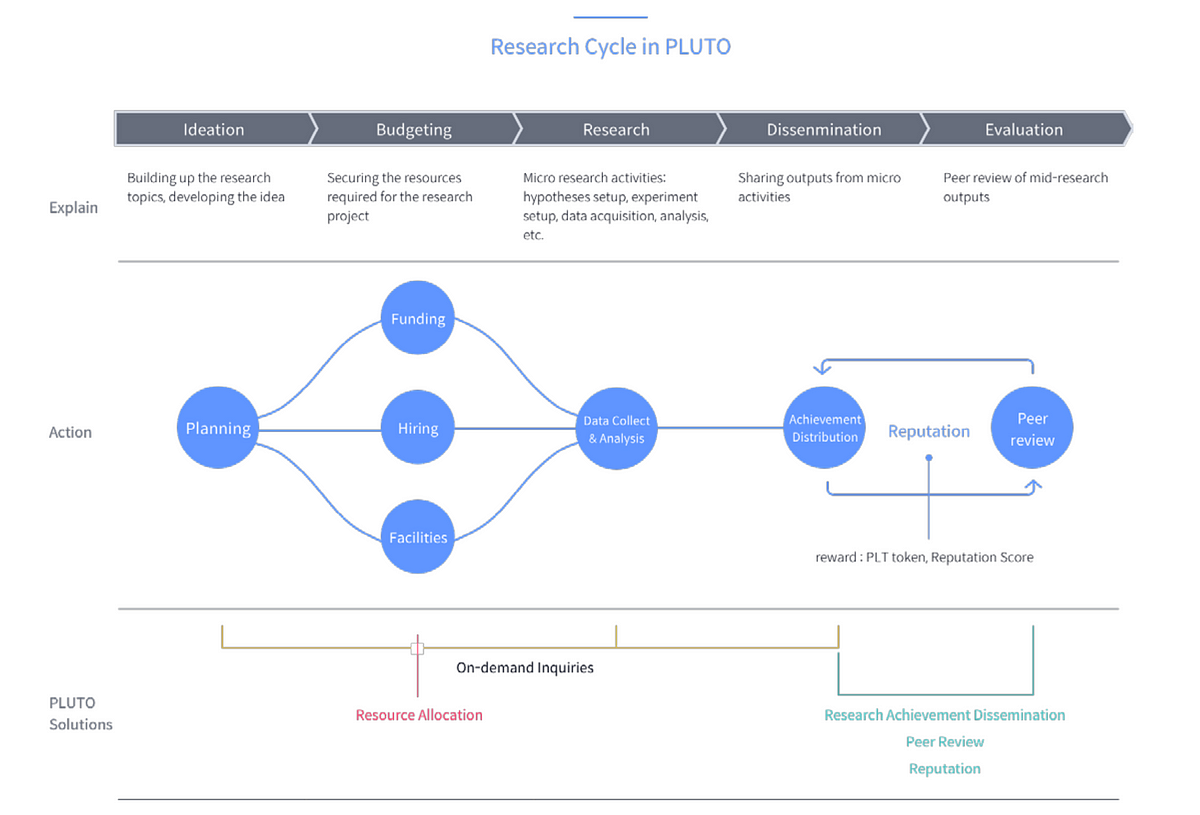
We had designed the decentralized platform which is for scholarly communication where any sort of players involved in the academia(i.e. researchers, institutes, funding agencies) can utilize with 100% confidence without the need of trust. What we mostly focused on in platform design was the process of publishing the research paper. The key point of the process of publishing is the peer review system. The peer review system is the process of subjecting an author’s scholarly work, research, or ideas to the scrutiny of others who are experts in the same field, before a paper describing this work is published in a journal, conference proceedings or as a book. The peer review helps the publisher (that is, the editor-in-chief) decide whether the work should be accepted, considered acceptable with revisions, or rejected. Current peer review system with publishers has problems in that it gives no compensation for researchers’ contributions and that it is very inefficient. So we made a lot of effort to design a peer review protocol for a publishing service in which, when a researcher publishes the paper, other researchers review the paper and receive rewards according to their contributions. We thought that on top of smart contracts system enabled with Blockchain, a reward mechanism with tokens and reputations could make better scholarly communication ecosystem. And it will be the key to solve the problem of oligopoly by commercial publishers.
Initial Pluto platform design
However, when we finished the design of the platform, we got the following question.
Does academia need the decentralized publishing platform that uses Blockchain to solve the incentive structure problem? Yes.
If so, can the decentralized publishing platform solve the current problem of academia? No.
That is, although the decentralized publishing platform can alleviate the problem, it does not actually eliminate the key causes. Yes, this was a very idealistic plan. Even if there was a decentralized publishing platform, the indicators for evaluating researcher or their achievement(paper) are under the influence of journals owned by publishers. Therefore, researchers must continue to follow the Ancien Régime in order to sustain their career (incl. funding). In addition, scholarly communication as we know today has slowly evolved over the centuries, so adopting Blockchain technology in academia could be a radical change that requires a broad consensus of all stakeholders. The fact that the new platform is not easily accepted means it takes a long time to solve the problem with the new solution.
To summarize, we found the big problem in academia and were excited because we believed we could solve it. So we rushed and made a wrong judgment about priority. Suppose academia is a house, and it requires remodeling. The first step would be to check “structural design” and to find the pillars which are core support of the house, we focused on cleaning the house inside with expectations for a new house. That is, we designed the services we needed to eliminate problems identified right away, rather than figuring out the problem from a large scale to a small scale and then figuring out the roadmap for solving the problem.
Of course, this step is not meaningless. The peer review system is something that needs to be improved someday and we have experienced the pros and cons of developing decentralized protocols with smart contracts, specifically what they CAN DO and what they CAN’T. (e.g. smart contracts can’t handle with information that is not machine readable) It’s just we made a mistake in setting priority for problem-solving.
We needed to re-check the core cause of the problem.
The fundamental cause that we thought was:
Researchers and research achievements are not being evaluated rationally.
Currently, the evaluation of researchers and research achievements depend mainly on the impact factor(IF) of the journal and the number of citations or publications. That means, there is no evaluation metric which is reasonable and journal-independent.
If there are reasonable evaluation metrics, researchers could be able to just focus on their research they want, free of external nuisances. We thought this would be the most important and necessary first step in solving the problems of academia. Therefore, we decided to prioritize to make new evaluation metrics which are reliable and objective, rather than to develop a decentralized publishing platform.

Retrospect 2018

Start with Scinapse

In January 2018, we launched Scinapse the academic search engine. Because this was not the decentralized platform which we had been telling, most people had questioned.
This is based on the background mentioned above, which is the result of our re-direction to solve the problems of the academia sequentially. But why did Pluto choose an academic search engine in finding new metrics?

Why Pluto team makes Scinapse?

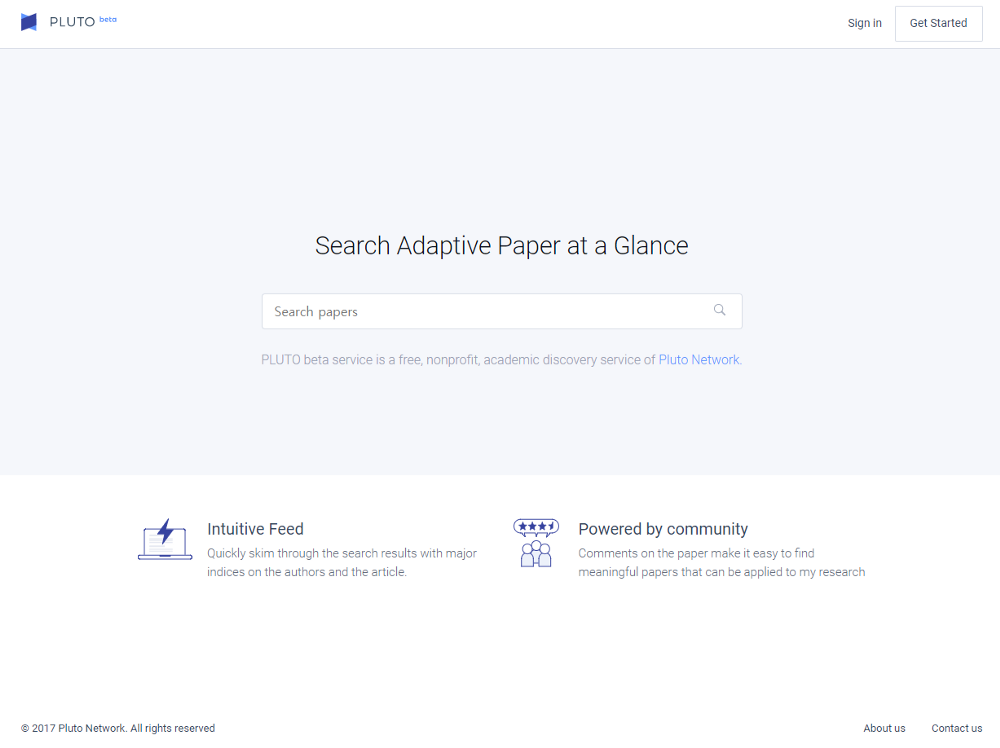
Pluto Beta: Initial main page of Scinapse
We were looking for a new metric to evaluate the objects of academia such as researcher, paper or anything that comes out of the research process. But there was another problem in making new evaluation metrics. The current academic data(i.e. author data, paper data) is totally a mess. There is no academic data with a standard form because all academic data is torn apart by publishers and journals. This problem makes it impossible to make metrics for evaluating individual researchers or their research achievements.
Another huge lesson we learned from our quick voyage into research ecosystem through 2017 was that we cannot solve problems, specifically these kinda where it’s largely dependent on the structural absurdities, without building a community of supporters who would be the grassroots game changers in solving the problem. That was another significant reason we determined to develop a service that can be readily used by actual researchers, right at the moment, thus a community can be formed.
In conclusion, the academic data must be refined and standardized. This is necessary not only for solving current problems of academia but also for the future research community. If academic data is well organized, new evaluation metric can be found based on this, and it makes the environment in which researchers and research achievements can be reasonably evaluated. We believed that this environment, and the community to run on this, is the first step in solving the problem of academia. So we made Scinapse!

What did Pluto do in 2018?

What we had done in 2018 can be divided into 3 broad categories.
  1. Developing ScinapseRefining and Standardizing academic data
     — Paper data: We have collected the paper data which comes from various journals.
     — Researcher(author) data: This can be described as our open project. We focused primarily on removing the author name ambiguity.
     — Journal data: We have collected journal data such as the IF of journals or their fields of study.
    Adding various features
     — 
    We had developed features that can make value as “Discovery” such as Paper show page or Collection features. Based on the search engine with refined and standardized academic data, we will develop the various feature for researchers such as the decentralized publishing platform we told or LinkedIn of the research community. Scinapse will be the foundation for eliminating the complex problem of academia.
     — We have developed these features: Search feed, Paper show page, Author show page, Author profile, Journal show page, Collection feature
  2. Communicating with stakeholders in the research communityOnline channel We have been communicating our news through Telegram, Twitter, Medium, Facebook, E-mail, etc. Especially, the series post which has been published on Medium is one of our efforts to continuously share our insights to academia.
    Off-line channel
     — 
    We attended events, for example, the IEEE Korean Blockchain summit, New Kids on the Block(D.camp), Hashed Night, Berlin Science Week, and The 1st international Conference on Blockchain for Science.
     — We had held a total of four Open Science Meetups. The meetups were held at best research universities in South Korea and were aimed for graduate students and early career researchers.
  3. Improving workflow and team cultureWorkflow More information is in the previous post. We currently have settled down a workflow called “Focus,” which makes our goals clear and meaningful attempts.
    Team culture The Gravity meeting described in the previous post is the result of this effort. We have been striving to make an environment where the team can work happily with a deep motivation.

We not only spent a lot of time trying to refine and standardize academic data but also added features which can help researchers discover more relevant papers. We believe Scinapse is one of the fastest grown services in last year. (limited to services for academia, of course)
Blockchain, and Cryptocurrency were hot keywords worldwide in last year. So some people may think that we are a simple project based on such trends. But this is not true.
We are a team for solving the problems of academia, not for Blockchain. We just believe in the power of decentralization and that it could bring about changes in academia. We determined that Blockchain is not required in the first step of solving the problem, and we instead sought the core cause of the problems and made Scinapse for dealing with academic data.
We had explored academia in 2017 and took the first step in 2018. And we think this is the right direction and foundation. In an upcoming post, I will introduce the yearly plan of Pluto for 2019. We are very grateful for your support and interest in Pluto so far, and we’ll always do our best to be better day by day in 2019!
Pluto Network
Homepage / Github / Facebook / Twitter / Telegram / Medium
Scinapse: Academic search engine
Email: team@pluto.network