Sunday, 28 May 2017

Home - Researcher Profiles and Academic Social Networking for Law - LibGuides at University of Melbourne

 Source: http://unimelb.libguides.com/researcher_profiles_law

Researcher Profiles and Academic Social Networking for Law


Communicating and Increasing the Impact of Your Research


These tools help you to:


Increase your online visibility > Make your publications more
accessible > Track your citations > Distinguish you from other
researchers


Researcher Profiles


ORCID Author Identifier
An ORCID (Open Researcher and Contributor ID) provides you with an
unique 16 digit identifier. It will not include any citation information
for your publications.


These identifiers are increasingly being used by journal publishers
and funding bodies including the Australian Research Council to identify
individual researchers.


Here is an example of an ORCID profile. Set up a profile.


Google Scholar Citations Profile
You can create a Google Scholar Citations profile page that lists your publications and citation metrics. Benefits are many:


  • increase your visibility because your profile will appear in general Google results
  • keep track of citations to your publications, and
  • check quickly who has cited your publications.
Here is an example of a Google Scholar Citations profile. Set up a profile.


Social Science Research Network (SSRN)
Set up an ‘Author Home Page’ via User Headquarters (HQ) and
share your publications and monitor metrics such as the number of
abstract views and downloads. If you are unsure which version of your
publication you can share in SSRN, please contact Angela Hendley-Boys via email or on extension 41090.


Access SSRN eLibrary content from the Library Catalogue and join Legal Scholarship Network to receive professional announcements and job openings.


Find an Expert - Standard University of Melbourne Profile​
Find an Expert information is harvested from Themis and Minerva Elements. Publications are now recorded and administered via Minerva Elements.


The Office of Research at the Melbourne Law School has prepared Quick Getting Started Guide: Minerva Elements. If you have any queries, please contact Angela Hendley-Boys via email or on extension 41090.


For information on how to modify sections other than publications, see the Themis guide How to edit Find an Expert profile.


Academic Social Networking


Academia.edu claims to have more registered users than
ResearchGate, however a recently published survey of academics, students
and research users indicated that ResearchGate is more than twice as
popular as Academia.edu. If you sign up for one network, choose the one
that has most academics in your area of law.


Make sure you are not breaching copyright by checking SHERPA/RoMEO and How Can I Share It which are searchable databases of journals' and publisher's policies regarding the self-archiving of journal articles on the web and in open access repositories.


Social Media


Twitter
Academia.edu and ResearchGate commonly connect you with people whom
you already know. Twitter, on the other hand, is seen as a
micro-blogging site that encourages new professional connections and
encourages engagement with a broader range of audiences. It allows you
to share 140 character updates.


An example of a Twitter profile. Set up a profile.


Be aware of the university's social media guidelines.
These guidelines for the University of Melbourne social media
accounts are also useful for personal accounts.  While you may claim
that the “views are my own” in your bio, you still represent your
employer on social media.


Professional Networking


LinkedIn
LinkedIn is primarily a professional networking site, but is suitable
for academic purposes and engaging with the legal profession as
well. You can network with people in your LinkedIn network and also set
up and join groups to share industry news and discuss ideas. It allows
you to share 600 character updates and write long LinkedIn Pulse
articles.


An example of LinkedIn profile. Set up a profile.


Home - Researcher Profiles and Academic Social Networking for Law - LibGuides at University of Melbourne

academic social networking | liddylib

 Source: https://liddylib.wordpress.com/tag/academic-social-networking/


The Scholarly Communication Practices of Medical Sciences and Health Sciences users on Academia.edu: A guided research study


As some of you may know, I recently completed my coursework for my
MLIS degree (yay!) and am finally all set to graduate in October. What
many of you may not know is that I chose to finish my degree by
completing a guided research study
instead of traditional coursework. Over the last 8 months, I have had
the opportunity to explore one of my research interests: the scholarly
communication patterns of users on academic social networking sites.


The uptake of academic social networking sites is an interesting
phenomenon. These platforms allow scholars to list their papers in a CV
type fashion, to share their research, to name their research interests,
and to look for others with similar research interests to their own.
Members can even upload their manuscripts and preprints and ask for
feedback on works in progress- which invites comparison to the
traditional peer review process found in academia. In other words, these
sites are being used for informal scholarly communication. But how are
scholars using these sites? Are social networking norms present or do
these sites follow the scholarly status quo ? Are there disciplinary
differences with regards to who is using these sites? These are just a
few of the questions that I’ve encountered during my research.


Following is a brief overview of my study, some of my findings, and a few ideas for future research.


Overview:

Why academic social networking sites (i.e Academia.edu)?


Many academics are active users of social media (Facebook, Twitter,
LinkedIn) and some even use these sites for professional networking. In
one study conducted by Procter et al. (2010), the authors found that 80%
of academics had a social media account, while 13% of scholars reported
using social media in novel forms of scholarly communication. For
example, a few studies have examined how Twitter allows scholars to
follow sessions and topics covered at academic conferences and the
relationship between sharing research on social media and citation
counts (Letierce, Passant, Breslin, Decker, 2010; Weller, Dornstädter,
Freimanis, Klein, & Perez, 2010; Weller & Puschmann, 2011).


However, while scholars can use traditional social networking
platforms to network with their peers, share research articles, and keep
up to date in their fields, there are some limitations that emerge when
these sites are used for academic purposes. A number of scholars have
expressed a perceived loss of personal privacy while using these
networks, while others have reported difficulties maintaining boundaries
between their personal and professional lives (Gruzd, 2012). As a
result, many academics have multiple social media accounts in order to
achieve a better work-life balance (Gruzd, 2012).


This is where academic social networking sites come into
play. Academic social networking sites, or social media sites designed
specifically for scholars, have emerged as one alternative to
traditional social networking services (Gruzd, 2012). Some examples of
popular academic social networking sites include Academia.edu, Mendeley,
and ResearchGate. After joining one of these sites, users are
encouraged to create a research profile, add contacts, search for
members with similar research interests, create and/or join groups, and
participate on discussion boards. Members can also consult a news feed
that updates them on the latest uploaded papers and comments from others
in their network (Oh & Jeng, 2011; Krause, 2012). A few academic
social networking sites, such as Mendeley and Zotero, also offer
bibliographic management tools to help scholars manage their documents
and citations (Jeng, He, & Jiang, 2015). Most academic social
networking sites, including Academia.edu and ResearchGate,
employ altmetrics that allow scholars to track their profile and
document views, total publications, total impact points, and downloads
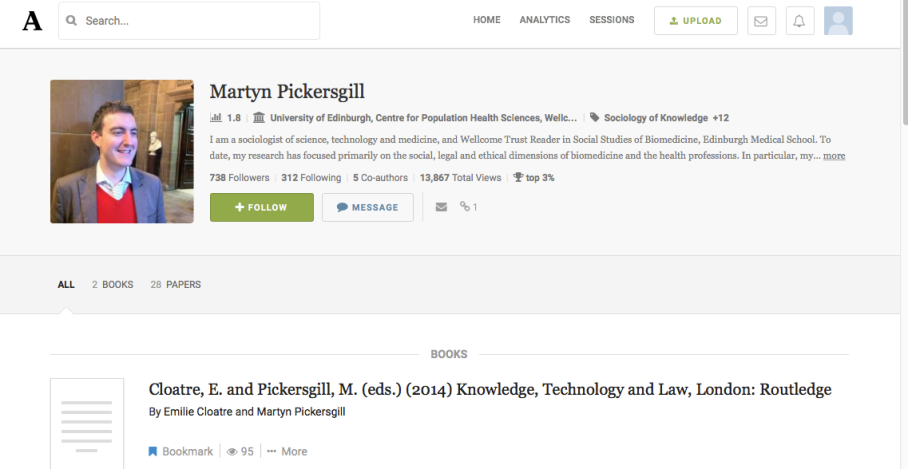
(See Figure 1).

Screen Shot 2016-07-21 at 8.28.19 PM
Figure 1. The profile page of a Health Sciences user on Academia.edu


How do these sites play a role in the scholarly communication process?


However, beyond allowing researchers the ability to track the
discussion and attention garnered by their work, academic social
networking sites are also formally playing a role in the scholarly
communication process. Scholarly communication can be defined as “the
system through which research and other scholarly writings are created,
evaluated for quality, disseminated to the scholarly community, and
preserved for future use” (ACRL, 2015). The introduction and subsequent
success of academic social networking sites, such as ResearchGate,
Academia.edu, and LinkedIn, have changed the way in which scholars
connect, collaborate, and disseminate their research (Greenhow, 2009;
Weintraub, 2012; Zaugg, West, Tateishi, & Randall, 2010). Many of
these more professionally marketed social media sites encourage members
to list their documents on their profiles and even give users the option
of uploading their manuscripts and preprints.  Users of these sites are
then encouraged to share their research with their scholarly network or
with the broader (and often worldwide) academic community via
traditional social media sites (i.e. Twitter). Such examples suggest
that academic social networking sites are also being used as a venue for
scholarly communication.


But are scholars actually using academic social networking sites to
share their research and to network and collaborate with others? A study
by Jordan (2014) revealed that most scholars on academic social
networking sites view their profiles as an ‘online business card’ or
curriculum vitae, rather than as a site for active interaction with
others. However, participants did like the concept of using the site to
promote their research, particularly junior researchers (Jordan, 2014). A
more recent study conducted by Jeng, He, and Jiang (2015) found
contradictory results. The authors examined user participation on the
academic social networking site Mendeley. While the majority of
participants reported using the site for its research features, or as a
document or citation management tool, many members also used Mendeley to
manage their academic contacts and to expand their professional
networks. There is also evidence to suggest that researchers are using
academic social networking sites to find scholars with similar research
interests to their own and to keep up to date in their fields. Results
from a survey of physicists, linguists, and sociologists on
Academia.edu, for example, showed that these academics are using the
site to read articles posted by other researchers. Participants also
searched for members with similar research interests to their own
(Megwalu, 2015). These studies suggest that academic social networking
sites are platforms where both formal and informal scholarly
communication occur, creating a unique space to study existing and
emerging communication behaviours.


Who is using these sites?


Fortunately, several studies have tried to address this question by
examining the academic status of those who use academic social
networking sites. For example, a study by Jordan (2014) investigated the
impact of academic seniority on network structure on Academia.edu.
Results of the study indicated that a user’s number of connections and
position within the network was dependent on academic seniority. Senior
academics tended to have more connections and a more prominent position
within the network in comparison to junior researchers. Professors also
had a stronger tendency to only follow people who they knew personally
in real life and were less likely to try and make new connections on the
site. In other words, professors enjoyed a privileged position within
the network, even though they were not actively trying to network as
much as students.


However, it is possible that this advantage is not due to academic
seniority, but to a higher user group activity. In a study by Megwalu
(2015), students were more likely to register on Academia.edu, but
post-docs and faculty members had the highest number of logins over a
ten-month period, making them more frequent users than students. In
another study conducted by Thelwall and Kousha (2014), the authors
discovered that students tended to list more interests then faculty, but
that faculty listed more books and papers and were cited more often
than students. Also, senior researchers received substantially more
document views and profile views than junior researchers. This study
confirms previous research by Almousa (2011), where faculty were found
to be more active and uploaded more documents than any other group in
all three disciplines studied.


Why medical sciences and health sciences?


While many studies have examined disciplinary differences in the use
of academic social networking sites, very little research has examined
the scholarly communication practises of health and medical researchers
on these sites. In one study conducted by Oh and Jeng (2011), the
authors looked at participation in Mendeley groups by discipline.
Results of the study showed that Medicine was the third largest member
group and had a high level of group member participation. In another
more recent study by Mohammadi, Thelwall, Haustein, and Larivière
(2015), the authors found that non-academics (medical professionals)
read more clinical medicine articles on Mendeley than academics.


Thus, more research is needed  in order to see whether scholars in
the health and medical field are using academic social networking sites
for scholarly communication. To address these gaps that persist in the
literature, this study sought to answer the following research questions
by focusing on faculty and graduate students in two disciplines –
Medical Sciences and Health Sciences – on Academia.edu:


R1: Is there a correlation between academic seniority and user activity (# of listed documents) on Academia.edu?
R2: Is there a
relationship between academic seniority and altmetrics score (# of
profile views, # of followers) on Academia.edu?
R3: Are there disciplinary differences in use between Medical Sciences and Health Sciences?

Summary of Findings:

Overall, faculty members
were the most active user group on Academia.edu. In both Medical
Sciences and Health Sciences, more faculty members than graduate
students registered for an account on Academia.edu (See Figure 2 &
Figure 3 below). Faculty members also added significantly more documents
to their profiles than did graduate students in both Medical Sciences
and Health Sciences.
However, despite being
more active on the site, faculty members did not necessarily enjoy a
more privileged position within the network. While Health Sciences
faculty had significantly more profile views and followers than graduate
students, Medical Sciences graduate students had more profile views and
followers than faculty members. Also, the number of documents listed on
a user’s profile page had little bearing on the number of profile views
and number of followers that they received.
In regards to disciplinary
differences between Medical Sciences and Health Sciences, Health
Sciences was the more active user discipline. Health Sciences faculty
members and graduate students uploaded more documents to their profiles
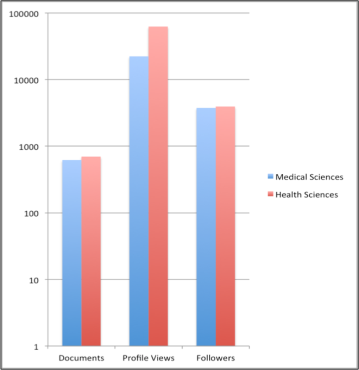
(699 : 621 total documents respectively) and received more profile views
and followers than their Medical Sciences counterparts. The most
notable difference between the two disciplines is evident when comparing
the number of profile views received, as members from the Health
Sciences community had nearly three times as many profile views as those
in Medical Sciences (See Figure 4).
Untitled
Figure 4. Total number of documents, profile views, and followers for Medical Sciences and Health Sciences on Academia.edu

Conclusions:

This study has provided insight into the scholarly communication
practices of health and medical disciplines on Academia.edu. Results
indicate that there are large populations of Medical Sciences and Health
Sciences users on Academia.edu and that these scholars are using the
site to network and collaborate with others, to share their research,
and to keep up to date in their fields. In other words, researchers in
the health and medical field are using academic social networking sites
for scholarly communication. More research is needed, however, in order
to determine the extent to which the site mirrors existing academic
structures (i.e. the faculty – student advantage) and social networking
patterns (age, gender, etc.). Further studies should also examine why
these scholars register for an account on Academia.edu over (or in
addition to) other more specialized social networking tools available to
non-academics in the health and medical field (i.e. Sermo, Medscape,
MDLinx). Web-based applications for scholarly communication evolve
rapidly and disciplinary norms are constantly changing, as are the
communication preferences of scholars on these sites. More research is
needed in order to understand this ever-shifting landscape.


References:

ACRL Scholarly Communications Committee. (2003). Principles and Strategies for the Reform of Scholarly Communication.


Almousa, O. (2011, December). Users’ classification and usage-pattern identification in academic social networks. In Applied Electrical Engineering and Computing Technologies (AEECT), 2011 IEEE Jordan Conference on (pp. 1-6). IEEE.


Greenhow, C. (2009). Social scholarship: Applying social networking technologies to research practices. Knowledge Quest, 37(4), 42.


Gruzd, A. (2012). Non-academic and academic social networking sites for online scholarly communities. Social media for academics: A practical guide, 21-37.


Jeng, W., He, D., & Jiang, J. (2015). User participation in an
academic social networking service: A survey of open group users on
Mendeley. Journal of the Association for Information Science and Technology, 66(5), 890-904.


Jordan, K. (2014). Academics and their online networks: Exploring the role of academic social networking sites. First Monday, 19(11).


Krause, J. (2012). Tracking reference with social media tools:
Organizing what you’ve read or want to read. In D. R. Neal (Ed.), Social media for academics: A practical guide (pp. 85-104). Oxford: Chandos Pub.


Letierce, J., Passant, A., Breslin, J., & Decker, S. (2010).
Understanding how Twitter is used to widely spread Scientific Messages.
In Proceedings of the WebSci10 Extending the Frontiers of Society Online.


Megwalu, A. (2015). Academic Social Networking: A Case Study on Users’ Information Behavior. In Current Issues in Libraries, Information Science and Related Fields (pp. 185-214). Emerald Group Publishing Limited.


Mohammadi, E., Thelwall, M., Haustein, S., & Larivière, V.
(2015). Who reads research articles? An altmetrics analysis of Mendeley
user categories. Journal of the Association for Information Science and Technology, 66(9), 1832-1846.


Oh, J. S., & Jeng, W. (2011, October). Groups in Academic Social
Networking Services–An Exploration of Their Potential as a Platform for
Multi-disciplinary Collaboration. In Privacy, Security, Risk and
Trust (PASSAT) and 2011 IEEE Third Inernational Conference on Social
Computing (SocialCom), 2011 IEEE Third International Conference on
(pp. 545-548). IEEE.


Procter, R., Williams, R., Stewart, J., Poschen, M., Snee, H., Voss,
A., & Asgari-Targhi, M. (2010). Adoption and use of Web 2.0 in
scholarly communications. Philosophical Transactions of the Royal Society of London A: Mathematical, Physical and Engineering Sciences, 368(1926), 4039-4056.


Thelwall, M., & Kousha, K. (2014). Academia. edu: social network or academic network?. Journal of the Association for Information Science and Technology, 65(4), 721-731.


Weintraub, A. (2014). Social networks attempt to spark academic university collaborations (vol 30, pg 901, 2013). NATURE BIOTECHNOLOGY, 32(3), 212-212.


Weller, K., Dornstädter, R., Freimanis, R., Klein, R. N., &
Perez, M. (2010). Social software in academia: Three studies on users’
acceptance of Web 2.0 Services.


Weller, K., & Puschmann, C. (2011). Twitter for scientific
communication: How can citations/references be identified and measured?.
(pp. 1-4). In Proceedings of the ACM WebSci’11, June 14-17 2011, (pp. 1-4). Germany: Koblenz.


Zaugg, H., West, R. E., Tateishi, I., & Randall, D. L. (2011).
Mendeley: Creating communities of scholarly inquiry through research
collaboration. TechTrends, 55(1), 32-36.


academic social networking | liddylib

Academic social networking websites

 Source:http://www.apa.org/science/about/psa/2017/02/academic-social-networking.aspx


From The Science Student Council

Academic social networking websites

A guide to managing your online presence.

By Joshua C. Palmer and Justin Strickland

Over the
last two decades, the development of new and readily accessible means of
communication, particularly the growth of social networking platforms,
have changed the way we view the world and interact with others.
Individuals now have the unprecedented opportunities to connect with
peers and colleagues, seek out new information and disseminate new ideas
to the broader public. For the scientific community, social networking
platforms provide a low-cost way to create a personal brand or identity
(Dutta, 2010) and develop a professional online presence (Donelan,
2015). In this article, we will discuss the benefits of managing your
online presence in order to leverage social networking platforms to
advance your scientific endeavors and professional career.


Become an active contributor on ResearchGate, Academia.edu and Google Scholar

A variety of academic social networking platforms, including ResearchGate, Academia.edu and Google Scholar,
have gained popularity over the past decade (Ovadia, 2014). A common
capability of many of these academic social networking websites is to
provide an online repository to which users can upload and share
research papers. Below, we describe in detail the functionality of some
of these academic social networking websites and their relative benefits
for professional development.


ResearchGate is an academic social networking
website that gives researchers the option to upload journal articles,
conference papers, posters, data and code to an online repository. This
can be particularly useful for locating conference materials such as
posters and slide decks that are not archived in other online databases.
ResearchGate users also receive analytics on their publications
including the number of times their papers have been read and cited by
other users on ResearchGate.


ResearchGate provides community interaction features that help distinguish it from other platforms. Users can:


  • Ask questions within the academic community regarding measures,
    constructs or topics and respond to questions posed by other users.
  • Opt to follow other researchers and receive notifications when they upload new work.
  • Contact other users through the ResearchGate direct messaging system.
  • Request authors upload full versions of their papers using the “request full text button”.
  • Directly contact readers of their publications to request feedback.
Additionally, ResearchGate allows researchers to create project logs
that can be used to update peers on current projects, attract potential
co-authors or request submissions for journal special issues.


Academia.edu is a similar resource that allows users
to create a personal profile, upload papers, request feedback, follow
researchers, send personal messages to other researchers and view
analytics on your papers. Users on Academia.edu can also import contacts
from Facebook, Twitter, Yahoo and Google to find colleagues who already
have Academia.edu profiles, thus connecting many different networking
tools described.


Before using these services, however, it is important for researchers
to check the archiving policies for each journal before choosing to
upload or share papers; if researchers upload a journal publication that
violates these copyright policies, they may receive a takedown notice
from the publisher (Howard, 2013). Specifically, researchers should
check their publishing agreement, which can often be found on the
journal’s website or in email correspondence. The SHERPA/RoMEO
journal database also contains a search tool where researchers can look
up publishers' copyright policies regarding authors archiving
publications online. Fortunately, of the 2,318 published articles listed
in the SHERPA/RoMEO, 80 percent allow at least some form of
self-archiving (e.g., either preprint or postprint; SHERPA, 2017).


Google Scholar provides a search engine that can be
used to identify hyperlinks to articles that are publically available or
may be obtained through institutional libraries. Users who choose to
create a personal Google Scholar profile can access their citations per
year metrics. Articles uploaded on ResearchGate, Academia.edu or other
databases can also be linked to your Google Scholar profile so that
readers can find hyperlinks to all of your work. Google Scholar also has
a “Scholar Button” that users can install on Chrome, Firefox or Safari
web browsers to quickly search for articles without typing in a web
address (one can download this button by clicking the "Setting" button
on their Google Scholar homepage, then selecting Button on the sidebar
to the left). If you have questions about how to use Google Scholar to
conduct a literature search, check out the article “Literature search tips and tricks” from the November 2016 issue of Psychological Science Agenda
(Mumper, 2016). Google Scholar also compiles a list of top publications
in each discipline based on journal impact (users can access data by
clicking the "Metrics" button on their Google Scholar homepage).


Using other social networking platforms to market yourself

Other, more traditional forms of social networking, such as Twitter or LinkedIn,
can also be used to manage one’s online presence, promote research and
form new professional connections (Ovadia, 2013). Although these
platforms are usually viewed as informal means of communication, they
may also be used to interact with other researchers and disseminate
research to a broader public audience. To see how psychologists have
used Twitter to build their online presence, check out the British
Psychological Society’s (2015) list of the 100 Most Followed Psychologists and Neuroscientists on Twitter

and Paul Thoresen’s (2015) list of 80 #IOPsych Pros to Follow on Twitter.
Professional networking websites, such as LinkedIn (and in some cases
students’ university website profiles), can be used to upload your
curriculum vitae, highlight your research interests and previous
accomplishments. However, it is also important to show that you are a
person (i.e., not a research cyborg) with interests outside of
research/professional activities. Some of these interests (e.g.,
volunteer work) can be highlighted on these professional networking
websites and provide the opportunity to present yourself as a
well-rounded individual.


Lastly and most importantly, be mindful of the public content you
post on social media (particularly Facebook and Twitter). In all
likelihood, having a strong positive online presence alone will not
result in landing your dream job (usually, this requires a combination
of knowledge, hard work, productivity, social skill and luck). However,
not filtering the public content on your social networking platforms may
cause universities or companies to think twice before hiring you when
you are on the job market (see Brown & Vaughn, 2011; Smith &
Kidder, 2010).


There is no denying that technological and communication advances
have changed the way we make connections and access information.
Face-to-face interaction is still crucial, but social networking has, in
a way, “changed the rules of the game.” Platforms such as ResearchGate,
Academia.edu, Google Scholar, Twitter, LinkedIn and Facebook can be
utilized to create a personal brand, disseminate scientific findings and
connect with researchers worldwide.


References

Brown, V.R., & Vaughn, E.D. (2011). The writing
on the (Facebook) wall: The use of social networking sites in hiring
decisions. Journal of Business and Psychology, 26(2), 219-225.
Donelan, H. (2015). Social media for professional development and networking opportunities in academia. Journal of Further and Higher Education, 40(5), 1-24.
Dutta, S. (2010). What’s your personal social media strategy. Harvard Business Review, 88(11), 127-130.
Howard, J. (2013). Posting your latest article? You might have to take it down. Chronicle of Higher Education, 60(16), A12.
Mumper, M. (2016, September). Literature search tips and tricks: Techniques for effectively using Google Scholar and PsycINFO. Psychological Science Agenda, 30(8). Retrieved Feb. 14, 2017, from http://www.apa.org/science/about/psa/2016/09/literature-search-tips.aspx.
Ovadia, S. (2013). When social media meets scholarly publishing. Behavioral & Social Sciences Librarian, 32(3), 194-198.
Ovadia, S. (2014). ResearchGate and Academia.edu: Academic social networks. Behavioral & Social Sciences Librarian, 33(3), 165-169.
SHERPA. (2017, Jan. 12). RoMEO Statistics. Retrieved Jan. 12, 2017, from http://www.sherpa.ac.uk/romeo/.
The British Psychological Society. (2015, Nov. 6).
The 100 most followed Psychologists and Neuroscientists on Twitter [Blog
post]. Retrieved Jan. 12, 2017, from https://digest.bps.org.uk/2015/11/06/the-100-most-followed-psychologists-and-neuroscientists-on-twitter/.
Smith, W.P., & Kidder, D.L. (2010). You’ve been tagged!(Then again, maybe not): Employers and Facebook. Business Horizons, 53(5), 491-499.
Thoresen, P. (2015, Dec. 7). 80 #IOPsych pros to follow on Twitter [Blog post]. Retrieved Jan. 12, 2017, from https://medium.com/@SurveyGuy2/80-iopsych-pros-to-follow-on-twitter-228ff16dcd2c#.e90k9aikf.

About the authors

Joshua C. PalmerJoshua
C. Palmer is the industrial/organizational representative to the APA
Science Student Council. He is a first-year doctoral student at Florida
State University.


Justin C. StricklandJustin
C. Strickland is the biopsychology representative on the APA Student
Science Council. He is a third-year graduate student at the University
of Kentucky.


The views expressed in this article are those of the author and do not reflect the opinions or policies of APA.


Academic social networking websites

Researcher Identifiers and your Online Research Profile - Guides at University of the Sunshine Coast

 Source: http://libguides.usc.edu.au/researcheridentifiers


Researcher Identifiers and your Online Research Profile

A guide to the
various different researcher identifiers, and how to set up researcher
identifiers, as well as managing your online research profile.


Contacts


For further information on Researcher Identifiers, please contact:


USC Research Bank:


Liaison Librarians:

  • Roger Carter (School of Health and Sports Sciences, School of Nursing and Midwifery) - rcarter@usc.edu.au

Why have a researcher identifier?


Over
the last few years, it has become increasingly important for
researchers to maintain an online presence to their research.  As the
research landscape
 expands,
it becomes essential to differentiate yourself from fellow peers and to
disambiguate yourself from other researchers with similar names or
fields of study.
Two ways to do this are to:
  1. Establish your researcher
    identifers to ensure that your research is associated with your name
    only (and not with other, similar sounding names); and
  2. Establish an online profile of your
    research to allow for greater dissemination, which in turn can lead to
    greater impact and citation metrics.

Example of why research identifiers need to be used...


An example of the problem the party infrastructure was attempting
to solve is demonstrated by the following examples of public
information about Tim Flannery:


Flannery, Tim F. (Tim Fridtjof) (1956-)


He is also known as:


  • Flannery, Tim
  • Flannery, Timothy
  • Flannery, Timothy F.
  • Flannery, Timothy Fridjof


And he may also be known as:


  • Flannery, T.
  • Flannery, T.F.
He may have multiple author identifiers as a result of his publications:


  • e.g. Scopus Id, Researcher Id, etc.

Researcher Identifiers


Researcher identifiers are important because they:

  • Provide a persistent identifier

  • Easily identify your work and increase your visibility

  • Offer a tool to measure impact

  • Resolve author misidentification and any changes in institutional affiliations

  • Group name variants for which an author has published under
  • Provide more accurate citation metrics, as all your publications are linked to your identifier without any 'ring-ins'
Researcher identifiers are like creating a DOI for a person.
Check out this example of linked identifiers (courtesy of ANDS):

Research Online Profile


The
rise of academic social networking sites, such as ResearchGate and
LinkedIn, has meant that researchers are increasingly being provided
with avenues to disseminate their research outputs and to connect with
other researchers in their field.  However, while it may be a good idea
to promote your online presence, care should be taken as to which online
site is used for what purpose, and to know the difference between what a
social networking site is compared to the humble open access
repository.


About - Researcher Identifiers and your Online Research Profile - Guides at University of the Sunshine Coast

Challenges and Opportunities for Open Assess Journals in Asia | Open Science

 Source: http://openscience.com/challenges-and-opportunities-for-open-assess-journals-in-asia/


Challenges and Opportunities for Open Assess Journals in Asia

Singapore Management University, Singapore, September 22, 2012 | © Erwin Soo.


May 29, 2017
Asian universities increasingly implement open
access mandates and repositories, in an effort to increase the
accessibility of research results.


A Blog Article by Pablo Markin.


Over three-quarters of Taiwanese research institutions and
universities have chosen to cease subscribing to Elsevier’s journal
access packages, in their efforts to adopt open access
as the format that sustainably enables local and international scholars
to access publicly-funded scientific output. This is likely to be of
more importance for the Asian scientific community than for its Western
counterpart, as in the long term open access can level the global
playing field in terms of research result accessibility by removing
financial barriers to academic journal access. While this is contrary to
the business models of large journal publishers, such as Elsevier, that
prefer maintaining high profit rates over a broader adoption of open or
hybrid access options. On the one hand, maintaining the quality of
scientific journals, such as via rigorous peer review and editorial
processing, has traditionally entailed the deployment of paywall-based
journal access models. On the other hand, in Asia, such as in Japan,
Taiwan and Singapore, voices that advocate open access publishing are
increasingly heard.


This is especially important from the perspective of journal
accessibility, since in many South and East Asian countries, such as
Malaysia, Indonesia, Thailand and Myanmar, where the implementation of
open access models can significantly contribute to the accessibility of
latest research to local scholars. As the Asia Open Access Summit that
took place in November 2016 in Kuala Lumpur, Malaysia, indicates,
regional bodies, e.g., the Association of Southeast Asian Nations,
leading scientific publishers, e.g., BioMed Central, and open
access-related organizations, e.g., Open Access Scholarly Publishers
Association, are keen to make available and exploit open access
resources. While the adoption of open access has a financial rationale,
as it eliminates journal access fees, it also demands a reorientation
away from a narrow focus on impact factor metrics to a wider range of
estimates gauging the prominence that published articles have in
scientific communities. Especially for Asian countries, both publishing
in and mandating open access can foster scientific collaboration and
findings’ communication.


As large journal publishers, such as Wiley, are increasingly heeding
the calls for a greater presence of open access journals among their
offerings. Not infrequently backed by scientific societies, open access
journals can combine high peer-review standards with collaborative
initiatives, while offering Asian scholars additional venues of research
dissemination. Likewise, the Chinese scientific community increasingly accepts
open access journals and open data repositories, even though open
access-oriented policies remain to be formulated in this country.

Thus, while open access journals can significantly reduce barriers to
scholarly publication accessibility in Asia, comprehensive policy-making
frameworks are yet to develop in this region.


By Pablo Markin


Featured Image Credits: Singapore Management University, Singapore, September 22, 2012 | © Erwin Soo.


This entry was posted on May 29, 2017 by Pablo Markin and tagged , , , , , , , , , , , , , , .


Challenges and Opportunities for Open Assess Journals in Asia | Open Science