Saturday, 23 May 2015

A comparison of 17 author-level bibliometric indicators for researchers in Astronomy, Environmental Science, Philosophy and Public Health in Web of Science and Google Scholar

Source: http://link.springer.com/article/10.1007/s11192-015-1608-4

A comparison of 17 author-level
bibliometric indicators for researchers in Astronomy, Environmental
Science, Philosophy and Public Health in Web of Science and Google
Scholar

Abstract

Author-level bibliometric indicators are becoming a standard tool in research assessment. It is important to investigate what these indicators actually measure to assess their appropriateness in scholar ranking and benchmarking average individual levels of performance. 17 author-level indicators were calculated for 512 researchers in Astronomy, Environmental Science, Philosophy and Public Health. Indicator scores and scholar rankings calculated in Web of Science (WoS) and Google Scholar (GS) were analyzed. The indexing policies of WoS and GS were found to have a direct effect on the amount of available bibliometric data, thus indicator scores and rankings in WoS and GS were different, correlations between 0.24 and 0.99. High correlation could be caused by scholars in bottom rank positions with a low number of publications and citations in both databases. The hg indicator produced scholar rankings with the highest level of agreement between WoS and GS and rankings with the least amount of variance. Expected average performance benchmarks were influenced by how the mean indicator value was calculated. Empirical validation of the aggregate mean h-index values compared to previous studies resulted in a very poor fit of predicted average scores. Rankings based on author-level indicators are influenced by (1) the coverage of papers and citations in the database, (2) how the indicators are calculated and, (3) the assessed discipline and seniority. Indicator rankings display the visibility of the scholar in the database not their impact in the academic community compared to their peers. Extreme caution is advised when choosing indicators and benchmarks in scholar rankings.

References:
  1. Alonso, S, Cabreriazo, F, Herrera-Viedma, F (2009) H-index: A review focused in its variants, computation and standardization for different scientific fields. Journal of Informetrics 3: pp. 273-289 CrossRef
  2. Alonso, S, Cabreriazo, F, Herrera-Viedma, F (2010) hg-index: A new index to characterize the scientific output of researchers based on the h- and g-indices. Scientometrics 82: pp. 391-400 CrossRef
  3. Altman, D (2005) Standard deviations and standard errors. British Medical Journal 331: pp. 903 CrossRef
  4. Archambault, E., & Gagné, E. V. (2004). The Use of Bibliometrics in Social Sciences and Humanities (Social Sciences and Humanities Research Council of Canada, SSHRCC), Montreal: Science Metrix. http://www.science-metrix.com/pdf/SM_2004_008_SSHRC_Bibliometrics_Social_Science.pdf. Accessed 30 March 2015.
  5. Bar-Ilan, J (2008) Which h-index? A comparison of WoS, Scopus and Google Scholar. Scientometrics 74: pp. 257-271 CrossRef
  6. Berk, RA, Freedman, DA Statistical assumptions as empirical commitments. In: Blomberg, TG, Cohen, S eds. (2003) Punishment and social control. Walter de Gruyter, New York, pp. 235-254
  7. Bornmann, L, Marx, W (2011) The h-index as a research performance indicator. European Science Editing 37: pp. 77-80
  8. Bornmann, L, Marx, W (2013) Evaluating individual researchers’ performance. Euorpean Science Editing 39: pp. 30-40
  9. Cabrerizo, FJ, Alonso, S, Herrera-Viedmac, E, Herrera, F (2012) Q2-index: Quantitative and qualitative evaluation based on the number and impact of papers in the hirsch core. Journal of Informetrics 4: pp. 23-28 CrossRef
  10. Connor, J. (2011). Google scholar citations open to all. Resource document. http://googlescholar.blogspot.dk/2011/11/google-scholar-citations-open-to-all.html. Accessed 30 March 2015.
  11. Costas, R, Bordons, M (2007) The h-index: Advantages, limitations and its relation with other bibliometric indicators at the micro level. Journal of Informetrics 1: pp. 193-203 CrossRef
  12. Courtault, JM, Hayek, N (2008) On the robustness of the h-index: A mathematical approach. Economics Bulletin 3: pp. 1-9
  13. Battisti, F, Salini, S (2012) Robust analysis of bibliometric data. Statistical Methods and Applications 22: pp. 269-283 CrossRef
  14. Egghe, L (2006) Theory and practise of the g-index. Scientometrics 69: pp. 131-152 CrossRef
  15. ESO. (2011). Some statistics on recent job hires in Astronomy: Who is getting the jobs and how do you compare? Science News. Resource document. https://www.eso.org/wiki/pub/Science/ScienceNewsLetter/ScienceNews-May-Jun2011.pdf. Accessed 30 March 2015.
  16. Farhadi, F, Salehi, H, Yunus, MM, Chadegani, AA, Farhabi, M, Fooladi, M (2013) Does it matter which citation tool is used to compare the h-index of a group of highly cited researchers?. Australian Journal of Basic and Applied Sciences 7: pp. 198-202
  17. Fiorenzo, F., Domenico, M., & Luca, M. (2013). The effect of dirty data on h-index calculation. Scientometrics, 95(3), 1179–1188.
  18. Franceschet, M (2010) A comparison of bibliometric indicators for computer science scholars and journals on Web of Science and Google Scholar. Scientometrics 83: pp. 243-258 CrossRef
  19. Franceschini, F, Maisano, D (2011) Criticism on the hg.index. Scientometrics 86: pp. 339-346 CrossRef
  20. Freedman, DA, Pisani, R, Purves, R (2007) Statistics. W.W. Norton & Company, New York, NY
  21. Gorard, S (2003) Quantitative methods in social science: the role of numbers made easy. Continuum, London
  22. Gorard, S (2006) Towards judgement-based statistical analysis. British Journal of Sociology of Education 27: pp. 67-80 CrossRef
  23. Gratton, R. (2014). Evaluation of Italian atronomical production: 2010–2012. Resource document. arXiv: arXiv:1402.4080v1 [astro-ph.IM]. Accessed 30 March 2015.
  24. Hagen, NT (2008) Harmonic allocation of authorship credit: Source-level correction of bibliometric bias assures accurate publication and citation analysis. PLoS ONE.
  25. Harzing, A. (2008). Google Scholar—A new data source for citation analysis. Resource document, http://www.harzing.com/pop_gs.htm. Accessed 30 March 2015.
  26. Harzing, A. (2012). Publish or Perish user’s manual. Resource document, http://www.harzing.com/pop.htm#metrics. Accessed 30 March 2015.
  27. Harzing, A (2014) A longitudinal study of Google Scholar coverage between 2012 and 2013. Scientometrics 98: pp. 565-575 CrossRef
  28. Haustein, S, Larivière, V The use of bibliometrics for assessing research: Possibilities, limitations and adverse effects. In: Welpe, IM, Wollersheim, J, Ringelhan, S, Osterloh, M eds. (2015) Incentives and performance: Governance of research organizations. Springer International Publishing, Switzerland, pp. 121-139 CrossRef
  29. Hirsch, J (2005) An index to quantify an individual’s scientific research output. Proceedings of the National Academy of Sciences of the United States of America (PNAS) 102: pp. 16569-16572 CrossRef
  30. Jacsó, P (2005) As we may search? Comparison of major features of the Web of Science, Scopus, and Google Scholar citation-based and citation-enhanced databases. Current Science 89: pp. 1537-1547
  31. Jascó, P (2008) The plausibility of computing the h-index of scholarly productivity and impact using reference-enhanced databases. Online Information Review 32: pp. 266-283 CrossRef
  32. Kamphuis, P., & van der Kruit, P. C. (2010). Citations and impact of Dutch astronomy. Resource document arXiv:1011.5311v1 [astro-ph.IM]. Accessed 30 March 2015.
  33. Kendall, MG (1955) Rank correlation methods. Hafner Publishing Co, New York
  34. Kosmoloulos, C., & Pumain, D. (2014). Citation, citation, citation: Bibliometrics, the web and the Social Sciences and Humanities. Resource document, Cybergeo: European Journal of Geography. http://www.cybergeo.eu/index15463.html. Accessed 30 March 2015.
  35. Kosmulski, M (2006) A new type Hirsch-index saves time and works equally well as the original h-index. ISSI Newsletter 2: pp. 4-6
  36. Lancho-Barrentes, B, Guerrero, VP (2010) What lies behind the averages and significance of citation indicators in different disciplines?. Journal of Information Science 36: pp. 371-382 CrossRef
  37. Li, J, Burnham, JF, Lemley, T, Britton, RM (2010) Citation analysis: Comparison of Web of Science®, Scopus™, SciFinder®, and Google Scholar. Journal of Electronic Resources in Medical Libraries 7: pp. 196-217 CrossRef
  38. Meera, B. M., & Manjunath, M., (2012). h-index of astrophysicists at raman research institute: performance of different calculators, Working Group on Libraries, IAU Division XII Commission 5, In L. Utley (Ed.) Special session 15: Data-intensive astronomy, Beijing, China, 23-24 August 2012. http://iau-commission5.wikispaces.com/LibWG+Beijing+2012. Accessed 30 March 2015.
  39. Meho, LI, Yang, K (2007) Impact of data sources on citation counts and rankings of LIS faculty: Web of Science versus Scopus and Google Scholar. Journal of the American Society for Information Science and Technology 58: pp. 2105-2125 CrossRef
  40. Miller, C. W., (2006). Superiority of the h-index over the impact factor for physics. Resource document, arXiv: physics/0608183 [physics.soc-ph]. Accessed 30 March 2015.
  41. Neuhaus, C, Neuhaus, E, Asher, A, Wrede, C (2006) The depth and breadth of Google Scholar: An empirical study. Portal: Libraries and the Academy 6: pp. 127-141 CrossRef
  42. Panaretos, J, Malesios, C (2009) Assessing scientific research performance and impact with single indicators. Scientometrics.
  43. Patel, VM, Ashrafian, H, Almoudaris, A, Makanjuola, J, Bucciarelli-Ducci, C, Darzi, A (2013) Measuring academic research performance for healthcare researchers with the h index: Which search tool should be used?. Medical Principles and Practice 22: pp. 178-183 CrossRef
  44. Redner, S. (2010). On the meaning of the h-index. Journal of Statistical Mechanics: Theory and Experiment. doi:10.1088/1742-5468/2010/03/L03005.
  45. Roediger, H. L. (2006). The h index in Science: A new measure of scholarly contribution. Resource document, APS Observer: The Academic Observer. http://www.psychologicalscience.org/index.php/publications/observer/2006/april-06/the-h-index-in-science-a-new-measure-of-scholarly-contribution.html. Accessed 30 March 2015.
  46. Schneider, JW (2013) Caveats for using statistical significance tests in research assessments. Journal of Informetrics 7: pp. 50-62 CrossRef
  47. Schneider, JW (2015) Null hypothesis significance tests. A mix-up of two different theories: The basis for widespread confusion and numerous misinterpretations. Scientometrics 102: pp. 411-432 CrossRef
  48. Schreiber, M (2013) A case study of the arbitrariness of the h-index and the highly-cited-publications indicator. Journal of Informetrics 7: pp. 379-387 CrossRef
  49. Schreiber, M (2013) How to derive an advantage from the arbitrariness of the g-index. Journal of Informetrics 7: pp. 555-561 CrossRef
  50. Schreiber, M, Malesios, CC, Psarakis, S (2012) Exploratory factor analysis for the hirsch-index, 17 h-type variants, and some traditional bibliometric indicators. Journal of Informetrics 6: pp. 347-358 CrossRef
  51. Sidiropoulos, A, Katsaros, D, Manolopoulos, Y (2007) Generalized hirsch h-index for disclosing latent facts in citation networks. Scientometrics 72: pp. 253-280 CrossRef
  52. Smith, AG (2008) Benchmarking Google Scholar with the New Zealand PBRF research assessment exercise. Scientometrics 74: pp. 309-316 CrossRef
  53. Testa, J. (2012). The Thomson Reuters Journal Selection Process. Resource document, http://wokinfo.com/essays/journal-selection-process/. Accessed 30 March 2015.
  54. Tol, RSJ (2009) Of the H-index and its alternatives: An application to the 100 most prolific economists. Scientometrics 80: pp. 317-324 CrossRef
  55. Leeuwen, T (2008) Testing the validity of the hirsch-index for research assessment purposes. Research Evaluation 17: pp. 157-160 CrossRef
  56. Raan, AFJ (2006) Comparison of the Hirsch-index with standard bibliometric indicators and with peer judgment for 147 chemistry research groups. Scientometrics 67: pp. 491-502 CrossRef
  57. Vanclay, JK (2007) On the robustness of the h-index. Journal of the American Society for Information Science and Technology 58: pp. 1547-1550 CrossRef
  58. Waltman, L, Schreiber, M (2013) On the calculation of percentile-based bibliometric indicators. Journal of the American Society for Information Science and Technology 64: pp. 372-379 CrossRef
  59. Waltman, L, Eck, NJ (2012) The inconsistency of the h-index. Journal of the American Society for Information Science and Technology 63: pp. 406-415 CrossRef
  60. Wildgaard, L, Schneider, JW, Larsen, B (2014) A review of the characteristics of 108 author-level bibliometric indicators. Scientometrics 101: pp. 125-158 CrossRef
  61. Wilson, V (2007) A content analysis of Google Scholar: Coverage varies by discipline and by database. Evidence Based Library and Information Practice 2: pp. 134-136
  62. Yang, K., & Meho, L. I. (2006). Citation analysis: A comparison of Google Scholar, Scopus, and Web of Science., 2006. In 69th annual meeting of the American Society for Information Science and Technology (ASIST), Austin (US), 3–8 November 2006. http://eprints.rclis.org/8605/1/Yang_citation.pdf. Accessed 9 April 2015.
  63. Zhang, C (2009) The e-index, complementing the h-index for excess citations. PLoS ONE 4: pp. e5429 CrossRef


    A comparison of 17 author-level bibliometric indicators for researchers in Astronomy, Environmental Science, Philosophy and Public Health in Web of Science and Google Scholar - Online First - Springer

    Friday, 22 May 2015

    Heading for success: or how not to title your paper - Research Trends

     Source: http://www.researchtrends.com/issue24-september-2011/heading-for-success-or-how-not-to-title-your-paper/

    Old typewriter

    Heading for success: or how not to title your paper

    The title of a paper acts as a gateway to
    its content. It’s the first thing potential readers of the paper see,
    before deciding to move on to the abstract or full text. As academic
    authors want to maximize the readership of their papers it is
    unsurprising that they usually take a lot of care in choosing an
    appropriate title. But what makes a title draw in citations?


    Is longer better?

    Bibliometric analyses can be used to illuminate the influence of
    titles on citations. Jamali and Nikzad, for example, found differences
    between the citation rates of articles with different types of titles.
    In particular, they found that articles with a question mark or colon in
    their title tend to be cited less1. The authors noted that
    “no significant correlation was found between title length and
    citations”, a result conflicting with another study by Habibzadeh and
    Yadollahie finding that “longer titles seem to be associated with higher
    citation rates”2.


    Research Trends investigates

    Faced with inconsistent evidence, Research Trends decided to conduct its own case study of scholarly papers published in Cell between
    2006 and 2010, and their citations within the same window. Overall,
    there was no direct correlation between title length (measured in number
    of characters) and total citations. However, comparing the citation
    rates of articles of different lengths revealed that papers with titles
    between 31 and 40 characters were cited the most (see Figure 1). There
    were also differences in average number of citations per paper depending
    on the punctuation used in the titles: for instance, the few papers
    with questions marks in their titles were clearly cited less, but titles
    containing a comma or colon were cited more (see Figure 2). There were
    no papers with a semicolon in their title, and only one (uncited) paper
    with an exclamation mark in its title. It is interesting to note that
    the ten most cited papers in Research Trends’ case study did not contain any punctuation at all in their titles.


    The authors explain

    Research Trends contacted authors from highly cited papers
    in its corpus for their take on the influence of titles on citations.
    For some authors, such as Professor Deepak Srivastava — who published a paper in Cell with a title that included three commas3
    — the main emphasis when choosing a title is semantics: "We chose a
    title that would reflect the major findings of the paper and the
    conclusion we would like the field to derive from the contribution. I
    don't pay too much attention to the title's effect on citations."
    Interestingly, different criteria are used for title assignment
    depending on the type of paper, as explained by Professor Ben Blencowe:
    "For research articles, I try to use titles that are concise while
    conveying the most interesting and surprising new results from the
    study. For review titles, I generally start with the main overall
    subject followed by a colon and then one or more subtopics that best
    describe the contents of the review. My 2006 Cell review on alternative splicing4
    followed this format. It is not clear to me that this format increases
    citation impact — I would hope that the overall information content,
    timeliness and quality of writing in a review are directly related to
    citation impact! — but using punctuation in this way helps to convey at a
    glance what the review is about."


    Are you having a laugh?

    Given that straightforwardly descriptive paper titles run the risk of
    being dull, some authors are tempted to spice them up with a touch of
    humour, which may be a pun, a play on words, or an amusing metaphor.
    This, however, is a risky strategy. An analysis5 of papers
    published in two psychology journals, carried out by Sagi and Yechiam,
    found that “articles with highly amusing titles […] received fewer
    citations”, suggesting that academic authors should leave being funny to
    comedians.


    In sum, the citation analysis of papers according to title
    characteristics is better at telling authors what to avoid than what to
    include. Our results, combined with others, suggest that a high-impact
    paper should be neither too short nor too long (somewhere between 30 and
    40 characters appears to be the sweet spot for papers published in Cell).
    It may also be advisable to avoid question marks and exclamation marks
    (though colons and commas do not seem to have a negative impact on
    subsequent citation). And even when you think you have a clever joke to
    work in to a title, it probably won’t help you gain citations. Finally,
    while a catchy title can help get readers to look at your paper, it’s
    not going to turn a bad paper into a good one.


    Figures


    Figure 1 – Average number of citations per paper by title length for papers published in Cell 2006–2010, and their citations within the same window. Data labels show number of papers. Source: Scopus.


    Figure 2 – Average number of citations per paper by punctuation mark for papers published in Cell 2006-2010, and their citations within the same window. Data labels show number of papers. Source: Scopus.


    References


    1. Jamali, H.R. & Nikzad M. (2011) Article title type and its relation with the number of downloads and citations. Scientometrics, online first. DOI: 10.1007/s11192-011-0412-z

    2. Habibzadeh, F. & Yadollahie, M. (2010) Are Shorter Article
      Titles More Attractive for Citations? Cross-sectional study of 22
      scientific journals. Croatian Medical Journal, Vol. 51, No. 2, pp. 165–170.

    3. Zhao Y., Srivastava D., Ransom J.F., Li A., Vedantham V., von
      Drehle M., Muth A.N., Tsuchihashi T., McManus M.T. & Schwartz R.J.
      (2007) Dysregulation of cardiogenesis, cardiac conduction, and cell
      cycle in mice lacking miRNA-1–2. Cell, Vol. 129, No. 2, pp. 303–317.

    4. Blencowe, B. J. (2006) Alternative splicing: new insights from global analyses”, Cell, Vol. 126, No. 1, pp. 848–858.

    5. Sagi, I. & Yechiam, E. (2008) Amusing titles in scientific journals and article citation. Journal of Information Science, Vol. 34, No. 5, pp. 680–687.


    Heading for success: or how not to title your paper - Research Trends

    Kudos - University of Huddersfield

    Source: http://www.hud.ac.uk/library/staff/citations-bibliometrics/kudos/

    Kudos - increase your research impact

    Increase the reach and impact of your publications

    The
    University is working with a new service called Kudos, to help you
    maximize the reach and impact of your published work. It’s quick to use -
    you need to invest just a few minutes explaining your work in plain
    language, enriching it with links to materials that add context, and
    sharing it via your social, web and email networks.


    This
    makes your work more accessible, and helps ensure it is found, read and
    applied by people all over the world, both within and beyond your
    field.
    Kudos
    uniquely demonstrates the results of your activities – the effect on
    downloads, altmetrics and citations – to help you decide how best to use
    its tools. In a pilot program, publications that were shared through
    the Kudos tools received on average 19% more downloads than those in a
    control group.


    Kudos is free and easy to use: get started!

    Sat, 09 May 2015 13:31:00 BST


    Kudos - frequently asked questions

    Frequently asked questions

    1. What is Kudos? A web-based service for increasing
      the reach and impact of published research. Around 40,000 researchers
      are signed up to use Kudos, from over 10,000 institutions in over 200
      countries.


    2. Why are we participating? We are exploring different
      ways to support our researchers, and helping to encourage innovation in
      this space.  The pilot includes Universities such as Cranfield,
      Birmingham, Los Alamos, Stockholm, Carnegie Mellon and Zurich


    3. What do researchers have to do? Create a profile,
      claim publications, explain them in plain language, enrich them with
      related materials, share them via social media and email – sit back and
      watch the increase in usage! Kudos uniquely helps you to measure the
      effect of these actions on downloads, altmetrics and citations.


    4. What’s in it for me? Sharing your work, and creating
      simple descriptions that we and Kudos can share on your behalf,
      maximizes the likelihood of it being found and applied – both within,
      and beyond, your field. This helps increase its impact; in a pilot
      program, publications that were shared through the Kudos tools received
      on average 19% more downloads than those in a control group.


    5. What evidence supports the Kudos concept? A number of interesting studies build the case for Kudos, for example:
      • Publications with shorter / simpler titles attract more citations (doi:10.1258/shorts.2009.100020 and doi:10.6061/clinics/2012(05)17)
      • ‘Lay’ communication also contributes to scientific impact (doi:10.1056/NEJM199110173251620 and doi: 10.1177/1077699014550092)
      • Using social media can increase citations (doi:10.2196/jmir.2012) and usage (Journal of Digital Humanities and doi:10.1371/journal.pone.0068914)
      • Adding related resources can increase citations (doi:10.1371/journal.pone.0000308 and doi:10.7287/peerj.preprints.1v1)


    6. How does this differ from other services that researchers are encouraged to use? Kudos
      is the only toolkit specifically designed to: help you take control of
      the reach and impact of your published work; provide tools and guidance
      for explaining and sharing your research for wider audiences; bring
      together in one place multiple datasets about the performance of your
      publications.

      • ORCID: gives you a unique identifier,
      and enables you to list your publications. If you have done this, you
      can connect your ORCID and Kudos accounts to save you doing this part of
      the process again when you use Kudos to explain and share your work.

      • ResearchGate / Academia: allow you to create a profile but do not
      provide tools for increasing the reach and impact of your work, and do
      not bring in metrics from other systems to give you a one-stop view of
      how your publications are performing.
      • Google Scholar Profiles,
      ImpactStory, Altmetric: allow you to claim your publications and see
      metrics for them but do not give you tools for increasing their reach
      and impact


    7. It’s a pilot – what happens when it ends? The
      researcher service is free so you will still be able to use it. The only
      thing that would end is our institutional access to reports on which
      publications are being worked on in Kudos, and to what effect.


    Kudos - University of Huddersfield

    10 Chrome extensions to help manage references, notes, citations and capture information.

     Source: http://blogs.lse.ac.uk/impactofsocialsciences/2015/05/22/10-chrome-extensions-to-manage-references-notes-citations-and-capture-information/


    10 Chrome extensions to help manage references, notes, citations and capture information.


    FacebookBufferPocketShare

    tattersall smallFrom literature searches to collaborative online writing, a significant amount of the research process now takes place online. Andrew Tattersall provides
    a list of useful Google Chrome extensions that can be added to the
    browser to help facilitate the daily academic workflow. Recommendations
    below cover tools for reference management, link saving, and finding
    quick access to academic articles.


    Not everyone uses Google Chrome as their browser of choice, some
    can’t install it, others can’t get on with it and there are probably a
    few who still do not realise it exists. Whilst Chrome has a wealth of
    good reasons why you should use it, from syncing your accounts across
    devices to its search functionality; there are other reasons why you
    should consider Chrome. These are called extensions which you can
    install to improve your web experience even more. There are a growing
    number of useful extensions for the digital academic, of which I have
    picked 10 of the best below. I’ve also given the Chrome Store average
    review and how many copies of each extension has been installed, as a
    broad indicator of popularity and uptake.


    chromeImage credit: Stephen Shankland Flickr CC BY-SA
    Readability


    Readability is a tool I’ve promoted on countless occasions thanks to
    ability to turn complicated, image and link-heavy web pages into simple,
    clean PDF type documents. By clicking this extension whilst viewing a
    webpage you can read the article free of distraction or save it later to
    read offline on your computer or tablet.


    Chrome Web Store Rating 4 /5 – 583k users


    readabilityImage credit: Gustavo da Cunha Pimenta Flickr CC BY-SA
    Evernote


    Evernote is a bit of a Swiss Army Knife of an extension. Not only
    does it do something very similar to Readability and clean up web pages
    for later viewing but it also captures the web page in full with its Web
    Clipper tool. You can also take screenshots, save articles and bookmark
    pages to your Evernote scrapbook.


    Chrome Web Store Rating 3 /5 76k users


    bit.ly


    If you are making a presentation, poster or writing something that
    requires a URL it’s important to make those links as easy to copy and
    access as possible. Very often presentations link to external artefacts,
    or give copyright attributions that have a URL so long and complicated
    that only the most eagle-eyed will be able to write it down before the
    presentation moves on. The Bit.ly button turns the long URL into
    something much more digestible, as well as make it useful for anyone
    Tweeting the link and wanting to save on character space.


    Chrome Web Store Rating 4 /5 343k users


    bitlyImage credit: Tony Hirst Flickr CC BY
    Nimbus Screenshot


    Taking screenshots can be a laborious task and often resulted in
    hitting the ‘Print Screen’ button followed by cropping the outer content
    in Paint (when you could find it), PowerPoint or some other tool.
    Nimbus Screenshot is one of many similar tools that allows capture and
    crop all directly from the browser. Cropped content can be edited and
    annotated before being saved locally to your computer.


    Chrome Web Store Rating 41/2 / 5 – 257k users


    Lazy Scholar


    An interesting and inventive extension to say the least. Lazy Scholar
    gives users a snapshot of metrics relating to a piece of research. It
    can be hit and miss at times but is worth trying out to see what data it
    retrieves. By clicking on the extension in sites such as Pubmed the
    Lazy Scholar toolbar pops up giving information on Scholar Cites, Web of
    Science score, Altmetric score, Journal Impact Factor, as well as
    contact email and whether there have been any comments on the paper.


    Chrome Web Store Rating 4 /5 – 7k users


    lazy scholarImage credit: Lazy Scholar
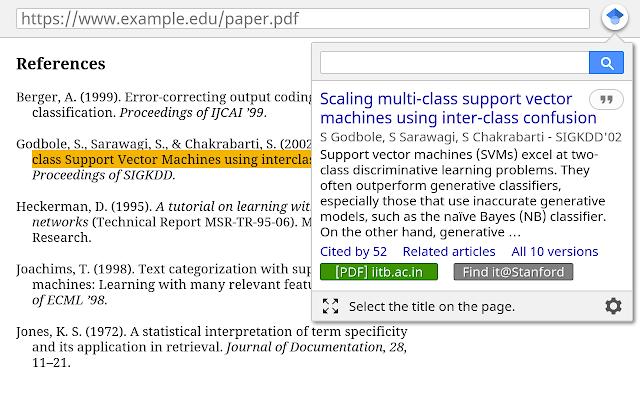
    Google Scholar Button


    This works with Google Scholar and turns search results into easy
    copy and paste references using the main styles of APA, MLA and Chicago.
    The extension also allows you to track down PDFs of the paper and
    export results in a variety of formats that can be used in reference
    management packages.


    Chrome Web Store Rating 4 ½ / 5 – 334k users


    Image credit: Google Scholar Button
    SilverBird


    This is an extension for Twitter that mirrors your Twitter experience
    and allows you to follow your timelines, compose Tweets, share, delete
    and favourite them. It automatically creates short URLs within the
    extension and acts as a notifier for new Tweets.


    Chrome Web Store Rating 4.5/5 – 280k users


    PaperPile


    Unlike the other extensions in this list, PaperPile isn’t free but
    comes with a 30 day free trial so at least you can decide whether it is
    useful. PaperPile is a reference management tool for researchers and
    students who rely on Google Apps to carry out their research. One of the
    flaws in the Google education model has been the lack of a good, solid
    reference management tool. Tools like Mendeley, Zotero and Endnote are
    quite comprehensive and rightly so as accurate and thorough referencing
    in academia is important. So whether this extension can match these
    established tools, only time will tell. Nevertheless it is worth
    investigation for Chrome based researchers.


    Chrome Web Store Rating 5/5 – 2k users


    Cite This For Me


    Another citation tool to investigate alongside the excellent EasyBib
    and RefMe ones that are also worth looking at. Cite This For Me can
    create references in APA, Chicago, Harvard and MLA formats and provides a
    pop-up box containing the appropriately formatted reference for  books,
    newspapers, journals and more. I tried it with a BBC football story and
    it worked fine, allowing me to switch between citation styles. It gives
    the option of adding to your Cite This For Me bibliography or exporting
    to a piece of research.


    Chrome Web Store Rating 4 ½ / 5 – 85k users


    citation neededImage credit: XKCD (Wikimedia)
    Extension Manager


    After a while you might start to notice whilst having multiple Chrome
    tabs open that your computer struggles with performance. Obviously
    having multiple tabs open is going to use valuable computing resources.
    Having lots of extensions running can also be at the detriment of your
    computing experience. Therefore it becomes increasingly important to
    have an extension to manage your extensions, especially when you accrue
    so many, some of which you may have stopped using.


    Chrome Web Store Rating 4 ½ / 5 – users 90k


    Note: This article gives the views of the author, and not the
    position of the Impact of Social Science blog, nor of the London School
    of Economics. Please review our Comments Policy if you have any concerns on posting a comment below.


    About the Author


    Andy Tattersall is
    an Information Specialist at the School of Health and Related Research
    (ScHARR) at the University of Sheffield. His role is to scan the horizon
    for Web and technologies opportunities relating to research, teaching
    and collaboration and maintain networks that support this. Andy has
    a keen interest in new ways of working by employing Altmetrics, Web 2.0
    and Social Media but also paying close attention to the implications and
    pitfalls for using such advances. @andy_tattersall


    Print Friendly


    Impact of Social Sciences – 10 Chrome extensions to help manage references, notes, citations and capture information.

    Thursday, 21 May 2015

    The Scientific Articles on Art Criticism

     Source: http://ccsenet.org/journal/index.php/ass/article/view/48870

    The Scientific Articles on Art Criticism

    Mina Hedayat, Pegah Jahangiri, Aida Torkamani, Mahsa Mashayekhi, Sabzali M. K., Nader Ale Ebrahim


    Abstract


    Research has been extremely involved in improving in the art
    criticism area. These improvements are reflected in scientific articles.
    This article purposed to investigate the 214 articles in art criticism
    to explore their main characteristics. These articles published in the
    Web of Science database of the Institute of Scientific Information (ISI)
    from the period of 1980 till 20 December 2013. Types of articles were
    article and review which is included in the study. The three top cited
    (more than 10 times citations) articles in art criticism were published
    in 1993 and 1999. The 214 articles mean citation rate was 0.87 (SD 2.38)
    times. Among the various fields, art (58.87%), arts humanities other
    topics (28.03%), both art and arts humanities other topics (5.14%), both
    art and education and educational research (2.33%), both art and
    history (1.40%), art, arts humanities other topics and literature
    (1.40%), both art and cultural studies (0.93%), both art and philosophy
    (0.93%), both art and literature (0.46%), and both arts humanities other
    topics and cultural studies (0.46%) were the most popular fields of
    research. The results showed that researches were done in the United
    States had highest citation which was written in English language.


    Full Text:
    PDF
    DOI: 10.5539/ass.v11n13p130


    Creative Commons License


    This work is licensed under a Creative Commons Attribution 3.0 License.


    Asian Social Science   ISSN 1911-2017 (Print)   ISSN 1911-2025 (Online)

    Copyright © Canadian Center of Science and Education 

    To
    make sure that you can receive messages from us, please add the
    'ccsenet.org' domain to your e-mail 'safe list'. If you do not receive
    e-mail in your 'inbox', check your 'bulk mail' or 'junk mail' folders.


    The Scientific Articles on Art Criticism | Hedayat | Asian Social Science